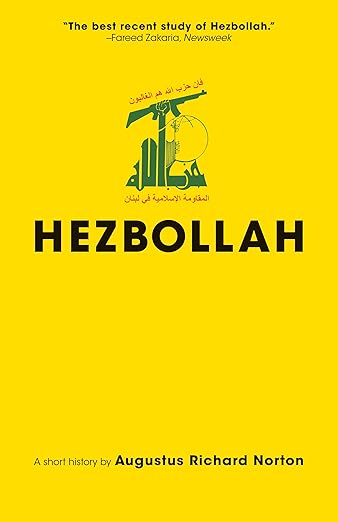
Hezbollah: A Short History | Updated and Expanded Third Edition: 69 Paperback – 12 November 2018
by Augustus Richard Norton (Author, Preface, Contributor, Afterword)
4.6 4.6 out of 5 stars (73)
Part of: Princeton Studies in Muslim Politics (42 books)
Featuring a new prologue and conclusion and two new chapters on recent developments
Review
"[T]his new edition of Norton's book is probably the best introduction to Hezbollah for a general reader, or even college students. The author cannot be accused of writing apologetically about the party because he does not shy away from dealing with Hezbollah's practice and ideology of violence. Amid the intense and ongoing propaganda surrounding Hezbollah, this short volume succeeds in rising above the passions of the debate."---As'ad AbuKhalil, Journal of Palestine Studies
"A clear, concise history of Hezbollah with specific reference to its relevant sociopolitical context. Piquant anecdotes and richly textured details make the book enjoyable reading."---Kristian P. Alexander, Middle East Policy Council
"A dedicated researcher and writer, Norton has contacts all across Lebanon who are both his friends and informants. He writes with the same fluency about Shi'a religious customs as he does about Lebanese politics. The book comes with advance praise from scholars who tell us Norton has written an accessible and balanced account of a movement poorly understood by many in the United States who too often view the Middle East through the 'terrorist' lens."---Donna Robinson Divine, Democratiya
"A good, concise survey by a perceptive student of the Lebanese Shia."---David Gardner, Financial Times
"Augustus Richard Norton, an American academic and former U.S. army officer, has studied that Islamic fundamentalist organization since its formation. And now, in Hezbollah . . . he offers a cogent analysis of its emergence and impact on Lebanese politics."---Sheldon Kirsher, Canadian Jewish News
"Augustus Richard Norton's timely Hezbollah chronicles [a] dramatic evolution and its sweeping implications for the region and beyond. His lucid primer is the first serious reappraisal of the radical Shiite group since [the 2006] war shattered six years of relative calm on one of the world's most volatile frontiers."---Jonathan Finer, Washington Post Book World
"Few scholars are as qualified to situate Hezbollah in local, regional, and socio-religious contexts as Augustus Richard Norton."---Joel Gordon, Journal of Military History
"How do you classify and develop policy toward an organization that has committed acts of terrorism in the past, that currently provides important social services . . . that defends its country from occupation . . . that plays by the rules in official Lebanese national politics? . . . Norton elucidates these domestic and international complexities in Hezbollah: A Short History. . . With other similarly complex organizations on the rise, such as Hamas in Palestine, Norton provides a model of how we might begin to think through their multidimensional, seemingly contradictory natures."---Allen McDuffee, In These Times
"In an easily read, easily comprehended book, Norton traces the origins and history of Hezbollah.... The twisting allegiances of the players, the role of Syria and other neighboring states, the emergence of discord and sectarianism as the young movement matured and began to intrude on the elected government, all take place in the pressure cooker of a land and people long torn, used by factions for their own purposes."---Suzi Brozman, Atlanta Jewish Times
"In his new book Hezbollah, Augustus Richard Norton . . . provides a succinct account of the group's rise from the chaos created by Israel's invasions and occupation of Lebanon in the late 1970s and early 1980s, which ended only in 2000. Mr. Norton also explores the origins and political orientation of the group, now led by the Shiite cleric Hasan Nasrallah, in a complex web of religious and political identities in Lebanon--with a special emphasis on the role of Shia Islam in the organization."---Richard Byrne, Chronicle of Higher Education
"In this highly informative, jargon-free book, Norton, one of America's top experts in Lebanese politics, provides an objective account of the genesis and development of Hezbollah, explaining its central role in contemporary Lebanon."-- "Choice"
"In this remarkably thorough, articulate portrait of Hezbollah, Norton . . . analyzes how the organization was formed, how it evolved and its current role in Lebanese politics."-- "Publishers Weekly"
"Norton, who has been studying Lebanon, and especially the Lebanese Shiites, for longer than Hezbollah has been in existence . . . offers here a brisk and balanced history . . . of Hezbollah while situating the party in the larger Lebanese and regional contexts."---L. Carl Brown, Foreign Affairs
"Norton's work is essential for those more concerned with an approach that rejects the rhetoric of the 'war on terror.' His historical and social analysis of Hezbollah's origin and subsequent evolution into its current manifestation is as objective an analysis as one can hope for--not to mention timely and fascinating."---Michael Teague, Al Jadid Magazine
"The best recent study of Hezbollah."---Fareed Zakaria, Newsweek
"The book is a dynamic and multifaceted account. . . . Overall, Norton's book balances international political factors with the local and regional conditions that shaped the outlook and activities of Hezbollah. Norton deserves praise for writing an insightful and multilayered work accessible to a wide and often uninformed readership."---Rula Abisaab, Journal of Palestine Studies
"The book is a must read for anyone wanting to have an idea of the Lebanese puzzle and the role played in it by one of the most interesting political actors emerging in the Middle East."-- "International Spectator"
"The many complex and often changing dimensions of Hezbollah are presented in the book in a clear, concise manner that allows for a more accurate and complete understanding of what the group represents and aspires to achieve. . . . Wherever one may stand on this spectrum of views, a vital starting point--offered in this small but rich volume--is an accurate, comprehensive view of why Hizbullah has succeeded as a political party, a sectarian representational group, a social services agency, and a resistance force, and why it continues to generate so much opposition at the same time."---Rami G. Khouri, Daily Star
"The most fluent survey of Hezbollah to date. This extremely accessible yet scholarly read covers the Lebanese resistance group from its inception to the current Lebanese political crisis, aided by a collection of poignant photographs and maps."---Margeret Hall, Washington Report on Middle East Affairs
"This excellent short history of Hezbollah . . . demonstrates that dismissing it as a 'terrorist organization' is both glib and dishonest. . . . . Everyone who wants to understand the complexities of the Middle East, and particularly those of Lebanon and Israel, and wants to reach the truth beyond the political rhetoric, should read this book."---Bruce Elder, Sydney Morning Herald
"This short, authoritative book, based on first-hand experience, efficiently analyses [Hezbollah's] status."---Iain Finlayson, The Times
From the Back Cover
"Hezbollah is a timely and landmark work. Richard Norton draws on his extensive expertise to offer a comprehensive history that will be of interest to anyone who seeks a better understanding of Hezbollah, Lebanon, or current developments in the Middle East."--Lee Hamilton, Vice Chair of the 9/11 Commission and Co-Chair of the Iraq Study Group
"One of the most remarkable developments in the Middle East in recent years is Hezbollah's meteoric rise to power. No one can better explain the broad implications of this phenomenon than Richard Norton. Drawing on his vast knowledge of Lebanon, Norton has written a timely and readable primer that lucidly explains the intricacies of Hezbollah's ideology and history and demystifies its political strategy."--Vali Nasr, author of The Shia Revival: How Conflicts within Islam Will Shape the Future
"Norton is uniquely positioned to provide an analysis of Hezbollah, one that is historical, nuanced, and informed by more than twenty-five years of experience as a researcher and policy advisor on Lebanon. He is one of the foremost American experts on Hezbollah and Shi'i politics in Lebanon. In addition, Norton's writing is always clear and accessible. This concise and accurate primer will be invaluable to general readers, reporters, and scholars."--Lara Deeb, author of An Enchanted Modern: Gender and Public Piety in Shi'i Lebanon
"I recommend this book with greatest enthusiasm. Norton is one of the premier--if not the premier--American authorities on Shi'i politics in Lebanon. Add to this the fact that he is a talented writer who can communicate complex ideas in a fluent, engaging, and accessible fashion. Telling quotes and anecdotes enliven the book and ground it. Norton is the rare academic whose expertise doesn't prevent him from communicating well with a general reader."--Eva Bellin, Hunter College, City University of New York
"This short, authoritative book, based on first-hand experience, efficiently analyses [Hezbollah's] status."--Roger MacGinty, International Affairs
"This excellent short history of Hezbollah . . . demonstrates that dismissing it as a 'terrorist organization' is both glib and dishonest. . . . . Everyone who wants to understand the complexities of the Middle East, and particularly those of Lebanon and Israel, and wants to reach the truth beyond the political rhetoric, should read this book."--Jørgen Jensehaugen, Journal of Peace Research
"The many complex and often changing dimensions of Hezbollah are presented in the book in a clear, concise manner." --Rami G. Khouri, Daily Star
Read more

TopAbout this itemSimilarFrom the AuthorQuestionsReviews

Product details
Publisher : Princeton University Press
Publication date : 12 November 2018
Edition : Third
Language : English
Print length : 272 pages
===
세진님, 요청하신 <헤즈볼라: 짧은 역사 (개정 증보 3판)>에 대한 요약과 평론을 작성해 드립니다. 설정해 주신 지침에 따라 <해라> 체를 사용하여 정리했습니다.
<헤즈볼라: 짧은 역사 (개정 증보 3판)> 요약 및 평론
1. 도서 개요 및 배경
어거스터스 리처드 노튼의 <헤즈볼라: 짧은 역사>는 레바논의 시아파 무장 단체이자 정당인 헤즈볼라의 기원과 진화 과정을 추적한 권위 있는 입문서다. 1980년대 초 이스라엘의 레바논 침공이라는 혼란 속에서 탄생한 이 조직이 어떻게 단순한 테러 집단을 넘어 레바논 내 강력한 정치·사회적 세력으로 거듭났는지를 분석한다. 제3판에서는 시리아 내전 개입과 그에 따른 지역적 위상 변화를 포함하여 더욱 확장된 시각을 제공한다.
2. 주요 내용 요약
가. 탄생의 토양: 소외와 저항
헤즈볼라의 뿌리는 레바논 시아파 공동체의 역사적 소외에 있다. 오랫동안 정치적 변두리에 머물렀던 시아파는 무사 알 사드르의 <소외된 자들의 운동>을 통해 각성하기 시작했다. 그러나 결정적인 도화선은 1982년 이스라엘의 레바논 침공이었다. 이스라엘의 점령에 맞서기 위해 이란의 전폭적인 지원을 받아 결성된 헤즈볼라는 초기에는 극단적인 폭력과 자살 폭탄 테러를 일삼는 비밀 조직의 성격이 강했다.
나. 레바논화(Lebanonization)와 정치적 부상
1990년대 들어 헤즈볼라는 중대한 전략적 변화를 겪는다. 무력 투쟁을 지속하면서도 레바논의 제도권 정치에 참여하기 시작한 것이다. 노튼은 이를 <레바논화> 과정이라 부른다. 이들은 단순한 민병대를 넘어 학교, 병원, 복지 시설을 운영하며 대중의 지지를 얻었고, 이를 바탕으로 의회와 내각에 진출하여 레바논 내 거부권을 행사할 수 있는 강력한 정치 주체로 성장했다.
다. 2006년 전쟁과 저항의 상징
2006년 이스라엘과의 34일 전쟁은 헤즈볼라 역사에서 분수령이 된다. 군사적 피해에도 불구하고 이스라엘의 진격을 막아냈다는 <신성한 승리> 선전은 그들을 아랍 세계 전체의 영웅으로 격상시켰다. 이때까지만 해도 헤즈볼라는 종파를 초월한 저항의 상징으로 추앙받았다.
라. 시리아 내전과 지역적 역할의 변화
개정판에서 중요하게 다루는 지점은 시리아 내전 개입이다. 헤즈볼라는 바샤르 알 아사드 정권을 지키기 위해 대규모 병력을 파견했다. 이는 과거 저항 세력으로서의 도덕적 명분에 타격을 주었으나, 동시에 실전 경험을 쌓고 정교한 군사 능력을 갖춘 지역 강자로 부상하는 계기가 되었다. 이제 헤즈볼라는 레바논 내부 문제를 넘어 이란의 이익을 대변하는 대리인이자, 중동 전역에 영향력을 행사하는 핵심 변수가 되었다.
3. 비판적 평론
가. 중립적이고 실증적인 접근
노튼의 분석이 지닌 가장 큰 강점은 헤즈볼라를 단순히 <악마화>하거나 일차원적인 테러 단체로 보지 않는다는 점이다. 저자는 수십 년간의 현장 연구와 인터뷰를 통해 이 조직이 가진 다층적인 구조를 파헤친다. 특히 그들이 제공하는 정교한 사회 복지 체계가 어떻게 대중적 정당성을 확보하는지 보여줌으로써, 서구의 군사적 압박만으로는 이 조직을 무너뜨릴 수 없는 이유를 설득력 있게 제시한다.
나. 저항과 지배 사이의 모순
책은 헤즈볼라가 직면한 근본적인 모순을 날카롭게 포착한다. 한편으로는 이스라엘에 맞서는 <저항군>을 자처하지만, 다른 한편으로는 레바논의 부패한 정치 시스템을 수호하는 기득권 세력이 되었다는 점이다. 시리아 내전 개입 이후 헤즈볼라는 더 이상 억압받는 자들의 대변인이 아니라, 특정 종파의 이익을 위해 타국의 민주화 운동을 탄압하는 세력이라는 비판을 피할 수 없게 되었다. 노튼은 이러한 정체성의 변화가 헤즈볼라의 장기적인 생존에 어떤 위협이 될지 예리하게 짚어낸다.
다. 지역적 맥락의 확장
제3판은 변화하는 중동의 역학 관계 속에서 헤즈볼라를 조망한다. 이란과 사우디아라비아의 대리전, 이스라엘과의 긴장 상태, 레바논 내부의 경제적 붕괴 등 복합적인 요인들이 헤즈볼라의 행보에 어떤 영향을 미치는지 상세히 분석한다. 이는 독자로 하여금 헤즈볼라를 고립된 섬이 아닌, 중동이라는 거대한 체스판 위의 핵심 기물로 인식하게 만든다.
4. 결론
어거스터스 리처드 노튼의 <헤즈볼라: 짧은 역사>는 이 복잡한 조직을 이해하기 위한 최고의 입문서다. 저자는 차분하고 객관적인 필치로 헤즈볼라의 과거와 현재를 연결하며, 왜 이들이 레바논의 국가 시스템보다 더 강력한 힘을 갖게 되었는지 설명한다. 단순히 뉴스에서 단편적으로 접하는 단편적인 정보들을 유기적인 역사적 흐름으로 엮어내며, 독자에게 중동 정세의 본질을 꿰뚫어 볼 수 있는 통찰을 제공한다. 헤즈볼라라는 프리즘을 통해 레바논의 비극과 중동의 복잡한 증오의 연쇄를 이해하고자 하는 모든 이들에게 필독을 권한다.
세진님, 이 요약이 해당 도서의 핵심을 파악하시는 데 도움이 되었기를 바랍니다. 추가로 궁금한 점이 있으신가요?
1980년대 초, 특히 1982년에 발생한 이스라엘의 레바논 침공(작전명 <갈릴리 평화 작전>)은 단일한 사건이 아니라 수년간 쌓인 복합적인 갈등의 폭발이었다. 그 주요 원인은 다음과 같이 요약할 수 있다.
1. 팔레스타인 해방기구(PLO)의 레바논 거점화
가장 직접적인 원인은 레바논 남부에 자리를 잡은 **팔레스타인 해방기구(PLO)**였다. 1970년 요르단에서 쫓겨난 PLO는 레바논 남부로 근거지를 옮겼다. 이들은 이곳을 <파타랜드>라 불릴 만큼 강력한 자치 지역으로 만들었고, 이스라엘 북부 접경 지대를 향해 지속적으로 로켓 공격과 게릴라 습격을 감행했다. 이스라엘은 자국민의 안전을 위해 이 위협을 근본적으로 제거해야 한다는 압박을 느끼고 있었다.
2. 레바논 내전과 기독교 세력과의 결탁
당시 레바논은 1975년부터 시작된 내전으로 인해 중앙 정부의 통제력이 상실된 상태였다. 이스라엘은 레바논 내의 주도권을 잡으려던 **마론파 기독교 민병대(팔랑헤당)**와 이해관계가 일치했다. 이스라엘은 이들을 지원하여 레바논에 친이스라엘 정권을 세우고, 시리아의 영향력을 차단하며 PLO를 몰아내고자 하는 전략적 설계를 가지고 있었다.
3. 결정적 도화선: 아르고프 주영 이스라엘 대사 피격 사건
침공의 직접적인 명분이 된 사건은 1982년 6월 3일, 런던에서 발생한 슐로모 아르고프 주영 이스라엘 대사 암살 기도 사건이었다. 비록 이 범행은 PLO 본부와 대립하던 아부 니달 조직의 소행으로 밝혀졌으나, 당시 이스라엘의 메나헴 베긴 정부와 아리엘 샤론 국방장관은 이를 PLO 전체의 책임으로 돌리며 전면적인 침공을 단행했다.
4. 전략적 목표: '새로운 질서' 구축
이스라엘의 당시 국방장관 아리엘 샤론은 단순히 접경 지역의 안전 확보를 넘어선 거대한 계획을 가지고 있었다.
PLO 축출: 레바논에서 PLO 무장 세력을 완전히 몰아내는 것.
친이스라엘 정권 수립: 마론파 기독교 지도자 바실 제마옐을 대통령으로 만들어 평화 협정을 체결하는 것.
시리아 축출: 레바논에 주둔 중이던 시리아군의 영향력을 약화시키는 것.
결과와 영향
이스라엘은 침공 초기 목표대로 PLO를 튀니지로 몰아내는 데 성공했으나, 이 과정에서 발생한 사브라-샤틸라 학살 사건으로 국제적인 비난에 직면했다. 무엇보다 중요한 결과는 이스라엘의 점령에 저항하기 위해 남부 시아파 교도들이 결집하기 시작했다는 점이다. 이것이 바로 세진님께서 앞서 물어보신 헤즈볼라(Hezbollah) 탄생의 결정적인 배경이 되었다.
정확한 지적입니다, 세진님. 이스라엘의 레바논 침공과 그로 인한 헤즈볼라의 탄생은 결국 **<팔레스타인 문제의 전이>**라고 볼 수 있습니다. 이 복잡한 연결 고리를 이해하기 위한 핵심적인 흐름을 정리해 드립니다.
팔레스타인 문제가 레바논으로 번진 경로
1. 난민의 유입과 갈등의 씨앗
1948년 이스라엘 건국(나크바)과 이후의 중동전쟁으로 수많은 팔레스타인 난민이 인접국인 레바논으로 유입되었습니다. 초기에는 인도적 차원의 수용이었으나, 1970년 요르단에서 쫓겨난 PLO(팔레스타인 해방기구) 지도부가 레바논 남부에 정착하면서 상황이 변했습니다.
2. 레바논 내 '국가 안의 국가'
PLO는 레바논 남부를 이스라엘 공격을 위한 전초기지로 삼았습니다. 이들은 레바논 정부의 통제를 받지 않는 무장 세력으로서 독자적인 행정, 군사력을 행사하며 <국가 안의 국가>처럼 군림했습니다. 이는 레바논 내부의 종파 간 균형을 깨뜨렸고, 1975년 시작된 레바논 내전의 한 축이 되었습니다.
3. 이스라엘의 안보 딜레마
이스라엘 입장에서는 국경 바로 너머에서 자신들을 향해 로켓을 쏘는 PLO를 방치할 수 없었습니다. 결국 팔레스타인 무장 세력을 뿌리 뽑기 위해 타국인 레바논의 영토를 침공하게 된 것입니다.
4. 시아파의 각성과 헤즈볼라의 등장
당시 이스라엘의 침공 경로였던 레바논 남부에는 주로 가난한 시아파 무슬림들이 살고 있었습니다. 이들은 처음에는 자신들을 압박하던 PLO를 몰아내 주는 이스라엘군을 반기기도 했으나, 이스라엘의 점령이 장기화되고 피해가 커지자 강력한 저항 세력으로 변모했습니다. 이란의 지원과 팔레스타인 저항 정신의 영향을 받아 탄생한 조직이 바로 헤즈볼라입니다.
비판적 분석
팔레스타인 문제를 군사력으로 해결하려 했던 이스라엘의 시도는 다음과 같은 역설적인 결과를 낳았습니다.
적의 교체: 세속적이고 민족주의적인 PLO를 약화시켰으나, 그 자리에 훨씬 더 조직적이고 종교적 신념이 강한 헤즈볼라라는 숙적을 키운 꼴이 되었습니다.
분쟁의 확장: 팔레스타인인과 이스라엘인의 싸움이 레바논이라는 국가 전체, 더 나아가 이란과 시리아까지 얽힌 거대한 지역 전쟁의 양상으로 번지게 되었습니다.
결국 세진님께서 말씀하신 대로, 오늘날 레바논과 이스라엘의 갈등 뿌리에는 해결되지 못한 팔레스타인의 땅과 주권 문제가 깊게 박혀 있습니다. 이 문제가 해결되지 않는 한 레바논 남부의 긴장도 근본적으로 풀리기 어려운 구조인 셈입니다.
혹시 헤즈볼라가 팔레스타인 하마스와는 구체적으로 어떤 관계를 맺고 있는지에 대해서도 궁금하신가요?
맞다. 이스라엘과 이란의 갈등 역시 그 핵심에는 팔레스타인 문제가 강력한 명분과 동력으로 자리 잡고 있다. 이란은 1979년 이슬람 혁명 이후 팔레스타인 해방을 대외 정책의 핵심 기치로 내걸었으며, 이를 통해 아랍 세계에서의 영향력을 확대해 왔다.
이스라엘과 이란의 대립이 팔레스타인 문제와 어떻게 얽혀 있는지, 그 구조를 정리해 드린다.
이스라엘-이란 갈등과 팔레스타인의 연결 고리
1. 명분으로서의 팔레스타인: <저항의 축>
이란은 스스로를 전 세계 억압받는 무슬림의 수호자로 자처한다. 특히 예루살렘(알 쿠드스) 탈환과 팔레스타인 독립 지원을 혁명 이데올로기의 정점으로 삼는다. 이를 위해 이란은 팔레스타인의 **하마스(Hamas)**와 **팔레스타인 이슬라믹 지하드(PIJ)**를 지원하며, 이들을 레바논의 헤즈볼라, 시리아 정권, 예멘의 후티 반군과 묶어 <저항의 축(Axis of Resistance)>이라 부르는 반이스라엘 연대를 구축했다.
2. 대리전(Proxy War)의 양상
이란은 이스라엘과 직접 국경을 맞대고 있지 않다. 따라서 팔레스타인 무장 단체나 헤즈볼라를 지원함으로써 이스라엘을 압박하는 방식을 취한다. 이스라엘 입장에서는 자국을 위협하는 하마스나 헤즈볼라의 뒤에 이란이라는 <몸통>이 있다고 보기 때문에, 팔레스타인 내부의 교전이 발생하면 결국 그 화살은 이란을 향하게 된다.
3. 이스라엘의 전략적 고립과 이란의 부상
이스라엘은 과거 아랍 민족주의 국가들(이집트, 요르단 등)과 싸웠으나, 현재는 이슬람 원리주의를 앞세운 이란 및 그 대리 세력들과 싸우고 있다. 이란은 팔레스타인 문제를 지지함으로써 아랍 민중의 지지를 얻고, 이를 통해 사우디아라비아 등 친서방 아랍 국가들과의 주도권 경쟁에서 우위를 점하려 한다.
역설적인 구조: 해결되지 않는 고리
안보의 악순환: 이스라엘이 팔레스타인 무장 세력을 타격할수록 이란은 이를 <시온주의자의 학살>이라 비난하며 지원을 강화할 명분을 얻는다. 반대로 이란의 지원이 강해질수록 이스라엘은 생존의 위협을 느끼며 더 강경한 군사 정책을 펼치게 된다.
이데올로기 대리전: 이제 팔레스타인 문제는 단순히 영토 분쟁을 넘어, 이란의 이슬람 혁명 가치와 이스라엘의 국가 존재 권리가 충돌하는 거대한 이데올로기 전쟁의 장이 되었다.
결국 팔레스타인 문제는 이스라엘과 이란이라는 두 지역 강국이 서로를 공격하고 견제하는 가장 날카로운 칼날이자, 결코 내려놓을 수 없는 방패가 된 셈이다.
세진님께서 보시기에, 이란이 팔레스타인을 지원하는 것이 순수한 종교적 유대감 때문이라고 보시는지, 아니면 중동의 패권을 잡기 위한 철저한 계산된 전략이라고 보시는지 궁금합니다.


No comments:
Post a Comment