Current sectionIsrael News
'NAZA' Directors Tell Haaretz: Netanyahu's Attacks on Us Are 'Incitement to Murder'

Rachel Szor and Yuval Abraham, the Israeli filmmakers behind 'NAZA,' in New York in September. Credit: Ben Kalmer
Yuval Abraham and Rachel Szor discuss the IDF officers' testimony in their film 'NAZA' and why they didn't shy away from drawing parallels to World War II. Of the backlash that awaits them in Israel, Abraham says: 'I don't want to be an exile'

Etan Nechin New York
Follow08:24 PM • September 27 2026 IDT
NEW YORK – Filmmakers Yuval Abraham and Rachel Szor haven't been back to Israel since "NAZA," their documentary about the Israeli military's conduct in Gaza, premiered in Venice earlier this month.
They spoke to Haaretz on Friday at The Guardian U.S.'s offices, ahead of the film's North American premiere at the New York Film Festival. A day earlier, they announced that The Guardian, which co-produced the film, would make it available online for free in November after its initial theatrical run.
Since the film's Venice launch and its 25-minute standing ovation, Israelis have largely been split into two camps: those who want to ban it and those who want to watch it but can't. Both camps have strong opinions despite not having seen it. Only a handful of journalists have been able to watch it so far (at small-scale press screenings). Abraham says he remains committed to bringing the film to Israeli audiences, but Israeli cinemas have so far declined to screen it, even for free.
"We chose to release the film online as early as November because we recognize the intense violence currently happening in Israel [surrounding the film], from multiple directions, which are trying to prevent it from being shown," Abraham says.
"Our goal is for Israelis to view it. In a few weeks, it will be accessible to everyone, and I hope the focus will shift to the film's content rather than everything around it."
The film has already provoked an uproar in Israel. Prime Minister Benjamin Netanyahu has threatened, at least twice, to strip the directors of their citizenship. The Israel Defense Forces Chief of Staff Lt. Gen. Eyal Zamir instructed the military's top lawyer to "advance possible legal measures concerning the film and those involved in it."
Culture Minister Miki Zohar threatened to cut funding for cinemas that screen it, and was the first to propose stripping Abraham and Szor of their citizenship. A far-right mob gathered outside Szor's parents' home twice in the days after the Venice screening, calling for the execution of " the traitors."
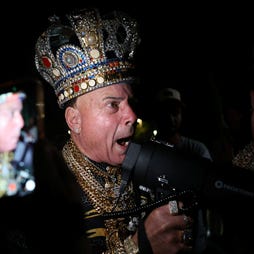
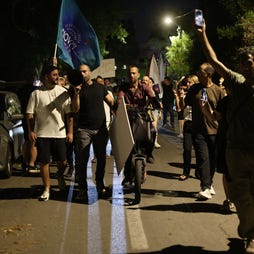
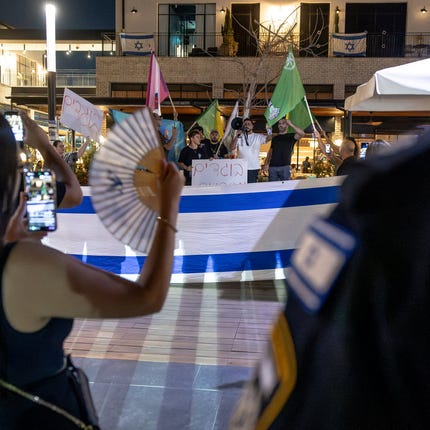 Far-right activists protesting outside Rachel Szor's parents' house in the Tel Aviv suburbs on September 17.Photos: Itay Cohen
On the morning of our conversation, Netanyahu likened "NAZA" to launching "dozens of ballistic missiles at Israel" in an interview with the religious Zionist publication Makor Rishon.
"It's obvious what you do to people who launch ballistic missiles. You kill them. This is incitement to murder," says Abraham.
"I think there's a line connecting this incitement to what we're seeing in the streets: the graffiti with crosshairs drawn over our faces, the chants outside Racheli's parents' house and, in a sense, the silence of the Israeli opposition in the face of all this," he adds.
"It's a feeling that's been around in the country in recent years, that there's no responsible adult," says Szor.
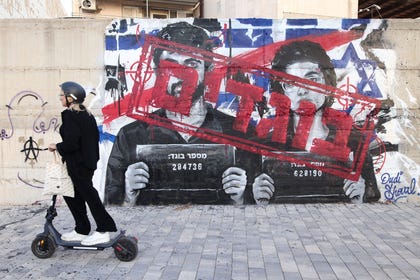
A mural in Ashdod depicting Yuval Abraham and Rachel Szor as prisoners and "traitors" in the days after "NAZA" premiered at the Venice Film Festival. Credit: Ilan Assayag
"The [Israeli] public is very angry at us. It raises the question of what inflamed it so much, even though they didn't watch the film. The people in charge, in the army, in the government, from every direction, are actually leading this," she adds.
Abraham sees the attacks as an appeal to Netanyahu's base ahead of the election and an attempt to evade accountability.
"You don't have to agree with us on everything, but this is a film whose aim is to open a critical discussion in Israel about the army's policy in Gaza. I think Netanyahu's latest statement is part of a broader move to divert this discussion elsewhere and to criminalize journalistic and documentary work," he says.
I think Netanyahu's latest statement is part of a broader move to divert this discussion elsewhere and to criminalize journalistic and documentary workYuval Abraham, co-director of "NAZA"
Despite the backlash, Szor says reaching Israelis remains a priority. "We had, not a hope exactly, but something like it, that for the first time there would be a discussion in Israeli society about everything that happened and what we did in Gaza," she says.
"And it took a very violent turn directed at us. Many people haven't seen it yet, but some of the testimonies and material are already public. It feels like a lot of [the uproar] is about avoiding what's actually in the film," she adds.
"NAZA," which grew out of Abraham's investigations for Israeli outlets +972 Magazine and Local Call, and his reporting with The Guardian, features testimony from 24 Israeli soldiers and intelligence personnel whose faces and voices are digitally altered. They describe military systems and practices that they say made mass killing of civilians routine in Gaza.
NAZA is a Hebrew acronym for "collateral damage," used to describe the number of civilian deaths authorized in a strike on a single target. The number is calculated before a strike; it is not a count of casualties afterward. A designation of NAZA 15 permits up to 15 civilian deaths in a strike on one target; NAZA 20 permits 20.
Abraham had been reporting on the IDF's rules of engagement, but says he sensed a gap between how experts discussed NAZA and his own intuition.
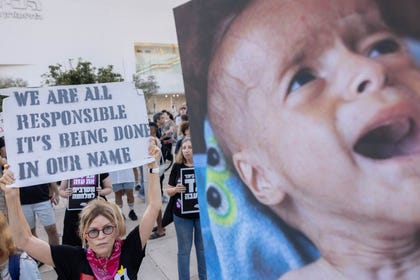
Left-wing Israelis demonstrating in central Tel Aviv against Israel's war and famine in Gaza in July 2025. Credit: Tomer Appelbaum
The idea for the film crystalized during a conversation with a senior intelligence source at a Tel Aviv café. The officer told him, half in shock, that earlier in the war he had begun seeing NAZA figures exceeding 100 – meaning strikes approved by senior command that could kill more than 100 civilians.
The officer compared the numbers to previous wars and operations in Gaza, including in 2021.
Abraham recalls the officer pointing to a tall building nearby and saying, "It's as if I want to kill one person, and I just drop a bomb on the building, killing everyone inside."
"That moment made me realize the film had to focus on this and be shot in Tel Aviv, using our buildings," says Abraham.
The film's anonymous sources describe designing and implementing these systems and practices.
Some describe using an artificial intelligence system called Lavender to identify tens of thousands of targets, which they say was known to incorrectly classify people as militants in up to 15 percent of cases.
The interviewees say that NAZA 200 and NAZA 300 were authorized for strikes on high-value targets. One officer says he once saw NAZA 500 authorized, though he didn't know how many people were ultimately killed in the strike.
According to the officers, strikes that leveled entire residential blocks in an effort to kill mid-ranking or senior Hamas members often failed to kill their targets.
"It was striking to me how many conversations I've had with Israeli intelligence officers where they describe strikes carried out in these conditions, and the end result is civilians being killed, but the so-called target not even being killed," says Abraham.
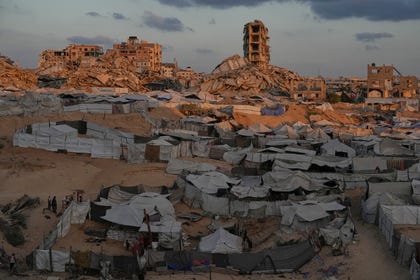
Tents sheltering displaced Palestinians are pitched below buildings damaged during Israel's war in Gaza, as seen in Gaza City on Saturday. Credit: Jehad Alshrafi/AP
We had, not a hope exactly, but something like it, that for the first time there would be a discussion in Israeli society about everything that happened and what we did in GazaRachel Szor, co-director of "NAZA"
One officer describes a strike in which intelligence personnel looked at the target's phone and saw a picture of him with his two daughters, ages 3 and 6. The officer says the army bombed the house, but the target had left his phone there and gone out, the officer says. His family was killed; he survived.
Before any IDF representative had seen the film, the army rejected the allegations, saying some claims were "clearly beyond the knowledge of junior-level soldiers." It also accused interviewees of misusing legal terms and making contradictory claims.
Zamir said the film was "based on blood libels, deliberate distortions of reality and grave, false accusations against IDF soldiers and commanders." Abraham stands by the film's claims.
"I think we've written, together with The Guardian, about 16 pieces dealing with the army's firing policies in Gaza and technology used by the military," he says.
"In the written text, we could be very specific. The claims included dates. One example is a strike in the Jabalya refugee camp on the 31st of October, 2023, on Ibrahim Biari, which had a NAZA 300, meaning the army authorized the killing of 300 civilians. When you check what happened on the ground, the razing of roughly 20 buildings full of civilians, different estimates put the number at 400 casualties: 120 killed, 280 injured. That checks out," he says.
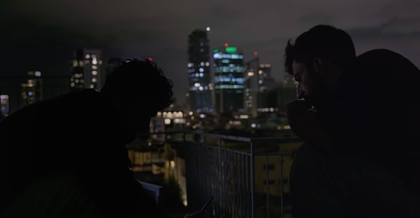
A screenshot from the trailer of "NAZA." Yuval Abraham (right) interviewing a subject on a Tel Aviv rooftop. Credit: The Guardian via YouTube
The film has drawn criticism for digitally altering its sources' voices and faces. Turning written investigations into a documentary changed the form, Abraham says, but not the journalistic standards.
"The claims made by soldiers require confirmation from multiple sources. We would need to go through a kind of normal process that you would go through as a journalist writing a written piece," says Abraham.
One of the main challenges was protecting the sources' identities.
"When you write a story, you have different kinds of tools to do that. You don't always have to quote someone. You can paraphrase. With a documentary, everything is a quote."
Abraham says some of the testimonies didn't make the cut.
"We had a lot of specific information that isn't in the film but helped us verify testimony and check its credibility. That was a challenge, and one of the differences between film and a written piece," he adds.

Yuval Abraham on the NAZA 500 allegation: "I know the army denied it. ... The truth will come out, and we stand fully behind the claim." Credit: Ben Kalmer
He also stands by the claim that the military approved NAZA 500.
"I know the army denied it. I don't want to go into more detail now, partly because of the risk of identifying sources. The truth will come out, and we stand fully behind the claim."
Beyond the officers' accounts, Abraham says, the images coming out of Gaza spoke for themselves.
"You can look at what's happening on the ground and listen to Palestinian journalists who have been describing this for a very long time. The insight we gain from the Israeli system and Israeli soldiers is the actual numbers, so we see that this is something very calculated. The army knows that it is bombing houses of families."
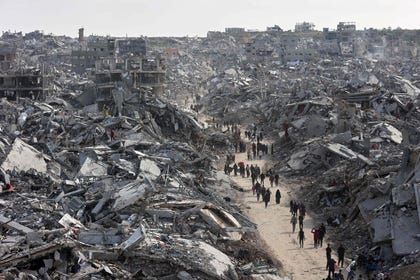
Palestinians returning to Jabalya refugee camp in northern Gaza in January 2025, shortly before a cease-fire deal between Israel and Hamas went into effect. Credit: Omar al-Qattaa/AFP
He also feels responsible for protecting his sources. "When I look at the government's insane response against us, I can only imagine what could happen to these soldiers, who, in my view, really took a step here and spoke about subjects that, I don't want to say an entire society, but most of Israeli society doesn't want to talk about right now."
The documentary, filmed by Szor and another cinematographer who remains anonymous, intersperses the officers' testimony with shots of Tel Aviv residents going about their daily lives or watching the evening news at home. It also uses archival footage of Tel Aviv's history, the 1948 war and the expulsion of Palestinians during the Nakba (particularly from Jaffa and Manshiyya, its former historical northern neighborhood that is now a part of Tel Aviv).
The film's historical references draw on contemporary Israeli discourse, Abraham says.
"The word [Nakba] returned to Israeli discourse not because of me and Rachel but because senior government figures speak about carrying out a Nakba in Gaza now," he says.
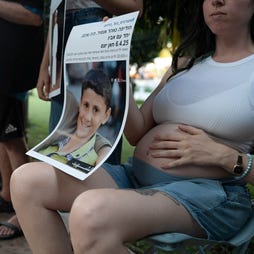
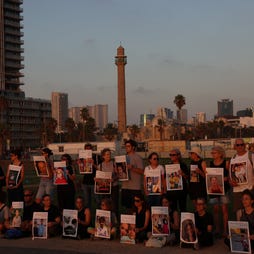
 Israelis holding portraits of children killed during the war in Gaza during three separate silent protests around central Tel Aviv in February and August 2025.Photos: Tomer Appelbaum
"Just recently, the defense minister spoke about the need for 'voluntary emigration' of Gazans. Netanyahu spoke about the army destroying homes so that Gazans have nowhere to return to, and said the inevitable result will be emigration from the Strip. ... Avi Dichter [agriculture minister and former head of the Shin Bet] said back in November '23 that we are now rolling out the Gaza Nakba.
"Pointing to the historical connections in the ongoing process of pushing Palestinians off their land doesn't mean casting doubt on the rights of Israelis or on Israel. This idea isn't new in Israeli public life, and it felt right for the film to touch on that too."
Szor says setting the film in Tel Aviv tied the city and mainstream Israeli society to what's happening only 60 kilometers (37 miles) away and to the reality hidden in plain sight, like Manshiyaa, or the Kirya – the military's headquarters, which sits in the heart of the city.
One of the soldiers describes going out to eat on Ibn Gabirol Street – one of Tel Aviv's main avenues – after approving a bombing in Gaza, in a blurring of military and civilian life.
"There's a sense that Tel Aviv is a liberal center that's easy to see as disconnected from everything. As Israelis, we've gotten used to these images. We don't even question the fact that this compound sits in the middle of the city," says Szor.
Abraham says the filmmakers kept the Hebrew acronym NAZA as the title, rather than translating it as "collateral damage," to convey how the officers' language reduces human beings to numbers.
"In Hebrew, the officers don't say nezek agavi, the full term for collateral damage. They say NAZA, which even for many Hebrew speakers is just a sound," he says.

An off-duty Israeli soldier carrying a rifle near Tel Aviv's beachfront in June 2025. Credit: Ohad Zwigenberg/AP
"What really stayed with me while conducting these interviews was how often this word was used as a substitute for human beings, for children. You hear it in the film: 15 NAZA, 20 NAZA, 50 NAZA, 200 NAZA. The word is thrown around without its weight. It came up in almost every interview with intelligence officers, multiple times, and we felt it would be a disservice to make it into something it isn't," says Abraham.
The film also references the Holocaust, including a shot of a billboard advertising a screening of Claude Lanzmann's "Shoah" in Tel Aviv on Holocaust Memorial Day.
Abraham says these references aren't meant to draw simplistic comparisons but to reflect how Israeli society invokes the Holocaust. He disagrees with the criticism that invoking Nazi Germany in a film about the Gaza war is unfair or defames Israeli society.
Israeli leaders do it all the time, he says. "We saw the memory of the Holocaust used after October 7 and still today. Netanyahu, in his speech at the UN, talked about the Holocaust as a means to legitimize or justify his own policies in Gaza."
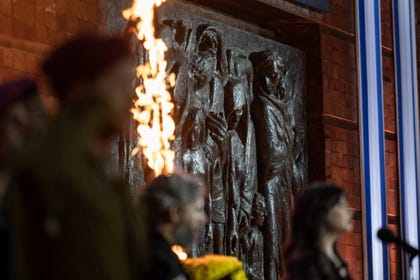
Israeli soldiers looking on at the state's 2025 Holocaust Memorial Day ceremony at Yad Vashem in Jerusalem. Credit: Naama Grynbaum
The film's first references to World War II and the Holocaust comes from the soldiers themselves.
One officer describes how, growing up, he saw the German perpetrators of atrocities such as the Holocaust as purely evil.
He then retells his part in the killings of civilians near food distribution sites in Gaza.
"The officer talked about coming back home and looking at many people he admired: his friends, snipers who took part in this, he understood something new about being a perpetrator. It challenged his notion of pure evil and what it meant," says Abraham.
"I understand it's a very sensitive topic. But when we say we should learn the lessons of the Holocaust, when we say 'never again,' part of that is understanding patterns of dehumanization, patterns of being a cog in a system, that can be seen in the present."
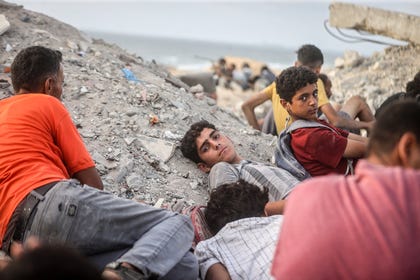
Palestinians taking cover after Israeli forces open fire on a crowd waiting for humanitarian aid near the Zikim border crossing near Gaza City on July 29, 2025. Credit: Ali Jadallah/Anadolu via AFP
Before the film's Venice debut, Abraham wrote that the film was intended for international audiences but also "directed inward, toward Israeli society."
The backlash raises the question of whether Israelis are ready to engage with it.
"I don't have an essentialist view of Israeli society. Societies can be complicit in very grave crimes, as is the case here. But societies and people can change. I've changed. I don't have the same opinions I had 10 years ago."
Despite the hostility, Abraham sees signs that the film is having an impact. He points to a letter in which the IDF chief denounced the film while saying the military would continue to investigate its conduct, correct mistakes and accept substantive criticism.
"The need to reassure everyone that what the army is doing is okay is a sign of things shifting. This term, NAZA, and the actions of Unit 8200 and Israeli intelligence have rarely been scrutinized to such a degree in Israeli society," he says.
"I think it's really important that these discussions are starting. It's super violent, and there's a lot of pressure, but it won't deter me and Rachel."
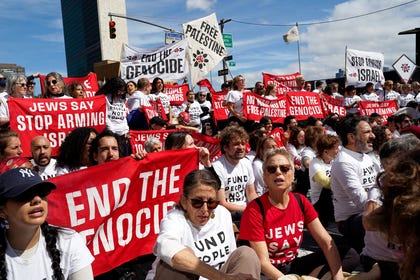
Activists from Jewish Voice for Peace and other groups protesting during Israeli Prime Minister Benjamin Netanyahu's UN address in New York on Thursday. Credit: Madison Swart/AP
Reaching audiences abroad, particularly in the United States, is almost as important, Abraham says.
"We just saw Trump again announcing weapons shipments, again this unconditional support. People who believe in the human rights of Palestinians and of Israelis – and I don't think there's a contradiction there – cannot keep sending weapons this way when they're used to violate international law. These conversations and actions need to happen in the United States as well."
Responding to reports that the IDF is considering releasing footage of the October 7 attacks to "counter" "NAZA," Abraham says empathy is not a zero-sum game.
"Recognizing the killing and erasure of entire neighborhoods, the killing of more than 20,000 children in Gaza, takes nothing away from the killing of children and civilians on October 7. Presenting empathy as a zero-sum game very much serves the government, and has served the Israeli right for many years. I don't think the public that opposes the government should accept it," says Abraham.
Announcing the film's free online release, Abraham wrote that he wouldn't be deterred. "Racheli and I will return to Israel and continue to fight for the future of this place, together with many partners."
Asked how soon they might return, Abraham is less certain.
"I don't want to speak for Rachel," he says, describing being "in the middle of the storm" making it "hard to see what will happen." But, he adds, "I definitely don't see the possibility of giving up. And personally, I don't want to be an exile."
"We're journalists. We're filmmakers. This is an important story. The storm will pass, and we will come back and move on to the next thing. I don't know what that will be. But I want to keep doing journalism and writing about things I think are politically and socially important," says Abraham.
===
Click the alert icon to follow topics:
FollowPalestinians
FollowIDF
FollowGaza
FollowTel Aviv
FollowIsrael-Gaza War
FollowArtificial Intelligence (AI)
FollowNAZA
first
11Brave people • 11:54
Brave people, facing a backlash which is, as harsh as it is, no surprise at all.
I hope for a better Israel to emerge from this.
But, this can well accelerate the descent into the moral and political abyss where the country is heading for.
Still, absolutely brave, but the timing could be wrong.
I do hope I am mistaken.
Reply
Like2Dislike2Report
10Mimini • 10:51
....oh well I think a good read about Thomas Mann...and you know it can take a while to return? And even then, it is difficult?
I hope for the best for both of them, they are very brave but also I fear for the worst...
Reply
Like1Dislike0Report
9Sodas • 10:24
Naza was created by Israelis who care deeply about Israel. I see it as an attempt to halt this mad rush toward the worst-case scenario. It is not an "anti" or "pro" manifesto, but a call to action.
Reply
Like2Dislike2Report
8Brave, Naive • 09:34
Yuval and Racheli will never be safe again in Israel... he is very naive that he will be able to "move on." his life is now permanently in danger, and this will take years to subside. Hardliners will use their religion to justify attempts to eliminate them. The fate of whistle blowers is not easy, similar to Snowden and Assange. People do not want the Truth, truth tellers are a threat, period.Tsahal (IDF) is a sacred cow no one dares to touch or criticize, I have seen it as the greatest taboo of Israeli society. Because soliders are protecting the country and because these are Israeli's children and grandchildren... it is one thing to criticize the government and another altogether to accuse your children of war crimes. But IT IS THE TRUTH,That doesnt take away the fact that there are noble and good soldiers! But war crimes were conducted on a daily basis, and continue today. The only way to stop the madness is to take responsibility. I doubt it will happen! Israel is now a Pariah stat
Reply
Like4Dislike0Report
7Christopher • 06:47
This documentary should be shown in every cinema in the Arab world and Iran; in countries hostile to Israel, such as Spain, Turkey, South Africa, Australia, Ireland, Norway; among Israel's archenemies which include Algeria, Yemen, Pakistan, Bangladesh, Malaysia and Indonesia. Most important, the documentary should be widely seen in the United States, upon which Israel is totally dependent for its survival.
The film exposes Israeli soldiers as depraved monsters and the worst cowards, not as brave fighters like American, British, Egyptian, Jordanian and Syrian soldiers. The film finally kills off the powerful Zionist Hasbara campaign, which portrays Israelis as moral people.
Reply
Like6Dislike4Report
SodasChristopher • 08:57
No, this film should not be shown among the enemies of Israel, it is not intended to stir up hatred. It must be projected everywhere in order to alert. And show that an army kills. there is no army more moral than another
Reply
Like0Dislike1Report
6Cedar05:34
Beyond the horror of the acts described, NAZA raises a question that reaches into the conscience of an entire society — one that should haunt any society that calls itself democratic: how can ordinary life continue when people know that, somewhere, men are acting in their name, with the institutions, weapons and authority of their state, while civilians, families and children pay the price?Any reasonable person should feel a profound moral vertigo before such a question. Once facts, testimonies and images of this gravity enter the public domain, the issue becomes something far more disturbing: what happens to a society when it knows, when it sees, when it hears?History does not examine only those who issue orders and those who carry them out. It also examines the societies surrounding them, the institutions that make their actions possible, and the silences through which the extraordinary becomes ordinary.
Reply
Like9Dislike2Report
5Connecticut05:12
I'll make a bet that this documentary is more meticulously sourced and verified than most documentaries are, even the highest quality ones. And certainly the journalism is more exhaustively fact-checked than most anything one reads in daily newspapers. The filmmakers surely had no illusions about the propaganda machine they would be up against, and likely made everything as air tight as they could -- or I hope so for their sakes and for the sake of everyone whose life is at risk. But in the end you cannot censor the soldiers themselves. They have stories they want people to hear. I look forward to seeing the film and imagine once it is released in the US, especially once it is available for free, it will make its way into Israeli homes by many different means, But as the film makers point out, the people who most need to see this film are the Americans paying the taxes that keep the Israeli killing machinery going. It is likely only they can stop these murders.
Reply
Like9Dislike3Report
4Sam03:36
Israel has lost its compass under this dictator. It is inevitable when the majority tolerates oppression against the Palestinians (the other), the same oppression will come around and will be applied against them. This is just the start. With people like Netanyahu, Ben-Gvier, and Smootrich, what else do you expect from this regime?
Reply
Like7Dislike3Report
3DanielS • 23:11
The documentary is far from perfect and from being complete, but the hear-say reactions from people who haven't seen it shows that it touches a very sensitive subject. We have seen indirect incitements to murder from "Satanyahu" already in 1995, against PM Rabin, whom (a modern Cain) he also inherited. Now he is fighting (inter alia) also for the continuation of the possibility for his Sara to bring dirty laundry to the White House!!! Let him continue to do that for life and stop taking half of the country as "Naza". His time is over.
Reply
Like8Dislike2Report
2Matan23:10
Honestly, as someone who has been amazed at how the suffering of the Palestinians has been used an excuse for the expression of virulent antisemitism under the guide of activism and concern, I'm horrified by the barbaric treatment of Palestinian civilians. You either value all life or none. When you find yourself thinking one is more valuable than the other, you don't really value human life.
Reply
Like19Dislike2
====
===


No comments:
Post a Comment