Mecca and the mall
In a bid for spiritual renewal, I made a pilgrimage to Islam’s holy city. Almost everything I expected to see was gone
The Great Mosque and the Kaaba in Mecca, seen from the Makkah Clock Tower, Saudi Arabia, 22 June 2023. Photo by Rania Sanjar/AFP/Getty Images
Azania Imtiaz Patel
is a writer and researcher based between Mumbai and London. She is the co-founder of the India Ghost Project, an independent research initiative examining how belief in the paranormal shapes economic behaviour. She is currently writing her first book on how anxieties about modernity find expression through ghost stories in Indian cities. Previously, she has reported for The Economist. She holds an MSc in South Asian Studies and an MPP from the University of Oxford, where she studied as a Rhodes Scholar.
Edited byMarina Benjamin
2,700 words
Rituals and celebrationsReligionValues and beliefs
SYNDICATE THIS ESSAY
SaveShare
Listen to this essay
20 minute listen
It is Ramadan, the holiest month of the Islamic calendar, and I am sitting in a rooftop café in Mecca, the holiest city of the religion. The sun has gone down, and an array of glittering shops and hotels lights up the urban expanse below me. At the heart of this ancient city, the foremost site of Muslim worship, guarded with fortress-like marble walls, is the Masjid al-haram complex – the largest mosque in the world. I’ve just completed my own pilgrimage to the holy site, and I’m struggling to name the discomfort that I am feeling.
There are few words to describe the whiplash of coming face to face with a Joe & The Juice, a Sephora and a plethora of other shops and hotels and Times Square-style billboards after going through one of the most spiritually charged experiences of my life. To find myself in what seemed just like any other petrodollar-fuelled Gulf port instead of a sanctified land was jarring. I felt robbed of the romanticism I had expected after a childhood built on admiration for religious lore and high-flown notions of a fantastical divine city.
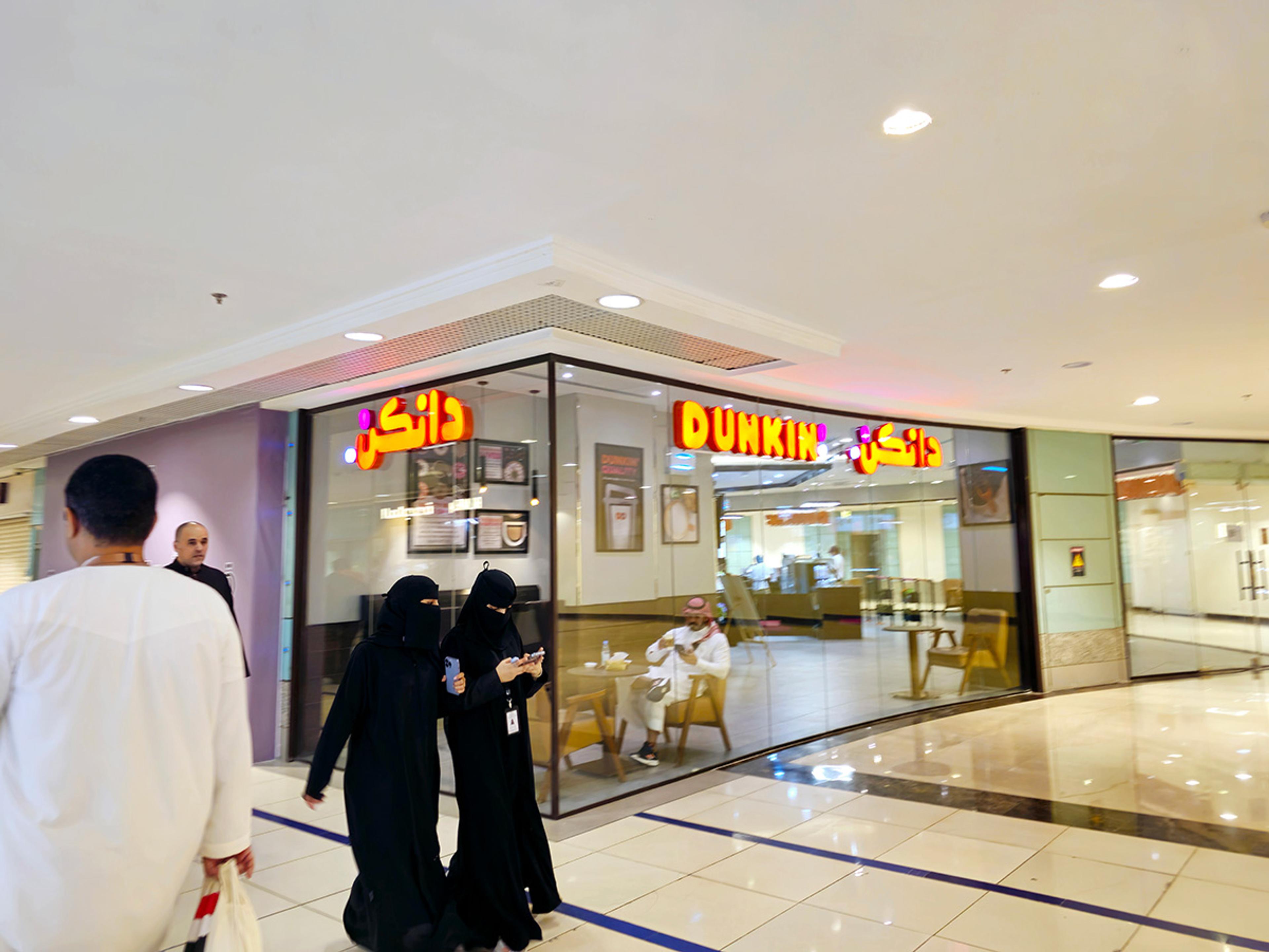
A Dunkin’ Donuts outlet in Mecca. Photo by Tamer Soliman/Getty Images
I’d found myself in Mecca, trying to catch a break from the existential dread of my day-to-day life – the constant round of applying for jobs I didn’t really want because it wasn’t sustainable to write full-time, going on first date after first date, trying to find love on apps that were designed for failure, doomscrolling social media while caught in a dopamine trap, and staring at my laptop screen while waiting for some revelation to break through the fog in my mind and string itself into life-changing words. My 30s were closing in, and I felt the noose of squandered potential around my neck.
One of my most frequent prayers comes from a verse in the Quran that narrates Moses’ escape from Egypt: ‘Rabbi inni lima anzalta ilayya min khairin faqir’ (‘My Lord, indeed I am in absolute need of whatever good You send down’). I have always been comforted by the notion that a divine power was looking after me, that something out there existed beyond the constraints of time and space – omnipresent, omnipotent – and yet closer to me than my jugular vein, as my Holy Book would tell me.
My rationale for the trip was that this kind of spiritual sugar rush would allow me to find my footing in the secular world. My worshipful hope was that God would be impressed by my performed devotion, and divine intervention would set my worldly affairs straight. And though I felt a sense of renewed worship in making my pilgrimage, that break from the ordinary world never came.
Join more than 270,000 newsletter subscribers
Our content is 100 per cent free and you can unsubscribe anytime.
Daily: A daily dose of Essays and Videos
Weekly: A week’s worth of big ideas
Sign up
I’m already subscribedPrivacy Policy
Islam is not an ascetic faith: interestingly, it prohibits monasticism. However, the state of being a pilgrim is the closest that one comes to forsaking the material world. Before entering the boundaries of the Holy City, dressed in a swishing white abaya with a prayer book hung on a lanyard around my neck, I had committed to a state of heightened spiritual purity known as the ihram.
The word ihram has etymological roots in the word haraam, which means to forbid. It is the embodiment of additional, out-of-the-ordinary prohibitions. In this consecrated state, pilgrims are not allowed to have sexual relations or to hunt an animal or to change the state of their body: they cannot cut their nails or hair, for example, or perfume themselves. Men must cover themselves only with two pieces of unstitched cloth, while women must wear unadorned garments that leave their faces and hands visible. The purpose of the ihram is to equalise worshippers for the duration of their pilgrimage. As the anthropologists Victor Turner and Edith Turner described (albeit in the context of Christianity), pilgrims occupy a liminal, threshold state. They enter a state of structural betweenness, termed ‘communitas’, where they find themselves stripped of their social identities, and in a temporary state of spontaneous egalitarianism.
There are two kinds of pilgrimages in the faith, the umrah – which takes a few hours to complete and can be done at any time of the year, and the Hajj – which takes five days, and can be performed only in the Islamic month of Dhul-Hijjah. Both pilgrimages require the same conditions of ihram. I began my umrah with a short ride to the Mosque on a government-funded shuttle service, decorated with an electric ticker that said: ‘Welcome Guests of Ar Rahman’, that is, guests of the Most Merciful. Pilgrims are not guests of the Kingdom of Saudi Arabia, but of God, and therefore, on paper, both prince and pauper must be alike. When in communitas, this sentiment feels enacted.
It is hard to look away from the symbol of your faith made manifest before you
Some pilgrims prayed on the shuttle with prayer beads, others read out verses from the Quran apps on their phones. Others still had prayer books similar to mine. But as we got closer to the Great Mosque, we were let off the bus, and everyone’s rhythmic chanting came into unison in a single phrase, as pilgrims cried out to the skies ‘Labbaik Allahumma Labbaik’ (‘Oh, here I am, my Lord! I have answered your call!’) The fervent declaration continued as we joined the crowd of thousands making their way on foot into the heart of Masjid al-Haram.
The first thing you experience when you enter the Great Mosque of Mecca is the smell of oudh and rosewater engulfing you. A cultural belief among many Muslim communities is that whatever you pray for when you first glance upon the Kaaba – the black raw-silk-covered cuboid stone at the centre of the mosque – will be granted, so most pilgrims enter for the first time with their eyes firmly planted on the cool marble floor – or held tightly shut as they hold on to the person guiding them in. And when you do open your eyes, that initial glance is surreal; an ocean of pilgrims clad in white circumambulate the Kaaba, flocks of swallows flit against the skyline, and there are hundreds of things in the periphery of your sightlines to be distracted by – from the towering malls to surveillance drones and battalions of guards with puffed chests patrolling against miscreants. Yet, despite these competing spectacles, it is hard to look away from the symbol of your faith made manifest before you – more enormous than you imagined, impossibly still, magnetic.
The Kaaba is an epitomic example of what Mircea Eliade, a foundational historian of religions, described in The Sacred and the Profane (1957) as ‘axis mundi’, or the navel of the Earth, a centre from which the world is said to have emerged. In Islamic belief, Mecca is the mother city, the land from which the rest of the world rolled out. In the same theology, the Kaaba was the first building on Earth, established for the worship of God, before being lost in the flood of Noah and then rebuilt by Abraham and his son Ismael in its present form.
Since Muhammad’s conquest of Mecca in 630 CE, the Kaaba has oriented all aspects of Muslim life. Wherever they are in the world, Muslims perform their five daily prayers facing towards the Kaaba, and dead bodies are buried with their head oriented in the same direction. The complex built around it encompasses all of the sacred topography you must go through on your pilgrimage. You start with the circumambulation of the Kaaba, before praying adjacent to the Maqam-e-Ibrahim, a stone enclosed in glass, which is supposed to bear the footprints of Abraham. Then, you must cross the distance between the hills of Safa and Marwa seven times, a total of 3.15 km (1.96 miles). Once these obligatory rituals of the umrah (which take a few hours) have been completed, men shave their heads, while women cut an inch or two of their hair to exit the state of being a pilgrim.
For Eliade, the sacred space marks a break from the locus of mundane, profane life. It is an anchor emerging through divine revelation, from which believers orient themselves, allowing access to a more primordial state of being. In the state of ihraam – eyes upon the anchor that had shaped my worship – my experience was more metaphysical than embodied. In those moments, I occupied an imagined Mecca, the fabled city of prophets and angels, and of mothers striving to keep faith in the face of cruel oppression. I could almost see what had been here before, the ghosts of a nascent faith, taking its first shaky breaths, keeping step with the flesh-and-bone believers centuries away.
Accessing that spiritual world required me to suspend my disbelief – because, in 2026, even the Great Mosque is, like Mecca itself, very different from the one I had read about in prophetic traditions. In the past decade, the mosque has been subject to a massive expansion and renovation project. At a cost of nearly $26.6 billion, the Saudi government has rebuilt the complex, growing it from 414,000 square metres to 1.564 million square metres of space, in order to accommodate a growing number of pilgrims and to make the area more accessible. However, this has come at a great cost to the historicity of the space and, to an extent, to the otherworldliness that the line between sacred and profane demands.
Except for the Kaaba, all historically significant structures in the complex have been either modified or destroyed
Four floors of marble walkways now surround the Kaaba, allowing more people to circumambulate at once. The different floors are accessed through a network of escalators and ramps. The final walkway comes with tracks for golf carts – and, at the price of 300 Saudi riyals ($80), pilgrims can complete their rituals on wheels. Those on a budget, meanwhile, can spend half that amount to rent a wheelchair if they’re struggling with walking more than the 2.5 miles expected.
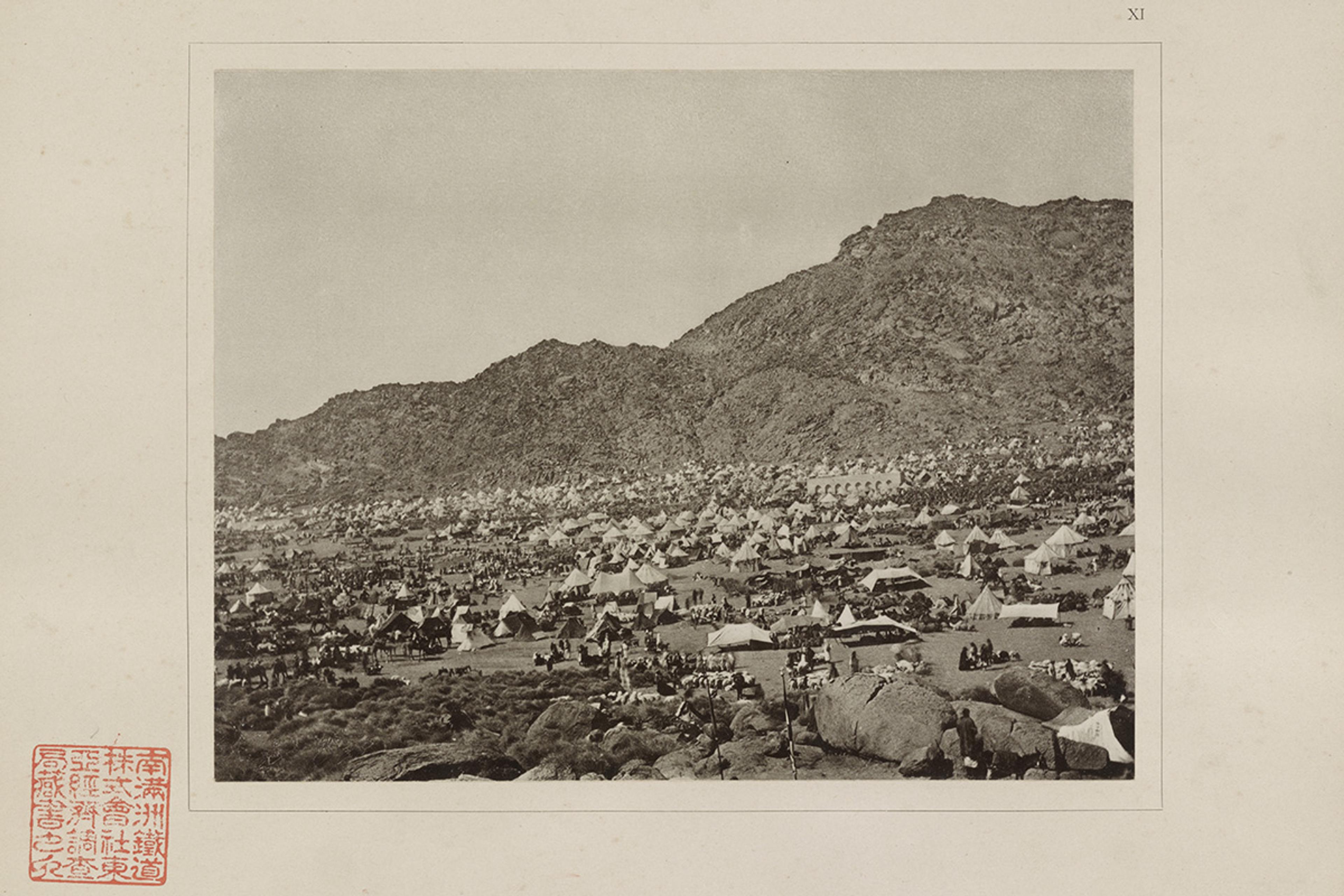
Pilgrims with tents, camels and livestock in the Miná Valley near Mecca during the Hajj; image published in 1889. Courtesy the Library of Congress
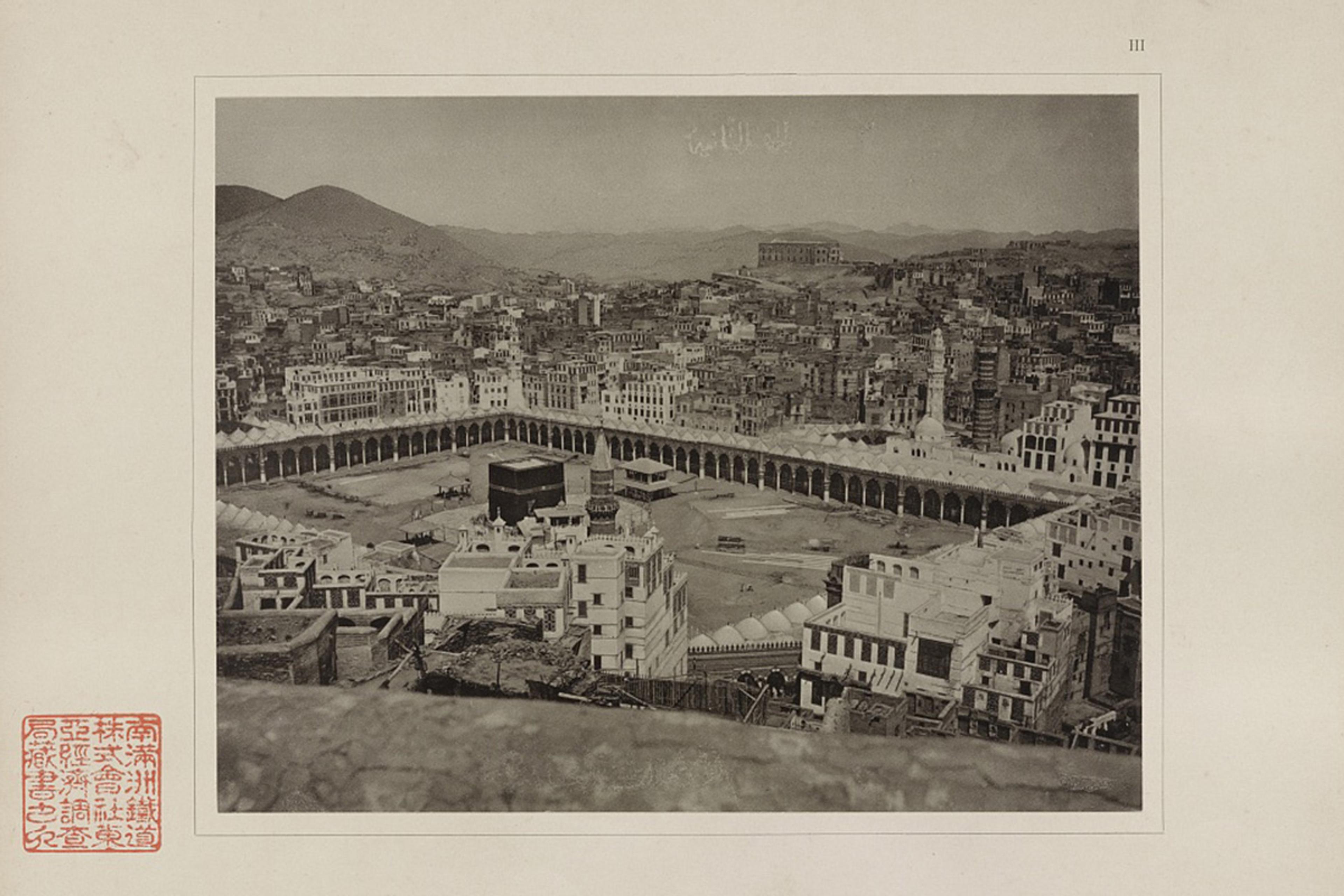
A view of the Kaaba and Mecca; image published in 1889. Courtesy the Library of Congress
In her travelogue Pilgrimage to Mecca (1934), Lady Evelyn Cobbold, the first British female convert to make the Hajj, wrote:
Even the Ford Motor could not vulgarise the lovely moon-splashed desert, whose stillness was unbroken by a camel caravan we passed, silently treading its way Northward; mysterious phantoms of beasts and men of another world than ours – I inwardly prayed that the motor may never displace the camel.
I wonder what she would make of the carts zipping through the mosque itself today. The consequence of these efficiency-oriented measures is that, except for the Kaaba, all historically significant structures in the Mecca complex have been either modified or destroyed.
The path between the hills of Safa and Marwa, where Muslims believe that the Prophet’s wife Hagar foraged for water, before the spring of holy water, Zamzam, miraculously burst open, has now been flattened and reconstructed as a multistorey, air-conditioned enclosure. The structure that marked the well of holy water has also been demolished, with pilgrims now able to access the water only through taps and tanks. Canopies dedicated to influential classical scholars of Islam within the mosque complex have been dismantled, while neon lights have been installed to mark the point at which circumambulation is to begin.
As I went through the rituals, the chasm between the sacred space in my mind and the very real, remade-for-modern-convenience one I occupied provoked a kind of grief. I mourned that these weren’t the same floors the forebears of my faith had walked, nor were these the pillars they had leaned against. On one hand, that sense of communitas with the other pilgrims nourished my soul; on the other, I was palpably aware of how much of a disjuncture I was at with the past. When I completed my pilgrimage, I reached under the swathes of my hijab to snip off a few curls from my head with small metal scissors. Exiting the state of ihram and physically changed by my acts of worship, I was pushed into a painful awareness of the mundane, profane world. The disjuncture became significantly more pronounced when I stepped out of the mosque.
In Cobbold’s memoir, written less than a century ago, Mecca is the city without walls, protected by mountains, with Bedouin caravans selling wares to pilgrims staying in modest homestays and camping on the desert trail. That Mecca no longer exists either. The homestays are gone, and the hospitable locals of yore now live on the outskirts of the city – their neighbourhoods swallowed up by hotels and shopping complexes.
Some changes are unavoidable. When Muhammad performed his final pilgrimage in 632 CE, an estimated 30,000 followers accompanied him. When I performed my pilgrimage in February 2026, an estimated 1.68 million people from abroad had been granted pilgrimage permits for the month of Ramadan. These pilgrims need space not just to worship, but also to sleep and eat, and to do all that mortal bodies do – and so infrastructure should be built to support those needs.
However, the de-historicisation of Mecca has been a calculated, ideological project, with what would be considered protected monuments in any other part of the world decimated to build vanity projects. Saudi Arabia’s premier religious ideology – Wahhabism – is an 18th-century revivalist movement that espouses a literalist, strict interpretation of the Quran, and it has encouraged the tearing down of historical sites such as the houses of early Islamic figures, and the enshrined gravesites of the Prophet’s family, claiming that they’d invite idolatry otherwise. The refitting of Mecca is also deeply entwined with the rise of the petrodollar in the Kingdom, creating a tense intersection where ritual jostles with capitalism for space. As the writer and public intellectual Ziauddin Sardar puts it in The Sacred City (2014), the Kingdom has made a steel and glass heaven of consumerism in the name of extinguishing idol worship.
Where those before us battled drought and death to find God, we battle excess and the temptation of abundance
So, now, a Hilton Hotel stands where the house of Islam’s first Caliph, Abu Bakr, once stood. A nondescript library stands in place of the home in which Muhammad was born, while an 18th-century citadel was torn down to make way for the Makkah Clock Tower complex, a collection of seven buildings that are part mall, part hotel. The tallest of these buildings is a Big Ben-esque structure, sporting a giant clock dial that overlooks the Kaaba.
On the back of the oil economy, the Kingdom has exported its brand of Wahhabi Islam across the world. Traditional ways of believing have been homogenised, and a dogmatic, cookie-cutter version of the faith has been parcelled off. In return, the Global North has exported the phenomenon of placelessness to Saudi Arabia, whereby an influx of foreign brands has remade both the country’s high streets and consumer choices. The commercial onslaught, compounded by the active destruction of material history, gives the fringes of sacred space a particular tone. Irfan al-Alawi, a theologian and heritage preservation proponent, described this in The Guardian as the ‘Manhattanisation of Mecca’.
As I walked through the grey concrete streets and glass malls of Mecca, I wondered if devotion here would have meant more when the skyline was dotted with sandy hills, and there was nothing but the House of God as your harbour against the angry desert. I contemplated whether my return to a comfortable hotel bed, and not a flimsy tent, implied something lacking in my commitment to giving up the material. Or perhaps it is just that I am of this time, and my prayers are subject to its whims. Indeed, perhaps it is in that very unease that ritual finds meaning – if all the world were holy, we would not gravitate as we do to the omphalos (literally, ‘navel’). The sacred is significant because it disrupts the profane. Where those before us battled drought and death to find God, we must battle excess and the temptation of abundance.
I can’t presume to know what God thinks of today’s Mecca. After all, to evolve is natural to the holy city; it has been moulded to dynasties and clerical moods over centuries. Belief continues to move past anachronisms, and yet, as one prays by the black-and-gold cloth-covered Kaaba, the shadow of the clock towers falls upon you – a too-obvious metaphor in action.
Rituals and celebrationsReligionValues and beliefs


No comments:
Post a Comment