West Bank
Israeli troops force families from homes amid settler terror campaign in West Bank
Former PM of Israel calls events ‘concerted and meticulous attempt at ethnic cleansing’ against Palestinians
Emma Graham-Harrison in JerusalemFri 14 Aug 2026 04.54 AEST
Share
Prefer the Guardian on Google
Israeli troops have forced two Palestinian families to leave their besieged West Bank homes, the day after a top Israeli commander personally promised he would end a violent settler campaign to drive them out.
Israeli soldiers also took over eight other homes in Qusra early on Thursday, telling the village’s mayor, Abdul Azim Wadi, that the buildings were needed for a days-long operation to remove the settlers. They later relinquished six. Settlers still roam the village.
The Palestinians’ ordeal began on Sunday when Israeli settlers and soldiers set up a tent blocking the entrance to three homes on the edge of the village. They severed water and electricity supplies and prevented an ambulance from reaching a sick toddler.
Amid mounting international pressure over the siege, Maj Gen Avi Bluth, who commands all Israeli troops in the occupied West Bank, visited Qusra on Wednesday to meet the trapped Palestinians and committed to “evacuate” the settlers from the village.
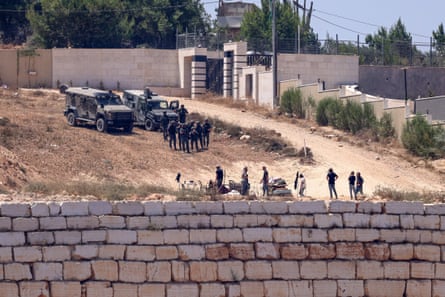 View image in fullscreenIsraeli soldiers stand guard next to settlers in front of Palestinian houses in the village of Qusra in the occupied West Bank on Wednesday. Photograph: Zain Jaafar/AFP/Getty
Bluth’s troops later removed the tent but left the militants, their bedding and other equipment. Soldiers retreated after a failed attempt to drive out the Israeli settler group with riot control techniques. The siege continued into a fifth day on Thursday, with the impact on the village only expanding after Bluth’s visit.
“The army arrived at around 10am and asked us to evacuate the houses because of a military operation in the area that would last for three days. We refused to leave,” said Qusai Ridi, one of the besieged Palestinians. “The army then moved us all into one house.”
He was allowed to return home in the afternoon, where he found Israeli soldiers had damaged a security camera system and stolen some equipment. They are still occupying the home of his neighbour Yousef Hassan, who is staying with Ridi.
Settlers are still patrolling outside in the area where 28-year-old Amir Moatasem Odeh was killed by a settler in March. Another attacker stabbed his father. No one has been arrested over the murder and assault.
“I am afraid and do not trust that the army will actually evacuate the settlers. But I sincerely hope they do,” Ridi said.
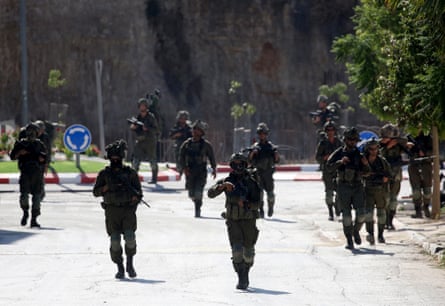 View image in fullscreenCritics in Israel say a lack of will on the part of soldiers in Qusra has led to the siege continuing. Photograph: Anadolu/Getty
His brother is an American citizen, and the US ambassador to Israel, Mike Huckabee, who is generally supportive of Israel’s settlement project, described the siege as a “horrific act of terror” carried out by Israeli terrorists.
On Thursday afternoon, Israeli soldiers left six homes they had taken over in the morning. The returning Palestinian families reported damage including a Qur’an with pages torn out and destroyed decorations.
Israel’s former prime minister Ehud Olmert said the siege was a “concerted and meticulous attempt at ethnic cleansing”, which left him disgusted and ashamed.
“These are crimes against humanity which are actively supported by the Israeli government and are assisted by the indifference and total lack of action by the IDF and the Israeli police. It’s unforgettable and unforgivable.”
The same terror tactics were used to force another Palestinian family out of their home in the neighbouring village of Jalud in July. Soldiers and settlers were filmed playing with a football together on the terrace of that house on Thursday.
An Israeli military spokesperson said soldiers had been ordered not to displace Palestinian residents of Qusra and would not operate inside the besieged homes.
“The soldiers were instructed that the Qusra residents will remain in their homes,” the military said in a statement. The spokesperson declined to comment on why those orders were being violated.
The chief of the general staff of the Israel Defense Forces (IDF), Eyal Zamir, has ordered a battalion of infantry reservists back from leave to reinforce troops in the West Bank. Domestic critics said the army’s failures in Qusra were more the result of a lack of will than shortage of forces.
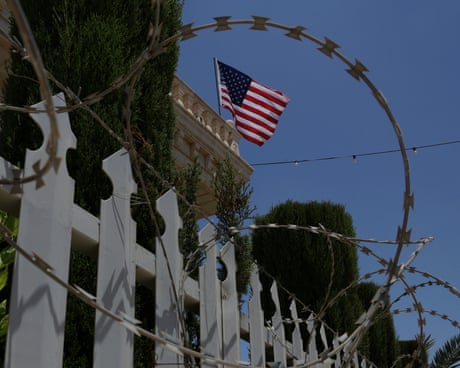
Abandoned by the US: Palestinian Americans trapped in a surge of Israeli settler violence
Read more
“Yesterday’s events in Qusra illustrate the impotence of the IDF, the police, the GSS [Shin Bet] and other security organizations in the face of a group of bullies,” the commentator Avi Ashkenazi wrote in the Israeli newspaper Ma’ariv.
“Instead of bringing a police van [and] arresting the criminals … [security forces] have been trying to negotiate with them. They are thugs. They believe themselves to be the lords of the land.”
Israeli militants target Palestinians with near total impunity in the occupied West Bank. Since 2020, Israeli civilians and soldiers have killed more than 1,100 Palestinians there, and there has been only one indictment over those deaths.
Violence is deployed as part of a broader campaign of ethnic cleansing. Israel has forcibly displaced 64 Palestinian communities over the past three years, the rights group B’Tselem said. Fifteen other communities have lost residents, with more than 4,800 people driven from their homes.
Sufian Taha contributed reporting
====
https://www.theguardian.com/world/2026/aug/03/palestinian-village-trapped-surge-settler-violence-turmus-ayya-west-bank
 View image in fullscreen
Abandoned by the US: Palestinian Americans trapped in a surge of Israeli settler violence
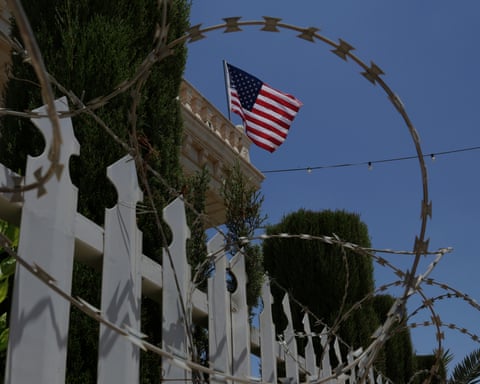
A US flag flies at a Palestinian home in the town of Turmus Ayya in the occupied West Bank. Photograph: Quique Kierszenbaum/The Guardian
After visits by US ambassador Mike Huckabee to the nearby Israeli settlement of Shilo, Palestinian Americans in Turmus Ayya have witnessed a terrifying rise in attacks
By Andrew Roth and Sufian Taha in Turmus Ayya, West Bank. Photography by Quique Kierszenbaum
Mon 3 Aug 2026 20.00 AEST
Share
Prefer the Guardian on Google
No man’s land in Turmus Ayya lies where the US flags end and the Israeli flags begin. It is a few hundred metres of soil scorched by molotov cocktails where Israeli settlers have placed a boulder to tell the Palestinian villagers: this is our land now.
On one side of that boulder are the white-stoned mansions where the Palestinian residents of Turmus Ayya live. About 80% of them are US citizens, members of the diaspora in New York, Chicago and Paterson, New Jersey, who return for the summers and bring their children here to experience Palestinian culture and learn Arabic. Many call themselves proud American patriots and fly the stars and stripes from their balconies.
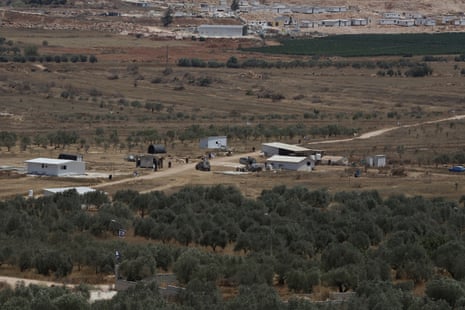 View image in fullscreenAn Israeli military Jeep patrols an illegal outpost built by Israeli settlers after they took control of private farmland owned by the people of Turmus Ayya. Photograph: Quique Kierszenbaum/The Guardian
On the other side is an illegal Israeli outpost of corrugated metal trailers and shacks staffed by young men who claim all of the West Bank as Jewish land.
The outposts radiate from Shilo, a hilltop settlement across the valley that has become a destination for Americans seeking Judaism’s first religious and spiritual capital before the first temple was built. Mike Huckabee, the US ambassador to Israel, has visited Shilo, which the UN says is a violation of international law, twice in the last two years.
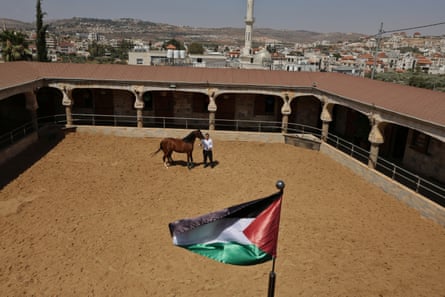 View image in fullscreenAshraf Rabi on the farm where he breeds Arabian horses in Turmus Ayya. He is worried that settlers attacking the village could harm his horses. Photograph: Quique Kierszenbaum/The Guardian
The irony is not lost on people here that the US has backed settlers claiming the West Bank as theirs, and that US dollars – through Jewish charities and the US budget to support the Israeli military – have helped finance the Israeli land grab. Given Shilo’s close ties to the US, they muse that some of those attacking Turmus Ayya could be fellow Americans.
“Only in Palestine will you find American citizens invading American citizens for land,” said Yaser Alkam, a semi-retired family law attorney from Turmus Ayya who for 35 years lived in Anaheim, California. He is now the head of this village’s council. “There is no fight. One side attacks and the other side defends with the limited means that we have.”
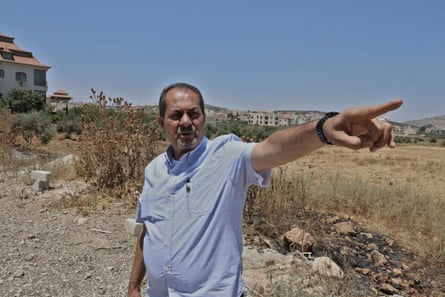 View image in fullscreenYaser Alkam, the head of the village council, who lived in the US for 35 years, shows the ‘hot areas’ where radical settlers attack Palestinian landowners. Photograph: Quique Kierszenbaum/The Guardian
The violence is relentless. At night, settlers roam the village in off-road vehicles and intimidate people with gunshots, screaming and shining flashlights through the windows. In a recent attack against a family on the edge of the village, the settlers spray-painted the word “Revenge” on the side of the house.
Among those accused of violence and intimidation is Amishav Melet, whose brother was killed in a clash when settlers marched into another Palestinian village last week. He has publicly declared that he believes Jews should retake all of the West Bank. He has denied claims that he is connected to settler violence.
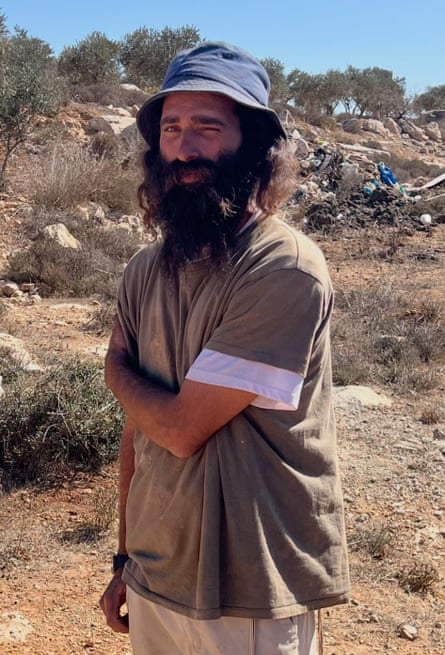 View image in fullscreenAmishav Melet has publicly declared he believes Jews should retake all of the West Bank and has been accused of violence and intimidation.
“I have his pictures,” Alkam said of Melet. “And I’m sure he has my pictures and he has my name. He knows me and I know him … And he’s probably waiting for the time to get me.”
While the Trump administration is focused on Iran, Israel’s accelerating land grab in the West Bank has found an enthusiastic supporter in Huckabee. The US ambassador is an evangelical Christian who has supported Jewish claims on the occupied land that settlers call Judea and Samaria.
Huckabee told residents in 2025: “President Trump loves this land. You are not alone. We stand with you, and so do many around the world. Those who do not stand with you do not stand with God.”
Relatives mourn Palestinian American beaten to death by Israeli settlers: ‘He made everyone feel loved’
Read more
When attacks take place, Alkam contacts Huckabee’s embassy for protection. Sometimes, he said, US officials have helped, most recently in late July when the Israeli military occupied a house owned by a doctor from Syracuse, who had hosted the Democratic congressman Ro Khanna during his visit to Turmus Ayya earlier in the month. Alkam credited the US embassy with “playing a big role” in getting the military to leave, he said.
But nine Palestinian Americans have been killed in the West Bank since 2022 by either settlers or the Israeli military, and the US is often unable to help or to restrain the settlers or military during violent attacks. A year after a Palestinian American from Tampa Bay was beaten to death by Israeli settlers in the West Bank, settlers attacked his family members and friends, and even a CNN crew, who had gathered for a vigil.
In response to questions from the Guardian, the state department said all US citizens in the West Bank had access to consular services, condemned violence “by any party in the West Bank” and said it was in “regular dialogue with partners about improving stability and security”.
“As the president has clearly stated, the United States does not support Israel annexing the West Bank,” the spokesperson said. “A stable West Bank keeps Israel secure and is in line with this administration’s goal to achieve peace in the region.”
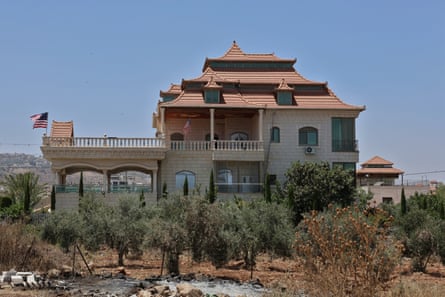 View image in fullscreenA US flag flies at a Palestinian home in Turmus Ayya. Photograph: Quique Kierszenbaum/The Guardian
The moments when the US has intervened have only convinced Alkam that Washington could be doing more to restrain the settlers and the Israeli government.
“We thought we would never get to this point,” he said. “We never thought that American citizens in Turmus Ayya are going to be attacked under the eyes and the ears of the current administration.” Many of the residents even voted for Trump, he said, but lost faith when the administration quickly moved to remove violent settlers from sanctions lists drawn up under the Biden administration.
Ghaith Odeh grew up in Queens, New York, and still spends most of his time in Paterson, New Jersey, but his wife and children moved to their family’s land in Turmus Ayya in 2021. They live on the border of the village near the settlers, and like others on the frontlines, they have shutters over their windows (plastic, not metal, he regrets). From there, he can scan the settler outpost below.
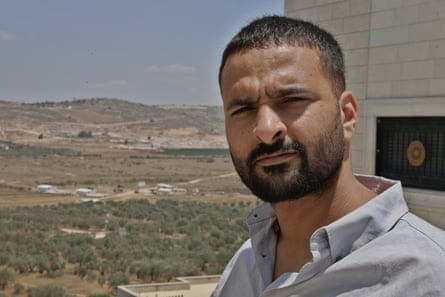 View image in fullscreenGhaith Odeh was born in New York and has a business in New Jersey, but his family moved to their land in Turmus Ayya in 2021. Photograph: Quique Kierszenbaum/The Guardian
The violence began before the Hamas attacks on 7 October 2023 and the launch of Israel’s war in Gaza, but has grown worse in the past year. “We’ve had multiple times where we were scared for our lives here, where we were actually in danger,” Odeh said, recounting the night that settlers burned down part of his parents’ house, the six Israeli military raids on his house, the regular gunfire near the village, and the time a rifle was pointed at his son, one of six children. He is especially scared when he is out of the house, he said.
When Odeh contacted the US embassy about the attacks, he said he was given canned replies to report them to local law enforcement. Asked what message he felt he had received from the US government, he said: “It’s OK for an Israeli American to live over here, but not for an American Palestinian.”
The violence has changed daily life in the village. Many fear bringing their children here and people have to rely on themselves for protection. The discussions in the village now revolve around security measures: whether to install barbed wire or hang more American flags to emphasise the village’s connection to the US.
Pointing to a neighbour from Chicago who was installing a barbed-wire fence, Odeh said: “I don’t want to live in a prison,” adding that he wanted to set an example for his children of how to live without fear.
“I’m born and raised in America,” he said. “We lived in freedom over there. And I’m not gonna live any other way.”
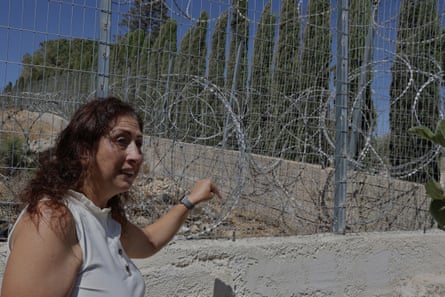 View image in fullscreenMaisoon Ali points to the protective razor wire outside her home that now resembles ‘a prison’. Photograph: Quique Kierszenbaum/The Guardian
But people are scared for their lives. Last month, Maisoon Ali, a 60-year-old retiree, was at home in nearby Deir Dibwan when she looked up and saw three young men running up the driveway with bottles filled with a flammable liquid. She says it was only luck that she ran into her house, where she pulled down the metal shutters that put a barrier between her and them. After trying to pour the liquid on her, the settlers set fire to furniture and the building’s exterior while Ali sheltered inside.
“Thank God I acted fast,” said Ali, who for decades lived in Vienna, Virginia, and whose children still live in the US.
“If I didn’t do that, I would have been burned alive,” she said.
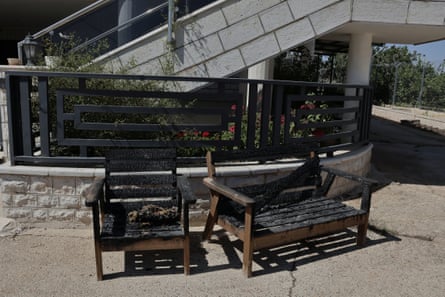 View image in fullscreenBenches outside Ali’s home in Deir Dibwan that were set on fire in an arson attack. Photograph: Quique Kierszenbaum/The Guardian
Ali’s father foresaw trouble in the 1970s when he built the house and installed bulletproof glass.
When he died, Ali’s father made her promise that she would not abandon the house. Now, she has turned the home into a “prison”, with fences around the house and the surrounding olive grove. She has abandoned her regular routine of travelling to Ramallah to see friends or swim at the local YMCA.
“It would kill him to see this,” she said, gesturing toward the fortifications. “It makes me emotional because this is our land and I’m 60 years old and I decided to retire in my family home. And I don’t want to live like this, scared, and not doing my routine.”
Meanwhile, the Israeli settlers camped nearby remain a constant threat. Dozens besieged the house again on 18 June, days after the first attack. One of the men has threatened her online, posting a video in which he is seen standing by a fence next to a basketball court behind Ali’s house. “The reality on the ground is shouting out what they already understand on their own: the homeowner has returned,” he says.
The firebomb attack against Ali took place on 14 June, two days after Huckabee made a surprise visit to Shilo to back the settlers.
Alkam, noting Huckabee does not address the Palestinian American community in the West Bank, said: “I’ve reached out at least four times asking for a visit to Turmus Ayya. He does not even consider that we exist.”
Israeli prosecutors say they have charged six settlers with “acts of terrorism, arson, sabotage and violent rioting” in Deir Dibwan, although the cases are reportedly covered by a gag order and it is not clear if they are related to the attack on Ali’s house. After filing an initial report with the US embassy, she said she was told to report the case to local authorities.
“If we were a Jewish Israeli American family who they had tried to burn alive, the American ambassador would have been here in two hours,” she said. “But I haven’t been contacted.”


No comments:
Post a Comment