Hind Rajab and The Shireen Defense
With Israel launching an investigation into the killing of Hind Rajab, they are carrying out the same deflection strategy they used with Shireen Abu Akleh.
Sam Avraham
Aug 22, 2026
On January 29 2024, the five-year-old Hind Rajab was killed by Israeli soldiers in the Gaza Strip along with six of her family members. An Israeli tank shelled the Rajab family car, and everyone except for Hind and her cousin Layan Hamadeh were killed immediately. Layan contacted the Palestinian Red Cross Society, whose recording of the call confirms the initial survival of both her and Hind. Layan screamed “They are shooting at us. The tank is right next to me. We’re in the car, the tank is right next to us,” and was killed during her final pleas for help. The five-year-old Hind begged “Come take me. Will you come and take me? I’m so scared, please come!” Israeli soldiers killed two Palestinian paramedics who attempted to reach the scene. Days later, after Israel’s withdrawal from the area, paramedics “found a black Kia, its windows blown out, its doors riddled with bullets. That was the car Hind and her family were in when they attempted to flee the city.”
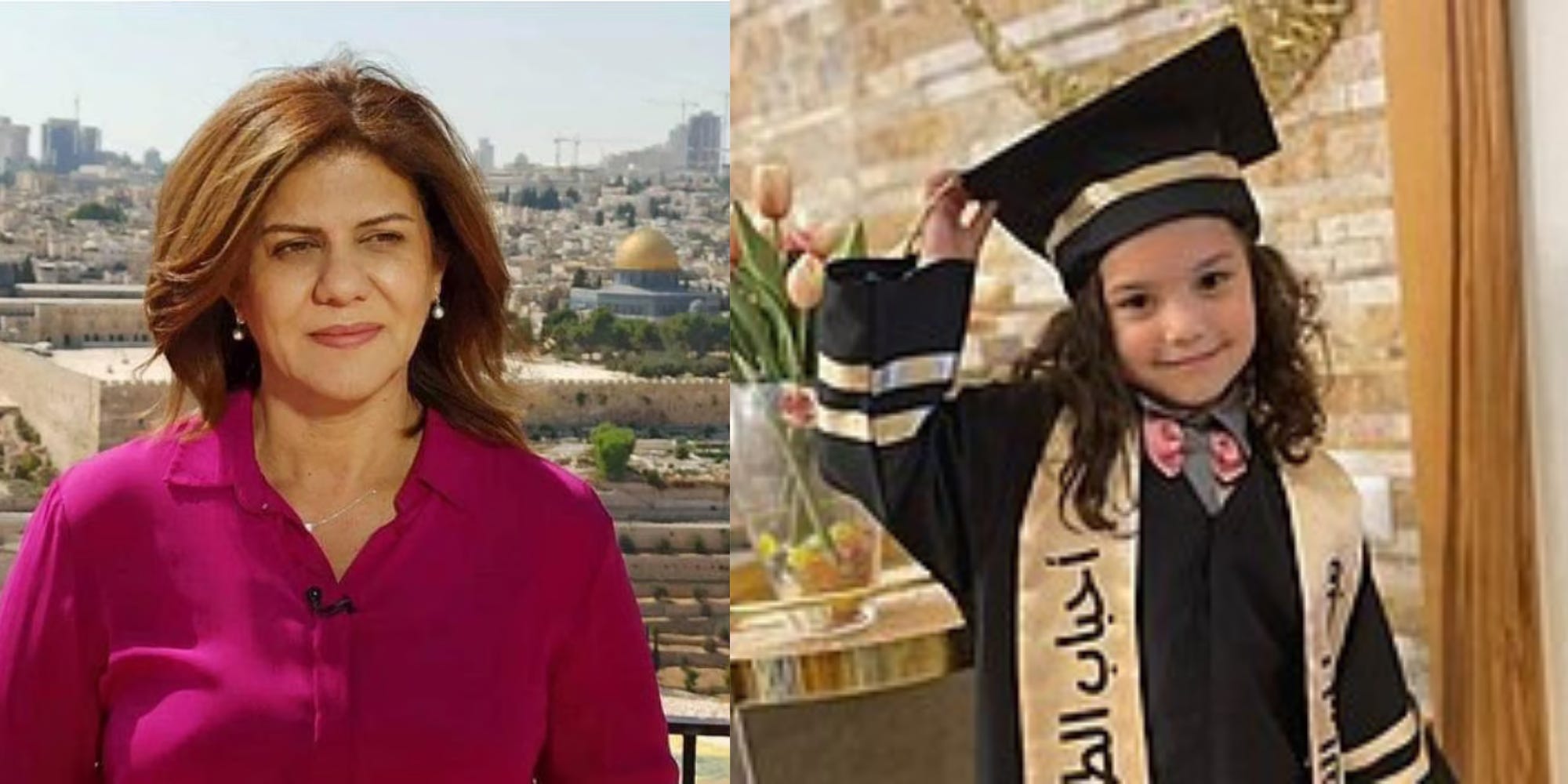
Shireen Abu Akleh (left) and Hind Rajab (right)
On August 19 2026, after a year and a half of international outrage, Israel announced they were launching a criminal probe into the killing of Hind Rajab and the two paramedics. This comes after initial denial — refuted by an abundance of evidence and counter-testimony — that Israeli troops were in the area where Hind and her family were killed. In the statement announcing this criminal probe, which was Israel’s first admittance of even being present at the incident, let alone of being the perpetrators, the Israeli military wrote that “the findings of the examination indicate that IDF troops fired at a vehicle that was approaching them while traveling contrary to the advanced notice that had been published in an announcement by the IDF Spokesperson to residents of the area.”
The Hind Rajab travesty is beginning to bear a striking resemblance to another case: the case of Shireen Abu Akleh, the Palestinian-American journalist killed by an Israeli sniper on May 11 2022. When she was killed, Abu Akleh was wearing a press vest and a helmet while documenting an Israeli raid on the Jenin refugee camp in the West Bank. Israel initially blamed Abu Akleh’s killing on Palestinian militants, but journalists at the scene reported that there were no militants present when Abu Akleh was shot. Palestinian journalist Shatha Hanaysha stated that Israel was specifically targeting journalists.
“We were four journalists, we were all wearing vests, all wearing helmets,” Hanaysha said. “The [Israeli] occupation army did not stop firing even after she collapsed. I couldn’t even extend my arm to pull her because of the shots being fired. The army was adamant on shooting to kill.”
Israel initially refused to conduct an investigation into the killing. After a wave of evidence refuting Israel’s narrative, and after refusing to cooperate in a US-led investigation, on September 5 2022, Israel announced its own tepid findings that “[I]t appears that it is not possible to unequivocally determine the source of the gunfire which hit and killed Ms. Abu Akleh. However, there is a high possibility that Ms. Abu Akleh was accidentally hit by IDF gunfire fired toward suspects identified as armed Palestinian gunmen during an exchange of fire.” They did not take steps to prosecute any of the soldiers involved in the incident. An investigation conducted by journalist Dion Nissenbaum concluded that “[h]ours after Shireen was killed, current and former US government officials told me, the top Israeli general in charge of the West Bank told American officials that one of his soldiers had probably killed Shireen. From the beginning, Israeli and American officials knew the truth. But Israel spent months denouncing a series of independent investigations by journalists that concluded an Israeli soldier had shot Shireen.”
The development of Israel’s response to the killing of Abu Akleh can best be summarized as follows: “We didn’t do it. We might have done it. We did it; there will be no consequences.” I have come to call this deflection from accountability “the Shireen Defense.” The Shireen Defense has been a simple but effective way for Israel to avoid consequences for its actions, even in the face of massive global outrage, by stalling until the news cycle has moved on. This only works because Israel faces neither the active consequence of sanctions for its actions, nor the passive consequence of limiting aid or trade.
Time will tell what comes of Israel’s investigation into the Hind Rajab incident. No expert or anyone familiar with Israel’s military conduct expects anything beyond possibly a slap on the wrist for one or two individual soldiers, with no change in broader policy. But we have already witnessed stages 1, outright denial, and 2, tepid backtracking, of the Shireen Defense applied to Hind Rajab. We may reach the 3rd and final step of Israel admitting to the killing, but not enforcing any consequences, or they may simply go further with their denial.
It is hard to talk about Israel without sounding like a broken record. As with everything else, the solution is sanctions and real international pressure. Whether it is Shireen Abu Akleh, Hind Rajab, or any of the hundreds of thousands of Palestinians Israel has killed since its inception, expecting Israel to punish itself is absurd on its face. It is not a win that Israel announced an investigation into the killing of Hind Rajab. It is a failure that international did not create real accountability a year and a half ago.
Sam’s Substack is a reader-supported publication. To receive new posts and support my work, consider becoming a free or paid subscriber.


No comments:
Post a Comment