Israel Elections 2026
With 88.6% of Votes Counted, Opposition Wins 67 Seats – With 19 for Arab Parties
Eisenkot's bloc has won 48 seats, meaning they will need the support of both Arab parties in order to form a government. Arab politician Ahmad Tibi said that the opposition can form a government 'if it wants to, if it is brave enough to'
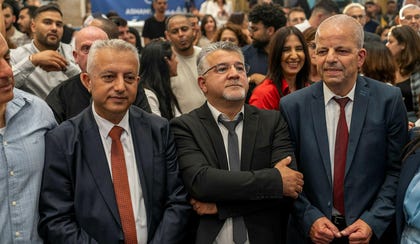
Yousef Jabareen, head of the Joint List, Tuesday. Credit: Daniel Rollider

Chen Maanit
FollowOctober 28, 2026
With 85.6 percent of the votes counted, the opposition has won 67 seats, including 19 for the Arab parties, while Prime Minister Benjamin Netanyahu's coalition has won 53 seats.

The bloc led by Gadi Eisenkot has won 48 seats, according to the partial election results, meaning they will need the support of both the Joint List and Mansour Abbas' United Arab List in order to form a government.
Likud leads with 26 seats, followed by Yashar with 21. Together and the Joint List each have 12 seats. The UAL has risen to seven seats.
Likud26Yashar21Together12The Joint List12The Democrats8United Torah Judaism7Shas7Otzma Yehudit7Yisrael Beiteinu7United Arab List7Religious Zionism6Amcha Yisrael0Reservists0
0
The counting of absentee ballots – the majority of them being votes cast by soldiers in the Israeli military – is set to begin at midnight Wednesday. Roughly 460,000 absentee ballots were cast in the previous election, the equivalent of nearly 13 Knesset seats.
Election officials believe that number will increase in this election, owing to the large number of IDF reservists who are not able to vote near their homes due to being deployed.
The Central Elections Committee initially said that all ballots other than double-envelope ballots had been counted. It later clarified that several hundred polling stations were still undergoing routine checks, with their results yet to be published and expected later in the day. The committee estimated that between 430,000 and 480,000 double-envelope ballots remain to be counted.

Double-envelope ballots are transported in boxes to the Knesset, where thousands of workers count them in shifts over 72 consecutive hours. Credit: Emil Salman
According to the latest update, the Democrats remain at eight seats, followed by Yisrael Beiteinu, Otzma Yehudit, United Torah Judaism and Shas, each with seven. Religious Zionism remains at six seats. The Reservists party, led by Yoaz Hendel and Yaron Zelekha, is still below the electoral threshold but has edged closer to crossing it. Ofer Winter's Amcha Yisrael party has also failed to cross the threshold.
Ahmad Tibi, who leads one of the factions that form a joint Arab party, said in an interview to Israeli Army Radio on Wednesday that the opposition bloc led by Yashar's Gadi Eisenkot can form a government "if it wants to, if it is brave enough to," he said.
The election result is a "historic achievement for the Arab public," Tibi said. If not for the high voter turnout in Arab communities, he added, "Netanyahu could have formed a government by himself with the right. We blocked that possibility."
Related ArticlesIgnoring Arab voters is a self-inflicted wound for Israel's liberal bloc Noa Landau
Opposition party head urges partnership with Arab parties to oust Netanyahu Noa Shpigel
What now? Israel's three post-election scenarios Michael Hauser Tov
The Arab leader also said that Israel is an ethnocracy, which singles out the Arab population from the get-go. "We're reaching our hand out to anyone who wants to change the reality, to topple the government, and to pave the way to a different government." The question, he added, is "if there's a hand extended on the other side."

Ahmed Tibi voting in the central Israeli city of Taybeh on Tuesday. Credit: Moti Milrod
Yousef Jabareen, who leads the Joint List, said on Wednesday morning that his party is ready to help replace Prime Minister Benjamin Netanyahu, as the results of the election appeared to show no clear majority for either bloc without cooperating with his party or the United Arab List.
"Whoever wants to offer a substantive and real alternative to Netanyahu's government of bloodshed will have to speak with us to pave the way for the change the public in Israel yearns for," Jabareen said. "We are ready to pave the way for Netanyahu's ouster," he added.
"It's either continued racism and continued exclusion and continued supremacy – or a true Jewish-Arab partnership," Jabareen added.
Democrats party leader Yair Golan, who is the only opposition bloc leader who actively called for the inclusion of Arab parties, also urged opposition leaders on Wednesday to form a government in partnership with Arab parties to replace Prime Minister Benjamin Netanyahu, calling on his allies to overcome their reluctance to cooperate with Arab citizens.
"We have no future here if we don't stop being afraid. And if we don't put an end to racism. We can no longer accept Netanyahu's racist distinction between Jewish and Arab votes," Golan wrote on X.


No comments:
Post a Comment