
Lost Enlightenment: Central Asia's Golden Age from the Arab Conquest to Tamerlane
by S. Frederick Starr (Author) Format: Paperback
4.6 4.6 out of 5 stars (367)
Contents
이
List of Illustrations ix
Preface xiii
Dramatis Personae xxi
Chronology xxxi
CHAPTER 1
The Center of the World 1
CHAPTER 2
Worldly Urbanists, Ancient Land 28
CHAPTER 3
A Cauldron of Skills, Ideas, and Faiths 62
CHAPTER 4
How Arabs Conquered Central Asia and Central Asia Then Set the Stage to Conquer Baghdad 101
CHAPTER 5
East Wind over Baghdad 126
CHAPTER 6
Wandering Scholars 156
CHAPTER 7
Khurasan: Central Asia's Rising Star 194
CHAPTER 8
A Flowering of Central Asia: The Samanid Dynasty 225
CHAPTER 9
A Moment in the Desert: Gurganj under the Mamuns 267
CHAPTER 10
Turks Take the Stage: Mahmud of Kashgar and Yusuf of Balasagun 303
CHAPTER 11
Culture under a Turkic Marauder: Mahmud's Ghazni 332
CHAPTER 12
Tremors under the Dome of Seljuk Rule 381
CHAPTER 13
The Mongol Century 436
CHAPTER 14
Tamerlane and His Successors 478
CHAPTER 15
Retrospective: The Sand and the Oyster 515
Notes 541
Index 611
In this sweeping and richly illustrated history, S. Frederick Starr tells the fascinating but largely unknown story of Central Asia's medieval enlightenment through the eventful lives and astonishing accomplishments of its greatest minds--remarkable figures who built a bridge to the modern world. Because nearly all of these figures wrote in Arabic, they were long assumed to have been Arabs. In fact, they were from Central Asia--drawn from the Persianate and Turkic peoples of a region that today extends from Kazakhstan southward through Afghanistan, and from the easternmost province of Iran through Xinjiang, China. Lost Enlightenment recounts how, between the years 800 and 1200, Central Asia led the world in trade and economic development, the size and sophistication of its cities, the refinement of its arts, and, above all, in the advancement of knowledge in many fields. Central Asians achieved signal breakthroughs in astronomy, mathematics, geology, medicine, chemistry, music, social science, philosophy, and theology, among other subjects.They gave algebra its name, calculated the earth's diameter with unprecedented precision, wrote the books that later defined European medicine, and penned some of the world's greatest poetry. One scholar, working in Afghanistan, even predicted the existence of North and South America--five centuries before Columbus. Rarely in history has a more impressive group of polymaths appeared at one place and time. No wonder that their writings influenced European culture from the time of St. Thomas Aquinas down to the scientific revolution, and had a similarly deep impact in India and much of Asia. Lost Enlightenment chronicles this forgotten age of achievement, seeks to explain its rise, and explores the competing theories about the cause of its eventual demise. Informed by the latest scholarship yet written in a lively and accessible style, this is a book that will surprise general readers and specialists alike.
Read less
 Report an issue with this product
Review
"Lost Enlightenment is a most amazing book, one with--if we are lucky--the potential to shape global public thinking for decades ahead. . . . Lost Enlightenment is an entirely readable, informative and even entertaining book. Although it might surely serve as an inspiration to the modern inhabitants of Central Asia, it should also serve as a warning to any modern nation and civilization that it is tempted to intolerance."---Dimitry Chen, Asian Review of Books
"Lost Enlightenment is a remarkable and accessible scholarly tour de force."---David Morgan, Times Literary Supplement
"A great introduction to the 'Scientific Golden Age.'. . . [It] provides a deep insight into the much-overlooked lands, dynasties and cultures that made up Central Asia during the Islamic Golden Age."---Amina Smits, Insight Turkey
"Honorable Mention for the 2013 PROSE Award in European and World History, Association of American Publishers"
"In the book Lost Enlightenment, historian S. Frederick Starr chronicles the long tradition of scientists, mathematicians, engineers and literary intellectuals that flourished in the Iranian- and Turkish-speaking regions of Central Asia."---Noah Smith, Bloomberg View
"In this graceful, luxuriant history, Starr recovers the stunning contributions of Central Asia scientists, architects, artists, engineers, and historians during the four centuries that began just before the Arab onslaught of the eight century and lasted until the Mongol siege in the thirteenth century. . . . The book offers a lucid exploration of the era's intricate philosophical and theological debates and a succinct depiction of its poetry and art, enhanced by many illustrations."-- "Foreign Affairs"
"One of Choice's Outstanding Academic Titles for 2014"
"Starr argues rightly that the region's brilliant culture rested on a highly cosmopolitan mix of ethnic groups, languages and religions; a long, rich pre-Islamic intellectual tradition (mainly Buddhist); and prosperity. . . . Starr shines in his core chapters, where he presents the great achievements of the Central Asian philosopher-scientists at a time when their homeland was the creative intellectual capital of the world."-- "Nature"
"Starr is that rare scholar with the horsepower to write about the medieval culture of this vast region that is bounded by Persia to the west, and China to the east, and India to the southeast. . . . An indispensable title for scholars, this lively study should prove equally compelling to serious lay readers with an interest in Arabic and medieval thought."-- "Library Journal"
"Starr undertakes a daunting task--the intellectual history of Central Asia through the medieval period. Happily, he succeeds. . . . Starr's book is thorough and well researched, and includes ample supplemental material and sources, so that even novice students will find it instructive and useful without being overwhelming."-- "Choice"
"The true value of the book is that it presents comprehensively collated data and sources, amalgamated in chronological order, about the history, culture, material life and sciences in mediaeval Central Asia, pre- and post-Islamisation. Furthermore, the author's reasoning for the rise and decline of Central Asia's Enlightenment is nothing short of impeccably convincing. Finally, based on the author's arguments, one may come to appreciate the value of mediaeval Central Asia as a model for the modern world."---Peter Nicolaus, Iran and the Caucasus
"This book does a marvelous job of highlighting the contributions of medieval intellectuals from Central Asia to the history of world civilizations. . . . It is a very informative and readable book."---Richard Foltz, Fezana Journal
"This book is a must-read for those wanting to understand the development of this vast region of the world and the cultural and religious tides that gave rise to the conflicts we face today."---Carl G. Schuster, Explorers Journal
"This favorable account of Central Asia's intellectual life will enhance any reader's perception of Central Asia and challenge further investigation."---Isenbike Togan, Bogazici Journal
From the Back Cover
"A fantastic book."--President Ashraf Ghani of Afghanistan
"Lost Enlightenment brilliantly re-creates for us the world of Central Asia, which for centuries was not a backwater but a center of world civilization. With a sure mastery of the large historical sweep as well as an eye for detail, Fred Starr has written an important book that will be a resource for years to come."--Francis Fukuyama, author of The Origins of Political Order
"For more than three hundred years the Islamic world exercised the scientific and philosophical mastery of Europe. With compelling urgency and lucidity, Lost Enlightenment tells the story of the rise and tragic demise of this golden age of Islamic learning in Central Asia. It is a story whose lesson we should never be allowed to forget."--Anthony Pagden, author of The Enlightenment: And Why It Still Matters
"From 800 to 1200, Central Asia was the world's most advanced civilization in the sciences, mathematics, medicine, law, and art. Starr's Lost Enlightenment thoughtfully explains this astonishing evolution and its end."--Henry A. Kissinger
"Fred Starr makes the most persuasive case yet that medieval Central Asia was a major center of civilization and high culture--and what a picture emerges."--Richard W. Bulliet, Columbia University
"Drawing on his vast knowledge and experience of Central Asia, Fred Starr provides a brilliant account of the history and culture of the land that produced some of the greatest Islamic scholars, scientists, saints, artists, and architects. Thanks to this book, the Central Asian enlightenment is no longer as lost as some might think."--Seyyed Hossein Nasr, George Washington University
"A delight to read, this is a fine survey of the intellectual and cultural history of Central Asia by a distinguished historian. By showing the remarkable discoveries in astronomy, mathematics, medicine, and other fields made by Central Asians from the earliest times, Lost Enlightenment is certain to surprise many readers by challenging traditional misconceptions of the region. The book's biographical approach makes for lively reading. Anyone interested in the Silk Roads will find it enthralling."--Morris Rossabi, author of The Mongols: A Very Short Introduction
"This ambitious and much-needed book will be an eye-opener for many readers. S. Frederick Starr shows that Central Asia, often viewed today as a backwater, produced some of the most outstanding minds of the Middle Ages."--Peter B. Golden, author of Central Asia in World History
Read more

TopAbout this itemSimilarFrom the AuthorQuestionsReviews
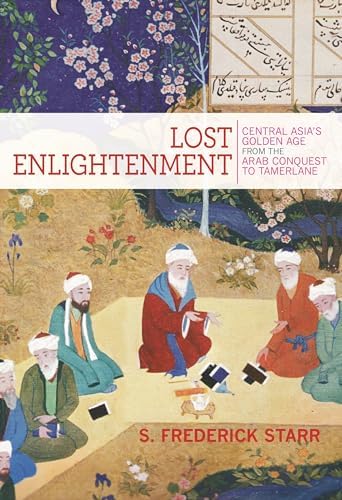 Lost Enlightenment: Central Asia's Golden Age from the Arab Conquest to Tamerlane
Product details
Publisher : Princeton University Press
Publication date : 11 August 2015
Top reviews from Australia

𐭠𐭥𐭲𐭧𐭱𐭲𐭥
5 out of 5 stars
Excellent and daring
Reviewed in Australia on 27 February 2026
Format: Paperback
Verified Purchase
This book is written with intellectual strength and historical knowledge. It dares to ask difficult questions and is willing to offer answers that reflect the historical realities, which may upset a few biased readers but will enrich and enlighten anyone willing to have a critical and deep understanding of history.
Helpful
Report
Aimal Amiri
2 out of 5 stars
Bias
Reviewed in Australia on 21 February 2021
Format: Kindle
Verified Purchase
The book is very informative and thoroughly researched, however the authors zealous crusade to rid of Islamic influences is grossly apparent. It makes for very exhaustive reading, presenting your opinion as objective truth rather than just “opinion” disservice the very people whom he’s trying glorify.
There is a lot of gems that can be gained from reading this book, but would I recommend it ? No. Simply let the historical record and the people in question ‘speak for themselves’. Imposing ones own values and understanding on a past peoples is wrong, let the texts speak for themselves
2 people found this helpful
Helpful
Report
See more reviews
Top reviews from other countries
Translate all reviews to English
Davees C. J.
5 out of 5 stars
Great work! A lot of research has gone into ...
Reviewed in India on 17 November 2015
Verified Purchase
Great work! A lot of research has gone into it. The volume of content and the meager price of the work do not match. An objective and unbiased study, the work is a treasure in personal collection.
Report
Petra
5 out of 5 stars
Buena presentación
Reviewed in Mexico on 13 July 2025
Format: Paperback
Verified Purchase
Muy fácil de leer y muy interesante. Llevo una quinta parte y no pienso abandonar la lectura. Es una parte de la historia que se tiene olvidada. Además la tipografía es agradable y facilita la lectura.
Report
Translate review to English
アーマチュア
5 out of 5 stars
非常にいい本
Reviewed in Japan on 14 January 2022
Format: Paperback
Verified Purchase
日本では、殆ど知られていないイスラム文化圏の文化史、知性史の本です。中央アジアの見方が変わります。翻訳がないのは、残念だけどけれど、読みやすい英語です。
Report
Translate review to English
Dagmar
5 out of 5 stars
A masterly report
Reviewed in Italy on 4 January 2014
Format: Hardcover
Verified Purchase
The author gives a thorough description of the Central Asian caravan cities and their territory in the centuries of their greatest splendor. Not only trade, but also culture and research flourished with ruler approval and financing. Writers, poets, mathematicians,astronomers found fertile ground for their work and also helped transfer philosophy and new scientific ideas from other areas (China,India,Arab Mesopotamia).
The territory included eastern Iran,Turkmenistan,Uzbekistan,Tadzikistan, the western fringes of China and northern Afghanistan.
The end of this splendor came with the Mongol invasion of Chinggis Khan with short revival under Timur.
All this was happening whilst Europe was sleeping under the dark ages.
Required reading for anybody interested.
Report
Plinio Freire Gomes
5 out of 5 stars
Lost Enlightenment: Central Asia's Golden Age from the Arab Conquest to Tamerlane
Reviewed in Brazil on 12 December 2022
Format: Kindle
Verified Purchase
Frederick Starr escreveu páginas memoráveis sobre um mundo quase completamente desconhecido. A Ásia Central, no coração da Rota da Seda, foi protagonista de uma fusão própria e original entre as culturas da Pérsia, da China e do Complexo Nômade das Estepes. Como ele mesmo reitera, não estamos falando de uma “encruzilhada de civilizações” e sim de uma “civilização da encruzilhada”.
Report
Translate review to English
See more reviews
===
===

'/%3E%3Cpath%20d='M16.0001%207.9996c0%204.418-3.5815%207.9996-7.9995%207.9996S.001%2012.4176.001%207.9996%203.5825%200%208.0006%200C12.4186%200%2016%203.5815%2016%207.9996Z'%20fill='url(%23paint1_radial_15251_63610)'/%3E%3Cpath%20d='M16.0001%207.9996c0%204.418-3.5815%207.9996-7.9995%207.9996S.001%2012.4176.001%207.9996%203.5825%200%208.0006%200C12.4186%200%2016%203.5815%2016%207.9996Z'%20fill='url(%23paint2_radial_15251_63610)'%20fill-opacity='.5'/%3E%3Cpath%20d='M7.3014%203.8662a.6974.6974%200%200%201%20.6974-.6977c.6742%200%201.2207.5465%201.2207%201.2206v1.7464a.101.101%200%200%200%20.101.101h1.7953c.992%200%201.7232.9273%201.4917%201.892l-.4572%201.9047a2.301%202.301%200%200%201-2.2374%201.764H6.9185a.5752.5752%200%200%201-.5752-.5752V7.7384c0-.4168.097-.8278.2834-1.2005l.2856-.5712a3.6878%203.6878%200%200%200%20.3893-1.6509l-.0002-.4496ZM4.367%207a.767.767%200%200%200-.7669.767v3.2598a.767.767%200%200%200%20.767.767h.767a.3835.3835%200%200%200%20.3835-.3835V7.3835A.3835.3835%200%200%200%205.134%207h-.767Z'%20fill='%23fff'/%3E%3Cdefs%3E%3CradialGradient%20id='paint1_radial_15251_63610'%20cx='0'%20cy='0'%20r='1'%20gradientUnits='userSpaceOnUse'%20gradientTransform='rotate(90%20.0005%208)%20scale(7.99958)'%3E%3Cstop%20offset='.5618'%20stop-color='%230866FF'%20stop-opacity='0'/%3E%3Cstop%20offset='1'%20stop-color='%230866FF'%20stop-opacity='.1'/%3E%3C/radialGradient%3E%3CradialGradient%20id='paint2_radial_15251_63610'%20cx='0'%20cy='0'%20r='1'%20gradientUnits='userSpaceOnUse'%20gradientTransform='rotate(45%20-4.5257%2010.9237)%20scale(10.1818)'%3E%3Cstop%20offset='.3143'%20stop-color='%2302ADFC'/%3E%3Cstop%20offset='1'%20stop-color='%2302ADFC'%20stop-opacity='0'/%3E%3C/radialGradient%3E%3ClinearGradient%20id='paint0_linear_15251_63610'%20x1='2.3989'%20y1='2.3999'%20x2='13.5983'%20y2='13.5993'%20gradientUnits='userSpaceOnUse'%3E%3Cstop%20stop-color='%2302ADFC'/%3E%3Cstop%20offset='.5'%20stop-color='%230866FF'/%3E%3Cstop%20offset='1'%20stop-color='%232B7EFF'/%3E%3C/linearGradient%3E%3C/defs%3E%3C/svg%3E)


No comments:
Post a Comment