
Read sample
Follow the author

Shoaib Ahmed MalikShoaib Ahmed…
Follow
Islam and Evolution: Al-Ghazālī and the Modern Evolutionary Paradigm
by Shoaib Ahmed Malik (Author) Format: Paperback
4.5 4.5 out of 5 stars (62)
Part of: Routledge Science and Religion (40 books)
ISBN-13: 978-1032026572 ISBN-10: 103202657X Edition: 1st
See all formats and editions
This book attempts to equip the reader with a holistic and accessible account of Islam and evolution. It guides the reader through the different variables that have played a part in the ongoing dialogue between Muslim creationists and evolutionists.
This work views the discussion through the lens of al-Ghazālī (1058-1111), a widely-known and well-respected Islamic intellectual from the medieval period. By understanding al-Ghazālī as an Ash’arite theologian, a particular strand of Sunni theology, his metaphysical and hermeneutic ideas are taken to explore if and how much Neo-Darwinian evolution can be accepted. It is shown that his ideas can be used to reach an alignment between Islam and Neo-Darwinian evolution.
This book offers a detailed examination that seeks to offer clarity if not agreement in the midst of an intense intellectual conflict and polarity amongst Muslims. As such, it will be of great interest to scholars of Science and Religion, Theology, Philosophy of Religion, Islamic Studies, and Religious Studies more generally.
*Winner of the International Society for Science & Religion (ISSR) book prize 2022 (academic category)*
==
==
==
==
==
Product description
Review
The topic of evolution and its potential clash with the mainstream teachings of Islam is one of the most contentious and charged issues of our times. How does a person of faith who also respects science reconcile between what science has almost definitively concluded as a fact with the claims of truth made by the Quran? In this comprehensive and highly readable monograph, Shoaib Ahmed Malik has done a commendable job of summarizing the various approaches taken by modern Muslim thinkers. The text is accessible to even non-specialists and has enough in-depth analysis to be of interest to specialists in science and religion, theology, and philosophy. I believe this work is essential reading for anyone interested in the topic of Islam and evolution.
Dr. Yasir Qadhi, The Islamic Seminary of America, USA
Evolution has presented a serious challenge to traditional Abrahamic faiths. The responses have too often fallen short of the rigours exhibited by modern science and the resulting assertions of evolutionists. Here is a serious Muslim response by Shoaib Ahmed Malik who understands the science of evolution and the faith of Islam and has no difficulty straddling both worlds without losing his faith in either.
Dr. Hamza Yusuf, Zaytuna College, USA
Shoaib Ahmed Malik’s work is timely, thought-provoking and stimulating. He marries the classical, theological framework of Ash’arism and modern evolution. The book’s focus on the metaphysical and hermeneutic approaches of al-Ghazālī, a globally-known Muslim figure, will fill a huge gap in the literature and answer the many questions in the public’s mind and academia on the status of evolutionary thought in Islam. Malik’s book is a well-written, exemplary work for scholars from a wide range of disciplines who wish to explore evolution in other Sunni, Shi’i and Ismaili theological schools, among others.
Dr. Majid Daneshgar, University of Freiburg, Germany
Evolution is one of the most discussed and misrepresented theories among Muslims today. The discussions are usually motivated by emotional reactions, which only obscures the debate’s multi-faceted nature and prevents us from seeing what the problem really is. To analyze the link between evolution and Islam carefully, one must differentiate the scientific foundation of evolution from its various philosophical glosses and have a consistent methodology for interpreting religious texts. Only with such sensitivity can one discuss to what extent evolution and Islam are compatible. Shoaib Ahmed Malik’s book is an outstanding contribution to this debate/question while exemplifying the required sensitivity. He takes one of the giants of Islamic intellectual history, al-Ghazālī, and analyses the issue in terms of his commitments in metaphysics and hermeneutics. Thus, he gives life to a medieval thinker’s ideas and brings him into dialogue with a contemporary problem. The result is a text that is a rare example of multi-faceted, critical, and innovative thinking.
Dr. Nazif Muhtaroğlu, Bahcesehir University, Turkey
This fascinating book is a pivotal source for anyone interested in Islam and evolution debate. Shoaib Ahmed Malik, first, provides careful, nuanced, and comprehensive examination of contemporary landscape of ideas on this important debate. Then, he presents his own fresh and thought-provoking perspective on whether a reconciliation between Islam and evolution can be reached by starting from the general principles of Ash’arite school al-Ghazālī’s thought. Tracing the implications of medieval Islamic thought for a contemporary discussion is difficult and complex. Malik’s book masterfully navigates the challenges and demands of this task.
Dr. Özgür Koca, Claremont School of Theology, USA
Shoaib Ahmed Malik’s book is one of the very rare works that takes an accurate understanding of evolutionary biology and engages with is it according to the terms of the Islamic tradition (in this case, the Ash`arite theology of al-Ghazālī) to determine what a viable faith-based stance could be. Rigorously researched, it explores with sensitivity the genuine theological issues that are confronted when biological evolution is considered in a religious light. It is indispensable reading on the subject.
Dr. David Solomon Jalajel, Prince Sultan Research Institute, Saudi Arabia
Evolution has been dynamite in the science-and-religion debate since the time of Darwin, in spite of many serious and intelligent proposals to resolve the problems. Here is one of the most serious and intelligent yet. Shoaib Ahmed Malik makes a highly original case for peace by examining the foundational Muslim thinker, al-Ghazālī, and showing how his thought can shed light where so far there has been much heat. This is a book which all theists who are worried about the evolution wars need to read.
Prof. Mark Harris, University of Edinburgh, UK
Sometimes a book is a total revelation. You realize just how very much you did not know. Those of us who work on the science-religion discourse too often assume that all of the Abrahamic religions – Judaism, Christianity, Islam – present the same challenges and opportunities. Shoaib Ahmed Malik’s remarkable book, Islam and Evolution: Al-Ghazālī and the Modern Evolutionary Paradigm, shows how very wrong we have been. In clear, careful, non-condescending language, Malik teaches us about Islam and its varieties, and the challenges posed by modern evolutionary science. He writes in a constructive and confident manner, not avoiding problems, but showing how there is much for all of us to learn, and leads us from the narrow, Eurocentric vision that restricts so much of our thinking.
Prof. Michael Ruse, Florida State University, USA
The topic of evolution and its potential clash with the mainstream teachings of Islam is one of the most contentious and charged issues of our times. How does a person of faith who also respects science reconcile between what science has almost definitively concluded as a fact with the claims of truth made by the Quran? In this comprehensive and highly readable monograph, Shoaib Ahmed Malik has done a commendable job of summarizing the various approaches taken by modern Muslim thinkers. The text is accessible to even non-specialists and has enough in-depth analysis to be of interest to specialists in science and religion, theology, and philosophy. I believe this work is essential reading for anyone interested in the topic of Islam and evolution.
Dr. Yasir Qadhi, The Islamic Seminary of America, USA
---------
Evolution has presented a serious challenge to traditional Abrahamic faiths. The responses have too often fallen short of the rigours exhibited by modern science and the resulting assertions of evolutionists. Here is a serious Muslim response by Shoaib Ahmed Malik who understands the science of evolution and the faith of Islam and has no difficulty straddling both worlds without losing his faith in either.
Dr. Hamza Yusuf, Zaytuna College, USA
---------
Shoaib Ahmed Malik’s work is timely, thought-provoking and stimulating. He marries the classical, theological framework of Ash’arism and modern evolution. The book’s focus on the metaphysical and hermeneutic approaches of al-Ghazālī, a globally-known Muslim figure, will fill a huge gap in the literature and answer the many questions in the public’s mind and academia on the status of evolutionary thought in Islam. Malik’s book is a well-written, exemplary work for scholars from a wide range of disciplines who wish to explore evolution in other Sunni, Shi’i and Ismaili theological schools, among others.
Dr. Majid Daneshgar, University of Freiburg, Germany
---------
Evolution is one of the most discussed and misrepresented theories among Muslims today. The discussions are usually motivated by emotional reactions, which only obscures the debate’s multi-faceted nature and prevents us from seeing what the problem really is. To analyze the link between evolution and Islam carefully, one must differentiate the scientific foundation of evolution from its various philosophical glosses and have a consistent methodology for interpreting religious texts. Only with such sensitivity can one discuss to what extent evolution and Islam are compatible. Shoaib Ahmed Malik’s book is an outstanding contribution to this debate/question while exemplifying the required sensitivity. He takes one of the giants of Islamic intellectual history, al-Ghazālī, and analyses the issue in terms of his commitments in metaphysics and hermeneutics. Thus, he gives life to a medieval thinker’s ideas and brings him into dialogue with a contemporary problem. The result is a text that is a rare example of multi-faceted, critical, and innovative thinking.
Dr. Nazif Muhtaroğlu, Bahcesehir University, Turkey
This fascinating book is a pivotal source for anyone interested in Islam and evolution debate. Shoaib Ahmed Malik, first, provides careful, nuanced, and comprehensive examination of contemporary landscape of ideas on this important debate. Then, he presents his own fresh and thought-provoking perspective on whether a reconciliation between Islam and evolution can be reached by starting from the general principles of Ash’arite school al-Ghazālī’s thought. Tracing the implications of medieval Islamic thought for a contemporary discussion is difficult and complex. Malik’s book masterfully navigates the challenges and demands of this task.
Dr. Özgür Koca, Claremont School of Theology, USA
---------
Shoaib Ahmed Malik’s book is one of the very rare works that takes an accurate understanding of evolutionary biology and engages with is it according to the terms of the Islamic tradition (in this case, the Ash’arite theology of al-Ghazālī) to determine what a viable faith-based stance could be. Rigorously researched, it explores with sensitivity the genuine theological issues that are confronted when biological evolution is considered in a religious light. It is indispensable reading on the subject.
Dr. David Solomon Jalajel, Prince Sultan Research Institute, Saudi Arabia
---------
Evolution has been dynamite in the science-and-religion debate since the time of Darwin, in spite of many serious and intelligent proposals to resolve the problems. Here is one of the most serious and intelligent yet. Shoaib Ahmed Malik makes a highly original case for peace by examining the foundational Muslim thinker, al-Ghazālī, and showing how his thought can shed light where so far there has been much heat. This is a book which all theists who are worried about the evolution wars need to read.
Prof. Mark Harris, University of Edinburgh, UK
---------
Sometimes a book is a total revelation. You realize just how very much you did not know. Those of us who work on the science-religion discourse too often assume that all of the Abrahamic religions – Judaism, Christianity, Islam – present the same challenges and opportunities. Shoaib Ahmed Malik’s remarkable book, Islam and Evolution: Al-Ghazālī and the Modern Evolutionary Paradigm, shows how very wrong we have been. In clear, careful, non-condescending language, Malik teaches us about Islam and its varieties, and the challenges posed by modern evolutionary science. He writes in a constructive and confident manner, not avoiding problems, but showing how there is much for all of us to learn, and leads us from the narrow, Eurocentric vision that restricts so much of our thinking.
Prof. Michael Ruse, Florida State University, USA
---------
For many writers on Islam and science, the medieval scholar and theologian al-Ghazālīis associated with a theory of causality inimical to the requirements of modern science. In exploring the scope for compatibility between Islam and the science of evolution, Shoaib Ahmed Malik takes a very different view, contending that the metaphysics and hermeneutics of al-Ghazālī permit the acceptance of much of the modern evolutionary narrative – with the critical exception of wholly naturalistic accounts of the origins of a unique and parentless Adam. I gladly recommend his book because it also paves the way for serious comparative studies of the receptivity of Islamic and Christian cultures to scientific innovation.
Prof. John Hedley Brooke, University of Oxford, UK
About the Author
Shoaib Ahmed Malik is an Assistant Professor of the Natural Sciences at Zayed University, Dubai. He researches exclusively on the topics of science and religion, atheism, and Islamic theology. He is the author of Atheism and Islam: A Contemporary Discourse (2018), and has book chapters and articles with various publishers and journals.

TopAbout this itemSimilarFrom the AuthorQuestionsReviews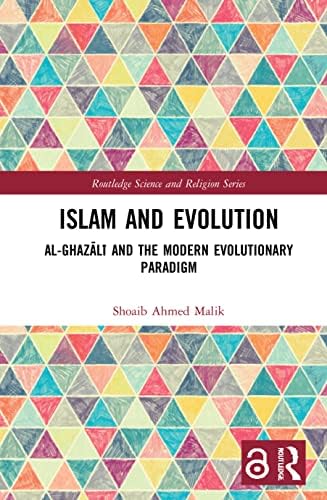 Islam and Evolution: Al-Ghazālī and the Modern Evolutionary Paradigm
Product details
Publisher : Routledge
Publication date : 9 January 2023
Edition : 1st
Product description
Review
The topic of evolution and its potential clash with the mainstream teachings of Islam is one of the most contentious and charged issues of our times. How does a person of faith who also respects science reconcile between what science has almost definitively concluded as a fact with the claims of truth made by the Quran? In this comprehensive and highly readable monograph, Shoaib Ahmed Malik has done a commendable job of summarizing the various approaches taken by modern Muslim thinkers. The text is accessible to even non-specialists and has enough in-depth analysis to be of interest to specialists in science and religion, theology, and philosophy. I believe this work is essential reading for anyone interested in the topic of Islam and evolution.
Dr. Yasir Qadhi, The Islamic Seminary of America, USA
Evolution has presented a serious challenge to traditional Abrahamic faiths. The responses have too often fallen short of the rigours exhibited by modern science and the resulting assertions of evolutionists. Here is a serious Muslim response by Shoaib Ahmed Malik who understands the science of evolution and the faith of Islam and has no difficulty straddling both worlds without losing his faith in either.
Dr. Hamza Yusuf, Zaytuna College, USA
Shoaib Ahmed Malik’s work is timely, thought-provoking and stimulating. He marries the classical, theological framework of Ash’arism and modern evolution. The book’s focus on the metaphysical and hermeneutic approaches of al-Ghazālī, a globally-known Muslim figure, will fill a huge gap in the literature and answer the many questions in the public’s mind and academia on the status of evolutionary thought in Islam. Malik’s book is a well-written, exemplary work for scholars from a wide range of disciplines who wish to explore evolution in other Sunni, Shi’i and Ismaili theological schools, among others.
Dr. Majid Daneshgar, University of Freiburg, Germany
Evolution is one of the most discussed and misrepresented theories among Muslims today. The discussions are usually motivated by emotional reactions, which only obscures the debate’s multi-faceted nature and prevents us from seeing what the problem really is. To analyze the link between evolution and Islam carefully, one must differentiate the scientific foundation of evolution from its various philosophical glosses and have a consistent methodology for interpreting religious texts. Only with such sensitivity can one discuss to what extent evolution and Islam are compatible. Shoaib Ahmed Malik’s book is an outstanding contribution to this debate/question while exemplifying the required sensitivity. He takes one of the giants of Islamic intellectual history, al-Ghazālī, and analyses the issue in terms of his commitments in metaphysics and hermeneutics. Thus, he gives life to a medieval thinker’s ideas and brings him into dialogue with a contemporary problem. The result is a text that is a rare example of multi-faceted, critical, and innovative thinking.
Dr. Nazif Muhtaroğlu, Bahcesehir University, Turkey
This fascinating book is a pivotal source for anyone interested in Islam and evolution debate. Shoaib Ahmed Malik, first, provides careful, nuanced, and comprehensive examination of contemporary landscape of ideas on this important debate. Then, he presents his own fresh and thought-provoking perspective on whether a reconciliation between Islam and evolution can be reached by starting from the general principles of Ash’arite school al-Ghazālī’s thought. Tracing the implications of medieval Islamic thought for a contemporary discussion is difficult and complex. Malik’s book masterfully navigates the challenges and demands of this task.
Dr. Özgür Koca, Claremont School of Theology, USA
Shoaib Ahmed Malik’s book is one of the very rare works that takes an accurate understanding of evolutionary biology and engages with is it according to the terms of the Islamic tradition (in this case, the Ash`arite theology of al-Ghazālī) to determine what a viable faith-based stance could be. Rigorously researched, it explores with sensitivity the genuine theological issues that are confronted when biological evolution is considered in a religious light. It is indispensable reading on the subject.
Dr. David Solomon Jalajel, Prince Sultan Research Institute, Saudi Arabia
Evolution has been dynamite in the science-and-religion debate since the time of Darwin, in spite of many serious and intelligent proposals to resolve the problems. Here is one of the most serious and intelligent yet. Shoaib Ahmed Malik makes a highly original case for peace by examining the foundational Muslim thinker, al-Ghazālī, and showing how his thought can shed light where so far there has been much heat. This is a book which all theists who are worried about the evolution wars need to read.
Prof. Mark Harris, University of Edinburgh, UK
Sometimes a book is a total revelation. You realize just how very much you did not know. Those of us who work on the science-religion discourse too often assume that all of the Abrahamic religions – Judaism, Christianity, Islam – present the same challenges and opportunities. Shoaib Ahmed Malik’s remarkable book, Islam and Evolution: Al-Ghazālī and the Modern Evolutionary Paradigm, shows how very wrong we have been. In clear, careful, non-condescending language, Malik teaches us about Islam and its varieties, and the challenges posed by modern evolutionary science. He writes in a constructive and confident manner, not avoiding problems, but showing how there is much for all of us to learn, and leads us from the narrow, Eurocentric vision that restricts so much of our thinking.
Prof. Michael Ruse, Florida State University, USA
The topic of evolution and its potential clash with the mainstream teachings of Islam is one of the most contentious and charged issues of our times. How does a person of faith who also respects science reconcile between what science has almost definitively concluded as a fact with the claims of truth made by the Quran? In this comprehensive and highly readable monograph, Shoaib Ahmed Malik has done a commendable job of summarizing the various approaches taken by modern Muslim thinkers. The text is accessible to even non-specialists and has enough in-depth analysis to be of interest to specialists in science and religion, theology, and philosophy. I believe this work is essential reading for anyone interested in the topic of Islam and evolution.
Dr. Yasir Qadhi, The Islamic Seminary of America, USA
---------
Evolution has presented a serious challenge to traditional Abrahamic faiths. The responses have too often fallen short of the rigours exhibited by modern science and the resulting assertions of evolutionists. Here is a serious Muslim response by Shoaib Ahmed Malik who understands the science of evolution and the faith of Islam and has no difficulty straddling both worlds without losing his faith in either.
Dr. Hamza Yusuf, Zaytuna College, USA
---------
Shoaib Ahmed Malik’s work is timely, thought-provoking and stimulating. He marries the classical, theological framework of Ash’arism and modern evolution. The book’s focus on the metaphysical and hermeneutic approaches of al-Ghazālī, a globally-known Muslim figure, will fill a huge gap in the literature and answer the many questions in the public’s mind and academia on the status of evolutionary thought in Islam. Malik’s book is a well-written, exemplary work for scholars from a wide range of disciplines who wish to explore evolution in other Sunni, Shi’i and Ismaili theological schools, among others.
Dr. Majid Daneshgar, University of Freiburg, Germany
---------
Evolution is one of the most discussed and misrepresented theories among Muslims today. The discussions are usually motivated by emotional reactions, which only obscures the debate’s multi-faceted nature and prevents us from seeing what the problem really is. To analyze the link between evolution and Islam carefully, one must differentiate the scientific foundation of evolution from its various philosophical glosses and have a consistent methodology for interpreting religious texts. Only with such sensitivity can one discuss to what extent evolution and Islam are compatible. Shoaib Ahmed Malik’s book is an outstanding contribution to this debate/question while exemplifying the required sensitivity. He takes one of the giants of Islamic intellectual history, al-Ghazālī, and analyses the issue in terms of his commitments in metaphysics and hermeneutics. Thus, he gives life to a medieval thinker’s ideas and brings him into dialogue with a contemporary problem. The result is a text that is a rare example of multi-faceted, critical, and innovative thinking.
Dr. Nazif Muhtaroğlu, Bahcesehir University, Turkey
This fascinating book is a pivotal source for anyone interested in Islam and evolution debate. Shoaib Ahmed Malik, first, provides careful, nuanced, and comprehensive examination of contemporary landscape of ideas on this important debate. Then, he presents his own fresh and thought-provoking perspective on whether a reconciliation between Islam and evolution can be reached by starting from the general principles of Ash’arite school al-Ghazālī’s thought. Tracing the implications of medieval Islamic thought for a contemporary discussion is difficult and complex. Malik’s book masterfully navigates the challenges and demands of this task.
Dr. Özgür Koca, Claremont School of Theology, USA
---------
Shoaib Ahmed Malik’s book is one of the very rare works that takes an accurate understanding of evolutionary biology and engages with is it according to the terms of the Islamic tradition (in this case, the Ash’arite theology of al-Ghazālī) to determine what a viable faith-based stance could be. Rigorously researched, it explores with sensitivity the genuine theological issues that are confronted when biological evolution is considered in a religious light. It is indispensable reading on the subject.
Dr. David Solomon Jalajel, Prince Sultan Research Institute, Saudi Arabia
---------
Evolution has been dynamite in the science-and-religion debate since the time of Darwin, in spite of many serious and intelligent proposals to resolve the problems. Here is one of the most serious and intelligent yet. Shoaib Ahmed Malik makes a highly original case for peace by examining the foundational Muslim thinker, al-Ghazālī, and showing how his thought can shed light where so far there has been much heat. This is a book which all theists who are worried about the evolution wars need to read.
Prof. Mark Harris, University of Edinburgh, UK
---------
Sometimes a book is a total revelation. You realize just how very much you did not know. Those of us who work on the science-religion discourse too often assume that all of the Abrahamic religions – Judaism, Christianity, Islam – present the same challenges and opportunities. Shoaib Ahmed Malik’s remarkable book, Islam and Evolution: Al-Ghazālī and the Modern Evolutionary Paradigm, shows how very wrong we have been. In clear, careful, non-condescending language, Malik teaches us about Islam and its varieties, and the challenges posed by modern evolutionary science. He writes in a constructive and confident manner, not avoiding problems, but showing how there is much for all of us to learn, and leads us from the narrow, Eurocentric vision that restricts so much of our thinking.
Prof. Michael Ruse, Florida State University, USA
---------
For many writers on Islam and science, the medieval scholar and theologian al-Ghazālīis associated with a theory of causality inimical to the requirements of modern science. In exploring the scope for compatibility between Islam and the science of evolution, Shoaib Ahmed Malik takes a very different view, contending that the metaphysics and hermeneutics of al-Ghazālī permit the acceptance of much of the modern evolutionary narrative – with the critical exception of wholly naturalistic accounts of the origins of a unique and parentless Adam. I gladly recommend his book because it also paves the way for serious comparative studies of the receptivity of Islamic and Christian cultures to scientific innovation.
Prof. John Hedley Brooke, University of Oxford, UK
About the Author
Shoaib Ahmed Malik is an Assistant Professor of the Natural Sciences at Zayed University, Dubai. He researches exclusively on the topics of science and religion, atheism, and Islamic theology. He is the author of Atheism and Islam: A Contemporary Discourse (2018), and has book chapters and articles with various publishers and journals.
TopAbout this itemSimilarFrom the AuthorQuestionsReviews
Islam and Evolution: Al-Ghazālī and the Modern Evolutionary ParadigmProduct details
Publisher : Routledge
Publication date : 9 January 2023
Edition : 1st
==
==
From other countries
Kindle Customer
5.0 out of 5 stars Must read! Evolution is not anti-Islam
Reviewed in Canada on 2 September 2021
Verified Purchase
Given that this is an ACADEMIC text, there were three audiences in front of Dr Shoaib: layperson, 'ulama, and academics. I personally believe he has done an exceptional job in making sure that this book is accessible to all 3 audiences.
He starts off by defining what the problem of Islam and evolution is. The problem ranges from struggling to accept evolution based on what the scientific evidence is presented to Muslims to ending up leaving Islam because the standard narrative that has existed over the years is that Adam (as) and Hawwa (as) were directly created beings from Allah, and evolution was nowhere to be found. There hasn't been much research into this topic. Indeed, as he says, the landscape is heterogenous. More detail is given further.
And there have been many misconceptions on this topic. e.g. "EVOLUTION MEANS THAT OUR PARENTS ARE MONKEYS! ASTAGHFIRULLAH" . Specially created by Muslim apologists such as Dr Zakir Naik and Harun Yahya. Personally, i believe that the science Zakir Naik refers to is the worst anywhere on the internet, but he can be seen as a good person in terms of comparative religion and fiqh. Dr Shoaib does mention them too and what has been the trouble caused by their narratives. But he also does mention how the new atheism movement has also polarized this issue too. The problem is made worse when because of these misconceptions, scholars consider evolutionists as Kafirs even when they've found a way to reconcile Islam and evolution.
He's coming from the Ash'ari school of thought. Dr Shoaib makes it clear that according to his work, Ash'ari school of thought is problem-free as far as the particular issue of Islam and evolution is concerned.
He does admit in the introduction itself that it's a challenge itself because he is actually juxtaposing Al-Ghazali's ideas to a modern issue but it is to say that you can still use Al-Ghazali's treatment of Ash'ari Islamic philosophy to say that (to the best of his knowledge) those ideas would show that there is nothing wrong in creating a narrative of Islam and evolution. He'll go into great details of how is that possible in the following chapters.
Chapter 1 is basically about what evolution is and what it isn't. He starts off by commenting on the famous image where a chimp like creature changes to a human by saying that the image is erroneous because the diagram has played an important role in giving way to the misconception the humans are descendants of monkeys. Next he moves on to explain the basics of evolution from a scientific perspective and their evidences. He explains some terms such as genomes, genotypes, phenotypes, and more.
Chapter 2 discusses Christian responses to evolution. This includes people like of Young Earth Creationists, Old Earth Creationists, Intelligent Design and Theistic evolution. Now you might be wondering why is it being discussed in a book which has an Islamic message at the centre? The truth of the matter is that evolution was fiercely criticized and even accepted in a variety of different ways in the Christian world. That's why it was necessary to discuss the history of how evolution has been seen throughout the course of theological history. Different approaches on how evolution was reconciled with theology started off in the Christian world. It's fair enough to see that some Muslims have also adopted these views, but Dr Shoaib does the right thing in discussing what problems and fallacies these views suffering from. A necessary chapter to set up a ground on why Christian theology isn't the same as Islamic theology. This will be clearer later in the book too.
Chapter 3 is about Islamic perspectives on evolution. So setting aside the problems in the Christian world I feel was the very right thing to do for 2 reasons:
1. Because Christian theology has some presuppositions that can clash with Islam such as original sin. So any Islamic viewpoint that arises for reconciling evolution and Islam should be free from the fallacies these viewpoints had.
2. If any critic of Islam is reading this book (I know that there are a few who watch my videos), it should be clear that projecting the criticism of Christian positions on the Islamic positions is a wrong approach, clearly because even though both religions do share a lot in common, they shouldn't be criticized from the same lens.
We need to keep Christian problems away from Islam. There will be a focus on that in later chapters too. What I like about this chapter is how it academically goes into classic Arabic contexts, and it also shows that the Qur'an and Hadith doesn't explicate any strictness in terms of chronology. It also shows that there is no reading of the Qur'an and Hadith which forces any historical chronology or time frame, rather there is quite a lot of room for interpretation based on the elasticity of the texts of classical Arabic. With regards to the subject of evolution when seen in the light of Qur'anic or classical Arabic, interpretations can be valid and can show a sense of possibility, but it's not possible to argue that they bring a conclusive chronology. Many verses in the Qur'an show no problem when viewed through an evolutionary lens. But WE ARE NOT READING EVOLUTION INTO THE QUR'AN but rather this chapter starts a narrative of saying that Islam has nothing against an evolutionary view of plant and animal species. The book touches on the issue of Adam (as) and gets into detail about the particular issues of Adam (as) in this chapter and in more specific details in chapter 4,6,10 because that is where the real problems in Islamic perspectives of evolution lie.
Chapter 4 is the point in the book where it now assumes that you have read the first three chapters, because there will be some technical terms which would likely require you to go back and revise what was said earlier. Chapter 4 introduces us to Muslim opinions on evolution, and also why there needs to be some sense of classification of ideas in the Islam and evolution area. I would say that table 4.3 is among the most important parts of this book. It very nicely summarizes different scholars opinions on evolution.
The classification table is great. However, for those who just want to read for the sake of reading Islam and evolution from a classical perspective, I would strongly recommend going through "Human exceptionalism" in much detail, because it briefly explains how classical frameworks of Al Ghazali, Ibn Sina, and Ibn Taimiyyah could be used for logical reasoning. Even though I'm more in favor of Adamic exceptionalism, I feel that the reading of the contents of human exceptionalism provided by Dr Shoaib is brilliant work. Adamic exceptionalism relies on tawaqquf, i.e. to refrain making a judgement due to conflicting evidence or lack of available evidence. It uses references to the consensus that scholars have believed that Adam (as) was created without parents. In a way, the position of Adamic exceptionalism goes away from the idea that Adam (as) was the start of humanity, because the Qur'an doesn't affirm or negate the idea of there already existing some form of humans before Adam (as), and they would have been a product of evolution. The last case is of "No exceptions" which states that non-humans, humans, and Adam (as) are part and parcel of the evolutionary process but Adam (as) was still created miraculously. There is a lot of detail distinguishing between bashr and insaan as used in the Qur'an, a tool which has been presented in this book as Dr Israr Ahmed, a famous Pakistani scholar. The point of this chapter is that all of these approaches believed that Adam (as) was created miraculously by Allah.
The understanding of miracles and occasionalism in the Al Ghazali paradigm is extremely important if you want a deeper understanding of how Ash'ari framework is problem-free for the issue of evolution.
Chapter 5 is basically about how people have somehow managed to read evolution onto Islamic texts such as those of Ibn Khaldun, Jalal ud-Din al Rumi, al-Jahiz, Ikhwan as-Safa, and more. To be more precise, it's about how they have misread evolution onto those texts. Dr Shoaib calls them "decontextualized interpretations". I found this chapter very useful because many people have quoted that these Islamic texts were the first to talk about biological evolution, and this chapter does a great job of debunking some narratives that have been wrongly attributed to Islamic texts.
I think the reason why Dr. Shoaib did this is because we saw in Chapter 4 that evolution has been seen by many to be associated with atheism and hardline naturalism. To contrast that, this chapter was written in light of Muslim perspectives on evolution as a more specific historical inquiry. Because apparently, one of the Muslim perspectives out there is the idea that old Muslim scholars used to think about evolution, the idea of chapter 5 was to debunk this incorrect idea.
Chapter 6 is WITHOUT A DOUBT my favorite chapter of the entire book! You can also think of this chapter as an introduction to Ash'ari philosophy and the Divine Action Plan. Chapters 6,7 and 8 are very philosophical in their content. You might want to read these chapters a few times to make complete sense of what's being discussed. Of course, philosophy isn't everyone's cup of tea. It definitely isn't mine, so I did struggle to get some concepts. The specific problems that will be dealt in this chapter are problem of naturalism (PON), the problem of chance (POC), and the problem of inefficiency (POI), and all from the perspective of Al Ghazali, who belonged from the Ash'ari school of thought. It will also deal with occasionalism, atomism, free will, laws of nature, creation, necessity, and more in the Ash'ari school of thought. Also, how the Ash'ari school of thought deals with Allah's will, knowledge, and power, and also the contingency of creation. For those who are aware of the contingency argument in favor of God and other philosophical concepts, they could grasp this chapter easily, but in my opinion, this is not an easy chapter, but if you really want to know which philosophical position is Dr. Shoaib coming from, and what would be the safest Ash'ari or philosophical position to take when believing in evolution, this chapter is a must read.
Consider this chapter as an introduction to the Ash'ari school of thought. My favorite parts about this chapter are the headings of "Laws of nature" and "Chance and God", so if you are struggling to understand the entire chapter, I would suggest giving these headings some extra time and effort, because to understand why the Ash'ari school is problem free in the light of Islam and evolution, a base level understanding of these two topics is required. These part talk about miracles and divine power are seen in the Ash'ari school. This will be extremely important in the rest of the book.
Whichever framework you adopt, whether it's creationism, human exceptionalism, Adamic exceptionalism, or no exceptions, the Ash'ari school of thought has no issues at all.
Chapter 6 is in my opinion, the best chapter of the entire book. The message by now would be to "know your theology!" You don't want to end up arguing for Christian theology while arguing in favor of Islam, because unknowingly many Muslims do that. People who raise problems of chance, inefficiency, and naturalism with regards to theology are actually bringing Christian problems into Islam.
Chapter 7 is about Intelligent Design (ID), or should I say a critique on intelligent design. This has been a very famous argument in Christian theology, and has been used by many, if not the majority, Muslim thinkers too. It was briefly discussed in Chapter 2, but here it's discussed in detail. Personally speaking, I was never actually sure if I would ever adopt the intelligent design narrative in theology, but my gut feeling said that it might not be suitable for the religious or scientific narrative. Dr Shoaib goes into Michael Behe's argument for irreducible complexity, but because there are WAAYYY TOO MANY Intelligent Design arguments out there, that could be critiqued from a philosophical level.
In short, Dr Shoaib throws ID under the bus and argues that in the Ash'ari school, intelligent design is irrelevant. For example, one of the ways the Ash'ari school of thought is critiquing ID by saying, "OK, why are you restricting God to only the complex characteristics?" If you haven't read chapter 6 and you jumped to chapter 8 only to see how ID is being critiqued, I highly doubt that you'll get anything from this chapter.
If you hold on to the ID narrative, I suggest reading the chapter with an extremely open mind, because you'll end up feeling that you were either arguing for a non-Islamic theology the whole time or you'll feel that Al Ghazali basically shattered your previous arguments in favor of something theologically better. ID has been instrumentalized as a God-friendly argument against evolution in many cases, but the Ash'ari worldview is not friendly to it. Contingency matters a lot more. Randomness and lack of design is NOT an issue in Ash'ari theology. You don't want to end up defending Christian theology. Nobody is denying design because there is complexity in nature, but relying just on design without focusing on contingency is useless in the Ash'ari paradigm.
Chapter 8 is really the hardest chapter of the entire book. It talks about morality and evolution. It speaks about how morals have been shaped in the light of evolution and what are technicalities associated with it. It includes descriptive, normative, and metaethics. What can be classified as good and how do we see altruism biologically, psychologically, philosophically? Whether humans and other species are born with morals? I'll admit that this is one chapter which I still haven't gotten the full grasp of it, may be because moral philosophy isn't my thing? I don't know, but I found this chapter, extremely tough. But DON'T SKIP THIS CHAPTER. Clearly because while reading about evolution and other topics related to it, you will ask that how are animal species helping each other? Do morals have an evolutionary function too? This can be a very essential discussion for some, but not everyone would be able to grasp it. I personally had that question too that can evolution dictate ethics? This chapter has given me a better understanding of evolutionary ethics than what I previously had. However, as compared to the rest of the chapter, Al Ghazali's framework of morals is relatively straightforward and easy to understand. Even the part where the problem of evil is discussed in the Ash'ari school is easy to read.
"If animals have evolved from previous beings, then how could good and bad be described?"
"Where does Allah come in to describe good and bad?"
"Is there any evolutionary function of good and bad?"
"What if evolution is true but our senses of good and bad aren't?"
This chapter will answer many of those questions for you. In short, what Allah wills is what He reveals. What Allah considers moral is what He reveals as moral. This does end up arguing for the Ahl E Sunnah position that Allah is the Creator of good and ALSO the Creator of evil, but that's because the definitions are coming intrinsically. Allah transcends all those definitions and Allah isn't bound by intrinsic definitions. So whether or not Allah is seen as the Creator of good and evil, the Ash'ari school has no problems with it. For more details, READ THIS BOOK! At the end of this chapter, you might end up being disappointed knowing that moral arguments in favor of God or God's existence are either irrelevant or baseless or senseless in the Ash'ari school, but again this might be a reminder to KNOW YOUR THEOLOGY. Most of the moral arguments in favor of God come from Christian apologists, such as William Lane Craig. So make sure that you're not adapting a Christian theological worldview when arguing for God. For more details, please read this important chapter.
The last part of the book which is Chapters 9 and 10. This chapter takes a dive into the study of texts and their interpretations. Chapter 9 basically sets the ground for hermeneutics and tafseers in light of how Al Ghazali thinks of it. The focus of Chapter 9 is to see Al Ghazali as a theologian, and not as a jurist or sufi. This chapter will ask "If we are deriving principles of reading texts from Al Ghazali's perspective, how is evolution compatible with Islamic scripture? What are the limits of interpreting those texts which prevent them from being problematic?". The discussions of "reason and revelation" and "science and hermeneutics" is a key highlight of this chapter. Don't go into this chapter any further if you haven't read this heading thoroughly, because if you skip or even skim this heading, you'll miss out on all the details of where Al Ghazali is coming from. Just take a look at the discussion about what makes Al Ghazali so scientific. This part shows that Al Ghazali can be in favor of saying that there might be some correlation between Islamic scripture and natural sciences but they shouldn't be seen as definitive, but also when someone talks of "scientific miracles" in the Qur'an as a method of seeing that scientific ideas are readily available in the Qur'an, but because this is something what Al Ghazali would definitely not approve of. Why would he not approve of this? To answer that question, please read the book.
Al Ghazali sees the Qur'an as a guiding lens rather than the source of definitive naturalistic knowledge. Al Ghazali focuses on striking the right balance between reason and revelation. Why is it necessary to discuss this part? Because there have been some aspects of evolution which say that belief in evolution has taken one out of the fold of Islam. You will not be able to fully appreciate Al Ghazali's thoughts and flexibility, if you haven't given much time and attention to these two headings i.e. "reason and revelation" and "science and hermeneutics". Only then you would be able to understand Al Ghazali's 5 layers' methodology for figurative reading of scripture. The last part about Hadith and its evaluations is also an easy read. You'll realize at the end of this chapter that Al Ghazali is a person who strikes a great balance between reason and revelation, unlike the absolutists of both. This chapter was easier than chapter 8 to read though.
Chapter 10 is the penultimate chapter that finally asks the question: Is there creationism in the Qur'an or is there evolution? Some of you might have answered evolution by now, but some of you may have answered creationism. This chapter will be an in-depth analysis of different viewpoints that might be relevant to Islam and evolution from a scriptural perspective. This chapter mostly revolves around the positives and negatives of different views on evolution and Islam and how they can be seen from the Al Ghazali's Qur'anic lens. There are some positions that don't accept miracles and they tend to be positions of scientism. DEFINITELY NOT Islamic positions. Even the Mu'tazilites accepted miracles.
Conclusion:
I dare say that THIS BOOK IS THE HURF E AAKHIR on the topic of Islam and evolution. My favorite chapter is chapter 6, other honorable mentions would be 9,10 and 4. This book is a must read for anyone who has an interest in topics of science and religion. This should also be a must read for Muslims who are troubled with atheistic narratives which see evolution as anti-theistic when the truth is that it actually isn't. May Allah bless Dr Shoaib for his effort of writing this book and making a lot of problems easier. Make tons of duas for him.
Report
WK
5.0 out of 5 stars Un excellent travail sur les ramifications entre Science et Islam
Reviewed in France on 2 June 2021
Verified Purchase
Voici un magistral travail de thèse fait par Shoaib Ahmed Malik sur un sujet aussi controversé que la théorie de l'évolution vue par un musulman. Malik nous livre les résultats de son travail minutieux, véritable fruit de centaines d'heures de discussion avec de multiples spécialistes de toute discipline (la plupart de ces débats, interviews sont disponibles sur Youtube). Et pourtant, que c'est clair, que c'est agréable de fournir des clés pour à la fois mieux comprendre le côté scientifique, ce que l'on peut accepter ou pas en tant que musulman, selon le paradigme d'al Ghazali, figure révérée par la quasi totalité des sunnites. Vous retrouverez 4 positions adoptées par les musulmans qui seront longuement discutées: 1/ le créationnisme adopté par la plupart des figures sunnites, 2/l'exceptionalisme humain adopté par Yasir Qadhi et Khan, 3/ l'exceptionalisme adamique adopté Malik et David Solomon Jalajel , 4/ l'absence d'exception à l'évolution adopté par Guessoum par exemple.
Report
Translate review to English
==
==

'/%3E%3Cpath%20d='M16.0001%207.9996c0%204.418-3.5815%207.9996-7.9995%207.9996S.001%2012.4176.001%207.9996%203.5825%200%208.0006%200C12.4186%200%2016%203.5815%2016%207.9996Z'%20fill='url(%23paint1_radial_15251_63610)'/%3E%3Cpath%20d='M16.0001%207.9996c0%204.418-3.5815%207.9996-7.9995%207.9996S.001%2012.4176.001%207.9996%203.5825%200%208.0006%200C12.4186%200%2016%203.5815%2016%207.9996Z'%20fill='url(%23paint2_radial_15251_63610)'%20fill-opacity='.5'/%3E%3Cpath%20d='M7.3014%203.8662a.6974.6974%200%200%201%20.6974-.6977c.6742%200%201.2207.5465%201.2207%201.2206v1.7464a.101.101%200%200%200%20.101.101h1.7953c.992%200%201.7232.9273%201.4917%201.892l-.4572%201.9047a2.301%202.301%200%200%201-2.2374%201.764H6.9185a.5752.5752%200%200%201-.5752-.5752V7.7384c0-.4168.097-.8278.2834-1.2005l.2856-.5712a3.6878%203.6878%200%200%200%20.3893-1.6509l-.0002-.4496ZM4.367%207a.767.767%200%200%200-.7669.767v3.2598a.767.767%200%200%200%20.767.767h.767a.3835.3835%200%200%200%20.3835-.3835V7.3835A.3835.3835%200%200%200%205.134%207h-.767Z'%20fill='%23fff'/%3E%3Cdefs%3E%3CradialGradient%20id='paint1_radial_15251_63610'%20cx='0'%20cy='0'%20r='1'%20gradientUnits='userSpaceOnUse'%20gradientTransform='rotate(90%20.0005%208)%20scale(7.99958)'%3E%3Cstop%20offset='.5618'%20stop-color='%230866FF'%20stop-opacity='0'/%3E%3Cstop%20offset='1'%20stop-color='%230866FF'%20stop-opacity='.1'/%3E%3C/radialGradient%3E%3CradialGradient%20id='paint2_radial_15251_63610'%20cx='0'%20cy='0'%20r='1'%20gradientUnits='userSpaceOnUse'%20gradientTransform='rotate(45%20-4.5257%2010.9237)%20scale(10.1818)'%3E%3Cstop%20offset='.3143'%20stop-color='%2302ADFC'/%3E%3Cstop%20offset='1'%20stop-color='%2302ADFC'%20stop-opacity='0'/%3E%3C/radialGradient%3E%3ClinearGradient%20id='paint0_linear_15251_63610'%20x1='2.3989'%20y1='2.3999'%20x2='13.5983'%20y2='13.5993'%20gradientUnits='userSpaceOnUse'%3E%3Cstop%20stop-color='%2302ADFC'/%3E%3Cstop%20offset='.5'%20stop-color='%230866FF'/%3E%3Cstop%20offset='1'%20stop-color='%232B7EFF'/%3E%3C/linearGradient%3E%3C/defs%3E%3C/svg%3E)


No comments:
Post a Comment