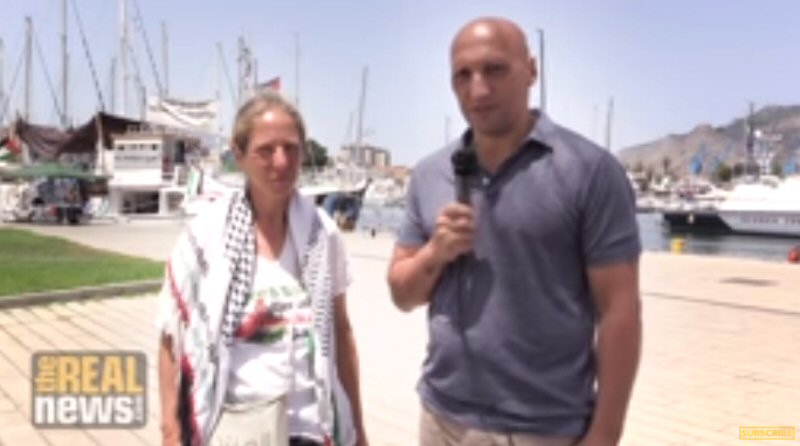
Zohar Regev Chamberlain says the injustice she witnessed as a child, in Israel, moved her to defend Palestinian human rights.
Dimitri Lascaris is a lawyer, journalist, and activist. After working in the New York and Paris offices of a major Wall Street law firm, Dimitri became a class action lawyer in Canada. His practice focused on shareholder rights, environmental wrongs, and human rights. In 2012, Canadian Lawyer Magazine named him one of the 25 most influential lawyers in Canada, and in 2013, Canadian Business Magazine named him one of the 50 most influential persons in Canadian business. Dimitri ran as a Green Party candidate in Canada’s 2015 federal election and has served as the Justice Critic in the Green Party of Canada’s shadow cabinet.
TRNN video & transcript:
DIMITRI LASCARIS: This is Dimitri Lascaris, reporting for The Real News Network from Palermo, Sicily.
I’m here today with Zohar Regev Chamberlain. She’s an Israeli national and she is the representative for the Spanish campaign for the Freedom Flotilla. Thank you very much for joining us today.
ZOHAR REGEV CHAMBERLAIN: Thank you.
DIMITRI LASCARIS: So I understand you, you were born and raised in a kibbutz. And I’m curious to know about your evolution from, you know, a child growing up on the kibbutz to what you are today, which is a human rights activist for the Palestinian cause. Could you sort of explain that?
ZOHAR REGEV CHAMBERLAIN: Okay. The evolution is, you know, part of me growing up. And I can say that as a child, already I’ve encountered injustice in the treatment of Israelis towards Palestinians. And one of the incidents I remember is my own kibbutz being, very much pushing for a Palestinian family’s house to be demolished quite close to us, and my parents helping those people by bringing them a tent, and you know, just showing solidarity with them, and how my peers on the kibbutz reacted to that. So saying, like, why are you helping these people? They’re, you know, sort of like, coming in towards us. And you know, they are human beings that we’re building on their land. They don’t have a house. There were children my age, and I just felt, you know, this wasn’t right.
So this was, you know, part of my family history, always being a part of the demonstrations against the settlements. I remember in ’82, 1982 after the Sabra and Shatila massacre, part of that demonstration asking, you know, demanding that there will be an investigation, and a lot of similar actions they have participated in. So my family’s always been, like, a dissident family. And it wasn’t accepted, it was a little bit nonconformist. And for me it was natural to grow from that. And as the situation gets worse, become more of an activist, try to do something more.
DIMITRI LASCARIS: And ultimately you emigrated to Spain, where your feelings about the Palestinian cause and the way that Palestinian people were being treated, part of your motivation for leaving the country.
ZOHAR REGEV CHAMBERLAIN: Yes. I left in 2004. And this was after or during the Second Intifada, depending on how you look at it. But you know, I could see that Israelis were sort of, like, claiming their right to go to a cafe while the Palestinians were maybe using violence. But they were just resisting, you know, occupation that’s been going on for too long. And the frustration after the Oslo Accords never actually, were never implemented.
And the feeling that I had was that if you stay in that situation as an Israeli citizen, with all the privileges that a Jew in Israel has, you’re collaborating. You pay taxes, but you also just accept living normally in a situation that shouldn’t be accepted by anyone. So by moving away, I was just trying to keep my own sanity, keep the sensitivity towards the suffering. But actually, it’s, of course I feel as a human being that, you know, this injustice inflicted on the Palestinians is a problem. But as part of, you know, the group that’s oppressing them I feel a double obligation to do something about it, or to, you know, to try out.
I was raised with the, you know, history of the Holocaust, and saying how could the world be silent when we were, you know, being taken to the gas chambers. And I say, you know, you don’t have to go to the gas chambers. It’s enough when you dehumanize somebody that ultimately you’ll get there. So you need to cry out way before. And now when people criticize Israel they’re being blamed, being anti-Semites, or whatever. I just feel that it’s totally hypocritical against the way I was brought up.
DIMITRI LASCARIS: What’s your assessment of the state of the Zionist project, and your prediction, acknowledging it’s very difficult to predict the sorts of things, about the future of the Zionist project?
ZOHAR REGEV CHAMBERLAIN: I think, first of all, the work we do here as the Freedom Flotilla, direct action to try to challenge the blockade, is all about human rights. But I think the fact that Zionism has neglected to respect the human rights of the indigenous people, you, know, the original residents of Palestine, makes it impossible to create a safe place for Jews, which was the original reason for Zionism. So I think it’s doomed to fail, and I just hope that it wouldn’t cause too much suffering before it ends.
DIMITRI LASCARIS: Lastly, I’d like to talk to you about the country you currently reside in. Spain seems to be, in many ways, on the forefront of the battle for Palestinian rights within the European Union. A number of communities, I believe you’re from Cadiz, and Cadiz is an example of a community that has taken a strong stand in defense of Palestinian rights. I believe it may have actually expressed some support for sanctions, the boycott movement. Valencia, a very large city in Spain, has declared itself an apartheid-free zone, Barcelona. And other cities, of course.
So on a local level there appears to be very strong support, and burgeoning support for the Palestinian cause in Spain. However, the national government doesn’t seem to be particularly interested in taking concrete measures to protect the rights of the Palestinian people. How do you explain that disparity between the grassroots support and the policies of the national government?
ZOHAR REGEV CHAMBERLAIN: I don’t think Spain is so much different to other countries in this respect. I think Western democracies don’t really listen to their people. I think people in Spain generally support the Palestinian cause, or at least traditionally supported. I think with time Israeli propaganda has filtered. And it’s true that we have a big network of local government and civil society groups that support human rights, defend human rights through the BDS movement. And there’s a whole network of Israeli apartheid-free zones in Spain.
But it’s still to be seen whether they’ll be able to put pressure on the central government to actually sanction Israel, because Israel is not held accountable. If they don’t feel the consequences of their policies. I don’t think there will be an end to it. And I think it needs to come from international pressure. I don’t believe that Israeli society itself can bring this change from within.
DIMITRI LASCARIS: I’d like to thank you very much, Zohar, for joining us today.
ZOHAR REGEV CHAMBERLAIN: Thank you.
DIMITRI LASCARIS: And this is Dimitri Lascaris, reporting for The Real News from Palermo, Sicily.
Interview 07/11/18 Dr. Basem Naim: Israel Shuts Vital Crossing, But Gazans Will Not ‘Die in Silence’
=
==
ZOHAR REGEV CHAMBERLAIN에 대해 그녀의 동기를 설명하는 인물 소개를 써주세요.
세진님, 공유해 주신 인터뷰 자료를 바탕으로 이스라엘 출신의 인권 활동가 조하르 레게브 체임벌린(Zohar Regev Chamberlain)의 인물 소개와 그녀의 활동 동기를 정리해 보았습니다.
인물 소개: 조하르 레게브 체임벌린 (Zohar Regev Chamberlain)
조하르 레게브 체임벌린은 이스라엘 태생의 국적자이자, 가자 지구 봉쇄에 맞서는 <자유 플로틸라(Freedom Flotilla)> 스페인 캠페인의 대표로 활동하고 있는 인권 활동가이다. 이스라엘의 집단 공동체인 키부츠에서 태어나 자랐으나, 현재는 스페인 카디스에 거주하며 팔레스타인의 인권 보장과 연대를 위한 국제적인 활동을 이어가고 있다.
주요 활동 동기 및 배경
유년 시절에 목격한 불의와 불복종의 가치 키부츠에서 자라던 어린 시절, 이스라엘 사회가 팔레스타인 주민들에게 가하는 불의를 직접 목격했다. 특히 인근 팔레스타인 가정의 가옥이 철거될 위기에 처했을 때, 그녀의 부모는 텐트를 제공하며 연대의 뜻을 보였다. 이러한 부모의 행동과 이에 반발하는 주변 동료들의 모습을 보며 사회적 모순을 인식하기 시작했다. 정착촌 반대 시위나 1982년 사브라·샤틸라 학살 조사 촉구 시위 등에 참여해 온 비순응주의적 격외(Dissident) 가정환경은 그녀가 자연스럽게 활동가로 성장하는 자양분이 되었다.
이스라엘 시민으로서의 특권과 연대적 책임감 제2차 인티파다가 진행 중이던 2004년, 그녀는 이스라엘을 떠나 스페인으로 이주했다. 이스라엘 사회가 유대인 시민에게 부여하는 모든 정상적인 삶과 특권을 누리는 것 자체가 팔레스타인 억압 체제에 협조(Collaboration)하는 행위라는 문제의식을 느꼈기 때문이다. 억압하는 집단의 일원으로서 가해지는 불의에 대해 더 큰 책임을 느껴야 한다는 <이중의 의무감>이 그녀를 행동하게 만드는 강한 동력이다.
홀로코스트 역사에 대한 올바른 계승 그녀는 유년 시절 홀로코스트 역사를 교육받으며 '유대인이 가스실로 끌려갈 때 세계는 왜 침묵했는가'라는 질문을 품고 자랐다. 그녀는 타자를 인간 이하로 취급하는 비인간화(Dehumanization)가 시작될 때 이미 비극은 예견된 것이며, 따라서 최종 파국에 이르기 훨씬 전부터 목소리를 높여 외쳐야 한다고 믿는다. 이스라엘의 정책을 비판하는 것을 반유대주의로 몰아세우는 주류 사회의 태도를 위선으로 규정하며, 홀로코스트의 진정한 교훈은 침묵하지 않는 것임을 강조한다.
시오니즘 프로젝트의 본질적 한계와 국제적 압력의 필요성 원주민인 팔레스타인 인권을 배제한 시오니즘 프로젝트는 유대인에게 안전한 공간을 제공한다는 원래의 목적을 달성할 수 없으며, 결국 실패할 운명이라고 진단한다. 또한, 이스라엘 사회 내부의 자발적인 변화 가능성을 낮게 평가하기 때문에, <자유 플로틸라>나 BDS(보이콧·투자철회·제재) 운동과 같은 외부의 국제적 압력과 제재를 통해서만 이스라엘의 정책 변화와 책임 추궁이 가능하다고 믿는다.
===
Zohar Regev Chamberlain은 이스라엘에서 태어나 키부츠(kibbutz) 공동체 안에서 성장했지만, 점차 팔레스타인 인권운동가로 변해간 인물이다. 그녀의 삶의 동기를 이해하려면, 단순히 “친팔레스타인 활동가”라는 정치적 정체성만이 아니라, 그녀가 경험한 <도덕적 불일치>와 <역사적 기억의 역전>을 함께 봐야 한다.
그녀는 자신이 어린 시절부터 이미 이스라엘 사회 안의 불의를 목격했다고 말한다. 특히 기억에 남는 사건은, 자신의 키부츠가 가까운 팔레스타인 가족의 집 철거를 추진했을 때였다. 그녀의 부모는 그 가족을 돕기 위해 텐트를 가져다주고 연대했지만, 주변 사람들은 “왜 저 사람들을 돕느냐”고 반응했다. 어린 그녀는 그때 이미 다음과 같은 감각을 갖게 되었다고 말한다:
→ <“우리가 그들의 땅 위에 살고 있는데, 저 아이들은 집이 없다. 이것은 옳지 않다.”>
이 경험은 그녀에게 중요한 윤리적 출발점이 되었다. 즉, 그녀의 동기는 외부 이념에서 온 것이 아니라, 오히려 이스라엘 내부에서 성장하며 체험한 모순에서 형성되었다.
또한 그녀의 가족은 이스라엘 사회 안에서 비교적 “비순응적(dissident)” 전통을 가진 집안이었다. 그녀는 부모가 정착촌 반대 시위에 참여했고, 1982년 사브라-샤틸라 학살 이후 진상조사를 요구하는 시위에도 나갔다고 회고한다. 그녀에게 팔레스타인 연대는 갑작스러운 급진화가 아니라, 이미 가족 문화 안에 존재하던 윤리적 감수성의 연장이었다.
그녀의 동기를 더 깊이 이해하게 해주는 부분은, 그녀가 홀로코스트 기억과 현재 팔레스타인 현실을 연결하는 방식이다. 그녀는 이렇게 말한다:
→ 유대인들은 “세계가 왜 침묵했는가”를 배우며 자랐는데, 지금 이스라엘이 팔레스타인인들을 비인간화하는 상황 앞에서 침묵하는 것은 자신이 배운 역사교육과 완전히 모순된다고 느낀다.
이 점이 핵심이다. 그녀는 유대인 정체성을 버린 것이 아니라, 오히려 유대인 역사 기억을 보편적 윤리로 적용하려 했다고 볼 수 있다. 그녀에게 “다시는 이런 일이 반복되어서는 안 된다(Never Again)”는 말은 유대인에게만 적용되는 슬로건이 아니라, 모든 인간에게 적용되어야 하는 윤리 원칙이었다.
2004년 그녀는 스페인으로 이주한다. 그 이유 역시 단순한 개인적 선택이 아니었다. 그녀는 이스라엘 시민으로 계속 살아가는 것이, 점령 구조에 “협력(collaborating)”하는 일처럼 느껴졌다고 말한다. 세금을 내고, 일상을 유지하며, 점령 상태를 정상적인 것으로 받아들이는 삶 자체가 자신의 윤리 감각을 마비시킨다고 느꼈다는 것이다. 그녀는 스스로를 “억압하는 집단에 속한 사람”이라고 인식했고, 그렇기 때문에 오히려 더 큰 책임감을 느꼈다고 말한다.
그녀의 Freedom Flotilla(가자 봉쇄 돌파 선단) 참여 역시 이런 맥락에서 이해할 수 있다. 그녀는 단순한 정치 캠페인이 아니라, <인간의 고통에 대한 직접적 응답>으로 이 행동을 보았다. 그녀는 시온주의가 팔레스타인 원주민의 권리를 존중하지 않았기 때문에, 결국 유대인에게도 안전한 미래를 제공할 수 없다고 비판한다.
흥미로운 점은 그녀가 단순히 “이스라엘을 미워하는 사람”의 언어를 사용하지 않는다는 것이다. 오히려 그녀의 언어는 죄책감, 윤리적 책임감, 역사적 자기반성에 가깝다. 그녀는 이스라엘 사회 전체가 변화하기는 어렵다고 보면서도, 국제적 압력과 시민사회 연대를 통해 변화를 만들 수 있다고 믿는다.
전체적으로 보면, Zohar Regev Chamberlain의 동기는 세 가지 층위에서 이해할 수 있다.
-
<어린 시절의 직접 경험>
팔레스타인 가족의 집 철거와 그에 대한 부모의 연대를 보며 형성된 정의감. -
<유대인 역사 기억의 윤리적 확장>
홀로코스트 기억을 특정 민족의 기억이 아니라 보편적 인간윤리로 해석하려는 태도. -
<가해 구조 내부자의 책임 의식>
“억압받는 사람”이 아니라 “억압하는 집단에 속한 사람”으로서 느끼는 책임감.
이 때문에 그녀는 단순한 활동가라기보다, <이스라엘 사회 내부의 양심적 반대자> 혹은 <기억의 역설 속에서 살아가는 디아스포라적 유대인 지식인형 활동가>에 더 가깝다고 볼 수 있다.
===
===


No comments:
Post a Comment