2001
Kindle$16.57
Available instantly
Hardcover $61.45
Paperback $27.00
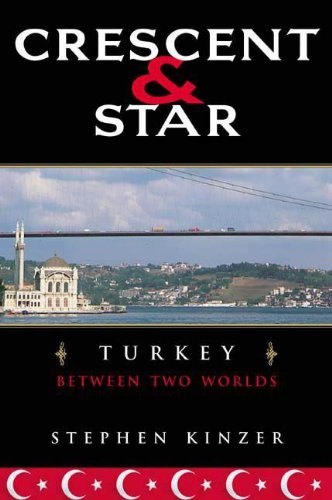
Crescent and Star: Turkey Between Two Worlds 2nd Edition, Kindle Edition
by Stephen Kinzer (Author) Format: Kindle Edition
4.5 4.5 out of 5 stars (146)
"A sharp, spirited appreciation of where Turkey stands now, and where it may head." —Carlin Romano, The Philadelphia Inquirer
In the first edition of this widely praised book, Stephen Kinzer made the convincing claim that Turkey was the country to watch -- poised between Europe and Asia, between the glories of its Ottoman past and its hopes for a democratic future, between the dominance of its army and the needs of its civilian citizens, between its secular expectations and its Muslim traditions.
In this newly revised edition of Crescent and Star, he adds much important new information on the many exciting transformations in Turkey's government and politics that have kept it in the headlines, and also shows how recent developments in both American and European policies (and not only the war in Iraq) have affected this unique and perplexing nation.
==
Review
"An unusually candid account of the state of Turkish politics . . . [Kinzer] is lyrical, even romantic, about the potential of a forceful, creative and (mostly) free people to realize their own implied glorious future." --Ira M. Lapidus, The New York Times
"Turkey matters greatly to us, given its crucial role both in Europe and in the Middle East, and this vivid book, both personal and analytical, is the best recent work on the subject." --Richard D. Holbrooke
About the Author
Stephen Kinzer was Istanbul bureau chief for The New York Times from 1996 to 2000. He is the author of many books, including All the Shah's Men and Overthrow. He lives in Chicago.
Product details
ASIN : B004OA64CK
Publisher : Farrar, Straus and Giroux
Accessibility : Learn more
Publication date : 22 September 2001
Edition : 2nd
Language : English
File size : 604 KB
Screen Reader : Supported
Enhanced typesetting : Enabled
X-Ray : Not Enabled
Word Wise : Enabled
Print length : 288 pages
ISBN-13 : 978-1429979399
Page Flip : Enabled
Best Sellers Rank: 510,326 in Kindle Store (See Top 100 in Kindle Store)86 in History of Turkey & the Ottoman empire
169 in Middle Eastern History Textbooks
241 in Islamic Social Studies
Customer Reviews:
4.5 4.5 out of 5 stars (146)

TopAbout this itemSimilarFrom the AuthorQuestionsReviews
 Crescent and Star: Turkey Between Two Worlds
About the author
Follow authors to get new release updates, plus improved recommendations.
Follow
Stephen Kinzer
Stephen Kinzer is an award-winning foreign correspondent who has covered more than 50 countries on five continents. His articles and books have led the Washington Post to place him “among the best in popular foreign policy storytelling.”
Kinzer spent more than 20 years working for the New York Times, most of it as a foreign correspondent. His foreign postings placed him at the center of historic events and, at times, in the line of fire. While covering world events, he has been shot at, jailed, beaten by police, tear-gassed and bombed from the air.
Today Kinzer is a senior fellow at the Watson Institute for International and Public Affairs at Brown University. He writes a world affairs column for The Boston Globe.
Kinzer’s new book, The True Flag: Theodore Roosevelt, Mark Twain and the Birth of American Empire, builds on his career watching the effects of American interventions around the world.
From 1983 to 1989, Kinzer was the Times bureau chief in Nicaragua. In that post he covered war and upheaval in Central America. He also wrote two books about the region. One of them, co-authored with Stephen Schlesinger, is Bitter Fruit: The Untold Story of the American Coup in Guatemala.” The other one, Blood of Brothers: Life and War in Nicaragua, is a social and political portrait that The New Yorker called “impressive for the refinement of its writing and also the breadth of its subject matter.” In 1988 Columbia University awarded Kinzer its Maria Moors Cabot prize for outstanding coverage of Latin America.
From 1990 to 1996 Kinzer was posted in Germany. From his post as chief of the New York Times bureau in Berlin, he covered the emergence of post-Communist Europe, including wars in the former Yugoslavia.
In 1996 Kinzer was named chief of the newly opened New York Times bureau in Istanbul, Turkey. He spent four years there, traveling widely in Turkey and in the new nations of Central Asia and the Caucasus. After completing this assignment, Kinzer published Crescent and Star: Turkey Between Two Worlds.
He has also worked in Africa, and written A Thousand Hills: Rwanda’s Rebirth and the Man Who Dreamed It. Archbishop Desmond Tutu of South Africa called this book “a fascinating account of a near-miracle unfolding before our very eyes.”
Kinzer’s last book was The Brothers: John Foster Dulles, Allen Dulles, and Their Secret World War. The novelist John le Carré called it “a secret history, enriched and calmly retold; a shocking account of the misuse of American corporate, political and media power; a shaming reflection on the moral manners of post imperial Europe; and an essential allegory for our own times.”
Kinzer’s previous book was Reset: Iran, Turkey, and America’s Future “Stephen Kinzer is a journalist of a certain cheeky fearlessness and exquisite timing,” the Huffington Post said in its review. “This book is a bold exercise in reimagining the United States’ big links in the Middle East.”
In 2006 Kinzer published Overthrow: America’s Century of Regime Change from Hawaii to Iraq. It recounts the 14 times the United States has overthrown foreign governments. Kinzer seeks to explain why these interventions were carried out and what their long-term effects have been. He is also the author of All the Shah’s Men: An American Coup and the Roots of Middle East Terror.” It tells how the CIA overthrew Iran’s nationalist government in 1953.
In 2009, Dominican University in River Forest, Illinois, awarded Kinzer an honorary doctorate. The citation said that “those of us who have had the pleasure of hearing his lectures or talking to him informally will probably never see the world in the same way again.”
The University of Scranton awarded Kinzer an honorary doctorate in 2010. “Where there has been turmoil in the world and history has shifted, Stephen Kinzer has been there,” the citation said. “Neither bullets, bombs nor beating could dull his sharp determination to bring injustice and strife to light.”
Customer reviews
4.5 out of 5 stars
===
Andreas Baer
5.0 out of 5 stars Superanalysis of modern Turkey
Reviewed in Germany on 7 August 2005
Verified Purchase
This book will delight anyone looking for a profound analysis of modern Turkey. The author is an American journalist and came to Istanbul as a correspondent. He spent a few years there, forming a picture of Turkey. In principle, Kinzer sees a deficit in real democracy and the rule of law because military and bureaucrats on the one hand, and politicians and influential circles are not interested in the country's real opening up to democracy.
However, Kinzer believes that Turkey could become a model state for democracy, human rights and modern Islam. He even sees the country on a good way there. Nevertheless, Turkey is not getting out of the grip of social power groups and is struggling, so to speak, with the modernization that Kemal Atatürk once enforced and set on its way.
His view that radical democratization and the rule of law would be sufficient for a long-lasting modernization boost is certainly to be criticized. Around 30 percent of Turks live below the official poverty line and more and more social groups no longer have equal access to education and social advancement. Muslim groups are striving for social Islamization and softening the country's west orientation. Prime Minister Erdogan was even an Islamist himself and had to serve a prison sentence for it. Well, I don't share Stephen Kinzer's opinion. But I would say that this book inspires and consistently analyzes the problems and strengths of modern Turkey and earned every single star with it.
Read less
Report
Translated from German by Amazon
See original ·Report translation
Sara
5.0 out of 5 stars Excellent and Entertaining OverviewReviewed in the United States on 25 June 2011
Format: PaperbackVerified Purchase
Stephen Kinzer is one of the most perceptive Western journalists around when it comes to 20th- and 21st-century history and politics in Turkey and Iran. There is so much misunderstanding of these two countries and their peoples in the West that Kinzer's books should be required reading in college classes. This book focuses on Turkey, the good and the bad, from the early 20th century until almost the present (with some quick looks back at Turkey's fascinating 4000+ years of ancient history). And it shows both sides of many events in Turkey's past. It also shows why Turkey is becoming more and more a country that the US should better understand and more closely align with. Moreover, like Kinzer's other books, this one is based on excellent research and much personal observation, and it'well written and entertaining as well. Recommended for any one who wants a better understanding of the world and of this endlessly intriguing country.
Report
Amazon Customer
5.0 out of 5 stars Interesting and informative bookReviewed in Canada on 17 May 2014
Format: KindleVerified Purchase
Both my husband and I found this book interesting and informative. We didn't know much about Turkey before our recent (and wonderful) trip there.
Report
Marilyn Mortimore
5.0 out of 5 stars GreatReviewed in the United Kingdom on 24 January 2018
Format: PaperbackVerified Purchase
Another very interesting book by this author. Great read
Report
Pukka Sahib
3.0 out of 5 stars read, but read with careReviewed in the United Kingdom on 30 November 2005
Format: HardcoverVerified Purchase
The author explores several issues of contemporary Turkish history - Atatürk's reforms, the Armenian genocide, the Kurdish question, the role of the military, etc. He writes in a highly readable and informative style. But it is good to keep in mind that he is not a historian, but rather a journalist. That is reflected in the fact that there are some inaccuracies about his references to older history. But its most obvious consequence is that the book is not at all nuanced in its description of what is happening and what according to the author "ought" to happen in Turkey. The author has his own clear opinions on what is right and wrong for Turkey and the Turks and he never hides these. I would say: The book is definitely a good and informative read, but you should keep a critical spirit while reading it.
Report
See more reviews
===
Verified Purchase
This book will delight anyone looking for a profound analysis of modern Turkey. The author is an American journalist and came to Istanbul as a correspondent. He spent a few years there, forming a picture of Turkey. In principle, Kinzer sees a deficit in real democracy and the rule of law because military and bureaucrats on the one hand, and politicians and influential circles are not interested in the country's real opening up to democracy.
However, Kinzer believes that Turkey could become a model state for democracy, human rights and modern Islam. He even sees the country on a good way there. Nevertheless, Turkey is not getting out of the grip of social power groups and is struggling, so to speak, with the modernization that Kemal Atatürk once enforced and set on its way.
His view that radical democratization and the rule of law would be sufficient for a long-lasting modernization boost is certainly to be criticized. Around 30 percent of Turks live below the official poverty line and more and more social groups no longer have equal access to education and social advancement. Muslim groups are striving for social Islamization and softening the country's west orientation. Prime Minister Erdogan was even an Islamist himself and had to serve a prison sentence for it. Well, I don't share Stephen Kinzer's opinion. But I would say that this book inspires and consistently analyzes the problems and strengths of modern Turkey and earned every single star with it.
Read less
Report
Translated from German by Amazon
See original ·Report translation
Sara
5.0 out of 5 stars Excellent and Entertaining OverviewReviewed in the United States on 25 June 2011
Format: PaperbackVerified Purchase
Stephen Kinzer is one of the most perceptive Western journalists around when it comes to 20th- and 21st-century history and politics in Turkey and Iran. There is so much misunderstanding of these two countries and their peoples in the West that Kinzer's books should be required reading in college classes. This book focuses on Turkey, the good and the bad, from the early 20th century until almost the present (with some quick looks back at Turkey's fascinating 4000+ years of ancient history). And it shows both sides of many events in Turkey's past. It also shows why Turkey is becoming more and more a country that the US should better understand and more closely align with. Moreover, like Kinzer's other books, this one is based on excellent research and much personal observation, and it'well written and entertaining as well. Recommended for any one who wants a better understanding of the world and of this endlessly intriguing country.
Report
Amazon Customer
5.0 out of 5 stars Interesting and informative bookReviewed in Canada on 17 May 2014
Format: KindleVerified Purchase
Both my husband and I found this book interesting and informative. We didn't know much about Turkey before our recent (and wonderful) trip there.
Report
Marilyn Mortimore
5.0 out of 5 stars GreatReviewed in the United Kingdom on 24 January 2018
Format: PaperbackVerified Purchase
Another very interesting book by this author. Great read
Report
Pukka Sahib
3.0 out of 5 stars read, but read with careReviewed in the United Kingdom on 30 November 2005
Format: HardcoverVerified Purchase
The author explores several issues of contemporary Turkish history - Atatürk's reforms, the Armenian genocide, the Kurdish question, the role of the military, etc. He writes in a highly readable and informative style. But it is good to keep in mind that he is not a historian, but rather a journalist. That is reflected in the fact that there are some inaccuracies about his references to older history. But its most obvious consequence is that the book is not at all nuanced in its description of what is happening and what according to the author "ought" to happen in Turkey. The author has his own clear opinions on what is right and wrong for Turkey and the Turks and he never hides these. I would say: The book is definitely a good and informative read, but you should keep a critical spirit while reading it.
Report
See more reviews
Report
Robert W. Hermanson
4.0 out of 5 stars Good (if somewhat slanted) Guide to Modern Turkish Politics
Reviewed in the United States on 26 August 2014
Format: KindleVerified Purchase
As Turkey seems to veer ever closer to becoming an Islamist state with a strongman in charge, I wonder if author Stephen Kinzer would wish to revisit his thesis in this 2001 book, revised 2008, that Recep Tayyip Erdogan's accession to power over the past dozen or fifteen years represents a long-delayed flowering of democracy in a moribund oligarchy. Kinzer's book accurately portrays the current tensions in Turkey between Kemalists and Erdoganists (for lack of a better word for the AKP and its supporters), but I often found his descriptions of the former veering toward caricature and the latter tending toward hagiography. (You can't get far into the book without knowing where Kinzer's sympathies lie.) The truth is that both points of view have some validity, and there are conscientious voices on both sides. Kinzer's book is an accessible general guide to modern Turkey's problems (albeit with only six years since its revision it seems a bit dated, especially given Erdogan's recent election to the Presidency), and gives enough history and perspective that the general reader can better appreciate what he reads in the newspapers. The book also has many charming and illuminating anecdotes from Kinzer's many years of exploring Turkey - and those made me envious, as I have greatly enjoyed my two brief visits to Turkey, and have always wished I could spend more time there.
5 people found this helpful
Report
RL
5.0 out of 5 stars Opinionated but provocative
Reviewed in the United States on 12 August 2009
Format: PaperbackVerified Purchase
I can certainly understand how some of the reviewers of this book felt it was too opinionated and preachy. After living in Turkey for the past year and a half it is a society in which its citizenry is strongly opinionated on the issues of Kemalist, Islam, democracy, entrance into the EU, etc. So, I found this book, actually a series of essays on the main topics affecting Turkey today, to be not only an accurate assessment but I found the writer's opinions to be thought provoking and insightful. I admire the fact that he speaks Turkish, has traveled and lived in this wonderfully complex country for what appears to be a long period of time.
You may not agree with what he writes and this may offend those whose political sensitivities are a bit touchy. But he provides a coherent and concise overview of the main issues Turkey faces today.
If there is one problem with this book, and it's not the author's fault, is that it is beginning to feel a bit dated. He does not cover the rise of the AK party and the current tension between the Kemalists and the Islamists. But he does touch on these issues in a more general way.
Both this book and Mango's book on Turkey are excellent overviews of contemporary Turkey. I highly recommend you read either, or both, of these books before your trip to this fascinating country that is caught between the East and West.
6 people found this helpful
Report
Howard Schulman
5.0 out of 5 stars Excellent background book to modern Turkey with some reservations (see review)
Reviewed in the United States on 4 July 2010
Format: PaperbackVerified Purchase
Before saying anything else, you should know that this is an excellent book: five stars. It's not a typical politics book, but more of an ex-New York Times Istanbul Bureau Chief's personal quest to come to terms with modern day Turkey. There are about ten chapters with short "meze" observations in between each chapter. ("meze" is the Turkish term for "appetizer") Each chapter covers a topic, such as the Kurdish problem, the military, religion, Armenians, the foundation of modern Turkey, etc.
Unfortunately, and I have a hard time saying this because I don't want to give the impression that the book is anything but excellent, but from the very beginning I suspected that Kinzer's book was overly biased in favor of the current Erdogan administration, perhaps because of the author's love of the Turkish people and country, perhaps because of his subconscious desire to maintain journalistic access to Turkish leaders. I frequently found myself wondering what he was not telling the reader. Kinzer clearly makes the case that Erdogan has been good for Turkey, but many have also had serious reservations.
The book is extremely engaging and well written. The author's own observations based on interviewing and following the key figures in Turkish politics are on target, spot-on. I started reading this book while on vacation in Turkey and frequently found the book explaining to the core things I had observed.
Only in the very last chapter did Kinzer addresses the concerning Islamic leanings of the Erdogan administration. These concerns are now more important in light of the Gaza flotilla and Erdogan's repudiation of the Israeli Prime Minister at a big international meeting. These events happened after Kinzer updated his book (originally written 2001, substantially revised and updated 2008), but were clearly on the minds of everyone involved when the book was written.
7 people found this helpful
Report
David A. Baer
4.0 out of 5 stars disturbingly beautiful
Reviewed in the United States on 12 September 2016
Format: PaperbackVerified Purchase
Stephen Kinzer’s rambling walk through the saga of modern Turkey will delight the ordinary reader with an interest in this ‘bridge nation’, while occasionally distressing the historian.
The dedication of this revised version (‘To the People of Turkey’) signals that Kinzer writes 51aed7hll-_sx331_bo1204203200_from the heart and with affection rather than from the discipline and precision one expects of the historian. This is not a criticism of Kinzer’s formidable work but rather an attempt to define its genre. Those who came to Kinzer’s writing—as this reviewer did—through his superb treatment of the Nicaraguan conflicts (The Blood of Brothers) will anticipate the bent of Kinzer’s method.
Kinzer, the erstwhile Istanbul Bureau Chief of the New York Times, does not hold back his own views and even prescriptions for the nation that has become his subject. The book’s earliest pages telegraph this. Published in 2008, the book’s introduction observes that ‘(A) new regime has emerged in Turkey that is likely to govern for years to come. This is good, because this regime draws its strength from the people’s will, but it is also disturbing.’ The first chapter’s opening line introduces us to a personal preference: ‘My favorite word in Turkish is istiklal.’
This is not a bad thing, for Turkey and ‘the Turk’ have been referents of oddness and even incarnate evil for Westerners since Medieval times. A Western writer who can be forthrightly described as turkophile is well placed to be a sympathetic and even accurate guide into this unfamiliar people and its complicated composition. For Western observers—as for the Turks themselves—ambiguities abound: Is Turkey a Middle Eastern country? Or is it European? Is Turkey Muslim? Or secular? Is the nation comprised of a single ethnicity that represents turkishness? Or is Turkey a composite state with large and venerable minorities whose adherence to the national mythology is tenuous?
Kinzer’s introduction of many of Turkey’s hard-wired enigmas is often channeled through a conversation with one friend or another. This adds an appealing personal hook for the non-expert reader (a group to which this reviewer manifestly belongs). The author effectively personalizes issues that are difficult to grasp in the abstract.
One emerges from Crescent and Star impressed with several facets of Turkey’s challenges and opportunities that are not independently unique, but that—in combination—profile Turkey as an exceptional nation.
First, one senses that events of the 20th and 21st century have left Turkey a conflicted nation. The coming to terms with its past has been uneven, leaving the Turks deeply divided as to the answers to difficult questions and even to the degree to which those questions can be permitted consideration. For example, what exactly happened to the Armenians? What would Turkey’s heroic paterfamilias, Ataturk, think of Turkey’s governing Islamic party?
Second, Turkey oscillates between a xenophobia that was for generations practically prescribed and a longing to join and be respected among the community of nations. A deeply existential variation of this theme turns on the place in the world outside of Turkey’s boundaries in which the nation most naturally belongs. Is it the complex of Muslim nations in its neighborhood? Or is Turkey’s belonging place rather the frustrating and often humiliating European family?
Third, who are the appropriate custodians of Turkey’s identity and well-being? Is it the generals, who have stepped in ‘to restore order’ so often as to constitute in some minds a backstop against political and cultural experimentation gone wrong? Or is it the Turkish people more generally, their will channeled through democratic process? Or ought trust in the guidance of Islamic centers of guidance be the nation’s modus operandi, no matter how ‘undemocratic’ this option might turn out to be?
Fourth, what is to be expected of Turkey’s minorities, preeminently the Kurds? Can a stateless people whose population straddles multiple nations in the region be entrusted with the challenge of becoming one component of a Turkish state? Or is independence—and therefore separation from and rebellion against the Turkish state—an irremediable instinct that must be suppressed? And who gets to say? Kurds or non-Kurds? And if Kurds, which ones?
The mere partial enumeration of these questions shines a light on the appropriateness of the book’s subtitle: Turkey Between Two Worlds. The phrase is patient of more than one application.
Turkey emerges from Kinzer’s wide-ranging description as a country between. As I write this review eight years after the publication of Crescent and Star’s 2008 revision of a 2001 original, news of a failed coup and the suppression of dissent with which it has been met have barely faded from the front pages. A 2nd revision would doubtless add even further texture and color to the nation’s between-ness.
But Stephen Kinzer has moved on to other things, and it would would be too much to ask of him a life-long chronicling of Turkey’s wrestlings with its betweens.
What he has given us is an impressionistic portrait of a nation that can confuse, but can also be loved, a people that is in the midst of drafting its own future, a state that must decide the purpose toward which it governs, a place and a people of disturbing beauty.
6 people found this helpful
Report
Charles D.
5.0 out of 5 stars Excellent historical analysis
Reviewed in the United States on 16 October 2024
Format: KindleVerified Purchase
This book presents a mostly balanced description of Turkish politics and how history and politics affects everyday life in Turkey. Turkey represents a case study of an Islamic country that is trying to westernize and democraticize. The book helped me to understand Tukey's problems.
Report
her countries
trvlr
3.0 out of 5 stars Not History
Reviewed in the United States on 18 February 2013
Format: KindleVerified Purchase
The book is an easy read The book provides the authors perspective on Turkey. I would like to see more facts and less opinion. Did the author have an agenda?
One person found this helpful
Report
tony giffone
4.0 out of 5 stars a must read
Reviewed in the United States on 11 July 2013
Format: KindleVerified Purchase
I bought and read this book as I was planning a trip to Turkey. It turns out that the trip had to be delayed but I do not for a moment regret reading the book. Kinzer is one of the best writers currently working in contemporary affairs. The former NY Times correspondent in Turkey, he knows the region inside out. His analysis is always insightful and his prose always lucid. His book on Iran, "All the Shah's Men" is probably his best book and is must reading for understanding contemporary Middle-East politics. "Crescent and Star" is only slightly less so. There are more recent books on Turkey that "update" the situation, but Kinzer's book is a great starting place.
Report
Svetoslav Tassev
2.0 out of 5 stars this book is shallow
Reviewed in the United States on 19 November 2001
Format: HardcoverVerified Purchase
This book was a big disappointment. I hoped to learn more about Turkish society and get and insight into the events that led to the formation of modern Turkish nation. I didn't get it.
The chapters in this book remind me of extra long magazine editorials, in which Mr. Kinzer lectures the Turks how to run their nation. "The Turkish government should...." is the most common phrase in this book. Very little is said about the Turkish people, their culture, history, etc. Only a few paragraphs are devoted to Kemal Ataturk. Little is mentioned about Turkey's relations to its neighbors. A reader may get the impression that the country exists in vacuum, surrounded only by the fears and fobias of its politicians. This book is all about lecturing the Turkish government in what they should do and what they shouldn't do. The style of the author reminds me of the US government rhetoric towards Human Rights in China. For some reason many Americans believe that they know the answer to all the problems in the universe.
Not only Mr. Kinzer gives advices but he claims that he know where most Turks stand on particular issue. They, of course, tend to support his ideas. No evidence is given to confirm his convictions. According to Mr. Kinzer most Turks will always agree with him.
All the information in this 250-page book could have been compiled in 50 pages or less. The book is full of redundancy. The author keeps repeating his opinion on a particular topic over, and over, and over again. It is not enough to say just once what the Turkish government should do but it has to be repeated again and again in every single chapter.
Mr. Kinzer goes as far as to give his own opinion on the intellectual capacities of Turkish politicians. Prime ministers are described as 'unimaginative', 'lacking analytical power' and even as 'lacking intelligence' (p.73). How does he know? One conversation is not enough to determine the intellectual capacity of an individual.
The book lack objectivity but what is even worse, it lacks content. "Shallow" is the right word to describe it.
33 people found this helpful
Report
Barton Cramer
5.0 out of 5 stars Very apropos for current events
Reviewed in the United States on 30 June 2013
Format: PaperbackVerified Purchase
I bought this book as a prelude to a recent visit to Greece and Turkey, and found it to be spot on with respect to the "Between Two Worlds" subtitle. Turkey unexpectedly (to me) proved to be a thriving and bustling nation, with evident prosperity, but also a clear split between secular liberals and Moslem conservatives. Picture women in burkas or head scarves mixed in with (young) women in low-rise jeans and you get the idea. Our tour group hotel was moved from near the scene of the recent demonstrations to across the Bosphorus to the Asian side, as a modest precaution. But we saw plenty of (peaceful) demonstrators on both sides, chanting slogans and waving flags.
The discussion of modern Turkey's "father" Mustafa Kemal Attaturk in this book is very helpful in giving insight to the massive changes this society has undergone and why there is now backlash by conservatives on one side, and opponents to some of Erdogan's programs and methods on the other.
A well done analysis and a good read.
One person found this helpful
Report
Carola
5.0 out of 5 stars For anyone interested in present day Turkey
Reviewed in the United States on 28 November 2011
Format: PaperbackVerified Purchase
I really enjoyed Kinzer's book. It is an excellent history of Turkish politics from Turkey's founding to the present Erdogan government. Although I think I remember from other reviews a criticism that Kinzer shouldn't be telling another country what to do, in truth he is certainly reflecting what many Turks also think. Kinzer loves Turkey, that is clear, and believes in its future, but he also points out without pulling punches both the destructive problems coming out of the Attaturk one-man rule and the heavy hand of the military elite ( Turkey's inability to face the Armenian issue- a little progress there- and to deal with the Kurdish rebellion and its multi-ethnic identity) and the failures, as well as successes, of the Erdogan regime (laws still on the books curbing freedom of expression, rising nationalism, questions re Islam and women).
I particularly liked Kinzer's strategy of mixing in more personal chapters, dealing with subjects such as drinking raki, racing camels, the poet Nazim Hikmet, that bring Turkey alive.
One person found this helpful
Report
John Z-Man
5.0 out of 5 stars Great Read for Travel Preparation
Reviewed in the United States on 6 September 2012
Format: KindleVerified Purchase
This was the first book I read in preparation for an upcoming first trip to Turkey and for this purpose it is exceptional. Kinzer focuses on the period from the founding of the Republic by Kemal Ataturk in 1923 and quickly moves into the late 20th and early 21st century, describing the different political, cultural and historical forces that pull and tear Turkey, often in conflicting directions as the country maintains a march with fits and starts toward progressive democracy. Kinzer writes well as both a journalist and former resident of Turkey, ending each chapter with a well-chosen and well written personal anecdote that highlights the chapter's theme. I followed this book with Orhan Pamuk's Istanbul Memoir and find that the first informs the second very well. I recommend this book to anyone who wants to understand the context behind the news on events in Turkey and its important role in the world today.
Report
Julie
5.0 out of 5 stars Fascinating and essential reading
Reviewed in the United States on 19 April 2014
Format: KindleVerified Purchase
Kinzler provides a wonderful understanding of Turkey's issues today, with background and clarification to spell out the issues and pitfalls of
where it is today. I found it riveting -- which was a terrific surprise, given that I expected a more pedantic approach that would be a slog to read through. Instead, I actually couldn't wait to get back into its pages and read on. Will hope that Kinzler updates this to include more recent demonstrations and tightening of restrictions on freedom -- but he certainly set the stage by talking about the result of Turkey's rejection by the EU and its likely ramifications (which is exactly what's unfolding). This was on the reading lists of tour books and tour groups -- and I'd now add my agreement that it's a "must read" for those who want the background on Turkey today.
Report
Glenn D. Robinson
4.0 out of 5 stars Greatly impressed
Reviewed in the United States on 18 August 2012
Format: PaperbackVerified Purchase
When the writer is enthusaistic about the subject, I find it extremely fun to read. Mr. Kinzer certainly is passionate about Turkey, the cultures, the history and the politics. Well worth the time to read as I gained many new ideas for our trip we have planned. A very good book for the history of the Republic, and the geographic area around Istanbul. The writing is vivid, the subject well researched and the writer bings the readers with him as he travlled all over the country, including being held in jail overnight for interrogation as to what his reporting trip was really all about. Time well spent with this book.
Report
T. McRae
5.0 out of 5 stars Turkey between two worlds
Reviewed in the United States on 22 April 2009
Format: PaperbackVerified Purchase
Stephen Kinzer draws heavily on personal experiences and his solid cultural and historical understanding of Turkey to produce a fascinating, even spellbinding text on the country's ongoing dilemma, alternately attracted as it is by the West, then the East, secularism, then Islam, authoritarianism, then democracy. These forces of history and geography have sometimes buffeted, often blessed this in-between land, as it has swung in pendulum-like manner between the poles of its roots. One cannot help feel Kinzer's love for this almost second country of his as it seeks not to spin out of control in any one direction. The reader will surely sense the tastes, sights, and smells of the places Kinzer knows and portrays so vividly. This text cannot substitute for a visit to Turkey, but until I am able to make that voyage, Crescent & Star comes very close.
Report
Denica
5.0 out of 5 stars Tough love from a true friend...
Reviewed in the United States on 4 January 2003
Format: HardcoverVerified Purchase
Mr. Kinzer truly loves Turkey. His eyes are also wide open. The result is a wonderfully written, easy to read, sensitive book. But, don't be fooled by that. It is also one of the most perceptive books written about Turkishness. Some may dismiss it as simplistic, some may even be offended by its advice. Of course, some will continue to say "Turkey is different. We can't practice democracy like others" etc. But, Turks must heed his advice. It is powerful and it is right on the money. If you are interested in reading about the very recent historical and political events in Turkey while learning the larger Turkish history concisely (and effortlessly, I might add) this is a good book. Fun to read. Clearly written. Good introduction. Mr. Kinzer has a lot of love for Turkey but this doesn't cloud his clear observations. I hope the book is translated into Turkish soon without losing a chapter or two to appease certain powers. I highly recommend this book.
7 people found this helpful
Report
====
===


No comments:
Post a Comment