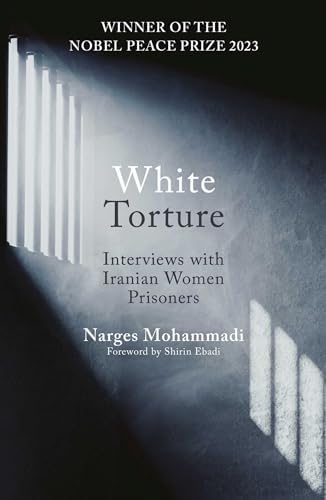
White Torture: Interviews with Iranian Women Prisoners - Winner of the Nobel Peace Prize 2023 : Mohammadi, Narges: Amazon.com.au: Books
Follow
==
Table of contents
Tine Page
CONTENTS
PREFACE
NARGES MOHAMMADI'S LETTER TO THE NORWEGIAN NOBEL COMMITTEE
FOREWORD
A NOTE ON NARGES MOHAMMADI
INTRODUCTION: IN SOLIDARITY
===
INTERVIEWS AND TESTIMONIES
NARGES MOHAMMADI
NIGARA AFSHARZADEH
ATENA DAEMI
ZAHRA ZAHTABCHI
NAZANIN ZAGHARI-RATCLIFFE
MAHVASH SHAHRIARI
HENGAMEH SHAHIDI
REYHANEН ТАВАТАВΑΙ
SIMA KIANI
FATEMEH MOHAMMADI
SEDIGHEH MORADI
NAZILA NOURI AND SHOKOUFEH YADOLLAHI
MARZIEH AMIRI
POSTSCRIPT: UPDATES ON THE WOMEN INTERVIEWED
==
NARGES MOHAMMADI'S LETTER TO THE NORWEGIAN NOBEL COMMITTEE
Dear Chair and members of the Nobel Committee,
I thank the Norwegian Nobel Committee for their clear and profound recognition of the power and impact of the people's protests in Iran's recent revolutionary and social uprisings.
In an attempt to denounce the award, the Islamic Republic's media broadcast the official announcement in the Women's Section of Evin Prison. As soon as Berit Reiss-Andersen, chair of the committee, began with the words 'Zan, Zendegi, Azadi' ('Woman, Life, Freedom'), I heard my cellmates' exultant cries echoing that powerful slogan. Their voices fused together, reverberating with the 'protesting power' of Iranians around the world.
The potent waves of this slogan, heard in two locations far from each other at the same significant historical mo-ment, spoke of the vast and formidable power of the people and their decisive role in today's global political climate.
The laudable decision of the committee to start the announcement by referring to Iran's revolutionary move-ment was a turning point in empowering all the social and protest movements around the world to become the key forces to bring about fundamental change in today's societies. Honouring a defender of human rights with this award gives all these movements special significance.
We in the Middle East, particularly those of us living in Iran and Afghanistan, do not learn about the importance of freedom, democracy and human rights from theories in textbooks, but through our personal experience of op-pression and discrimination. We have come to understand the importance of these concepts, and have risen up against their violators and adversaries, because from childhood, in our daily lives, we have faced oppression, open and subtle violence, harassment and discrimination by authoritarian governments.
When I was only nine years old, I heard my mother wailing, mourning the execution of her nephew, a young student. I heard my grandmother weeping at the torture of her son. Back then, I had no idea what 'execution' or 'tor-ture' meant. My childish illusions were ruthlessly torn apart.
No one heard the voices of the mothers seeking justice in the 1980s, a decade that saw widespread execution, torture, rape and assault in prisons. One of its main perpetrators was Ebrahim Raisi, the current president of the Islamic Republic. Despotism, hiding behind the mask of religion, imposed repression, domination, and widespread poverty and misery on Iran.
When I was nineteen, I was arrested for wearing an orange coat. In the detention centre with dozens of other women who had been arrested, I was shocked and utterly horrified to see whips in the hands of angry men in black who were viciously lashing four women, without any legal process.
Years later, in 2022, a young woman named Mahsa (Jina) Amini, who was wearing both a coat and headscarf, was arrested on the pretext of her inadequate hijab, and within hours lost her life while still in custody. Hundreds of protesters took to the streets and were blinded by bullets, hundreds more were killed, and six protesters were executed. A flood of arrests of women and protesters ensued, followed by torture, solitary confinement, assault and sexual harassment. Universities were attacked by thuggish security forces. Civic organizations and activists were in-creasingly suppressed, and even the families of those seeking justice for their loved ones were thrown into jail.
I declare that the reason for Islamic Republic's imposition of compulsory hijab is not its concern for religious rules, social customs and traditions or, as it claims, the safeguarding of women's reputations.
Instead, it openly aims to oppress and dominate women in this way as a means of dominating Iranian society as a whole. It has legalized and systematized this tyranny and the repression of women. The women of Iran will no longer accept this.
The compulsory hijab is an instrument of domination. It serves to prolong the reign of 'religious despotism'. For forty-five years this government has institutionalized poverty and deprivation in our country. This regime is based on lies, deception and intimidation, and with its destabilizing and warmongering policies, it has seriously threat-ened peace and calm in the region and in the world.
In today's Iran, women and youth make up the most radical, progressive and significant social force both fighting religious tyranny and seeking fundamental change to achieve a durable peace in Iran, the Middle East and the world. The world knows that this new revolutionary movement of 'Woman, Life, Freedom' is a continuation of the
ongoing political resistance in Iran, the struggle to re-establish normal life in society. The strength of this movement lies in the agency of Iranian women. We clearly know 'what we want' better than 'what we don't want'. We are com-mitted to it, we believe in it, and we are certain of our ultimate victory.
We, the people of Iran, demand democracy, freedom, human rights and equality. The Islamic Republic is the main obstacle for the realization of the collective will of the people. Our determination is unwavering. We are attempting to exercise solidarity and power in a non-violent and unstoppable process to transition away from a tyr-annical religious government, and restore glory and honour to Iran, making it worthy of its people.
Finally, speaking from Evin's Women's Section, surrounded by political prisoners and prisoners of conscience, including long-serving women prisoners with a variety of political and intellectual viewpoints, Bahá'ís in prison for their beliefs, environmental activists, public intellectuals, the passionate women protesters of the Mahsa/Jina move-ment, journalists and students, I send my most sincere greetings and gratitude to the Norwegian Nobel Committee, with a heart full of love, hope and passion.
I want to also extend my gratitude to the following: the global media; journalists who carry our voices out into the world; feminists of the world who consider women's rights to be a litmus test of democracy, peace and the qual-ity of life, and push the world to always change for the better; human rights bodies that are a sanctuary for human-ity; Amnesty International; civic communities; networks and organizations of social movements; 'the people', who are the ultimate authority; distinguished thinkers and politicians who consider human rights and peace a necessity for politics; artists who show the world a real picture of what's happening in Iran, Afghanistan and the Middle East; writers; PEN International; Nobel Peace laureates including Ms Shirin Ebadi; all my colleagues in Iranian NGOs; my cellmates over the long years in prison; the unnamed and unknown women who came onto the streets to protest, and in this way became the embodiment of resistance; the mothers seeking justice; my family, Kiana and Ali; and finally all those who congratulated me for this award. Thank you all. I ask you to support the people of Iran until our final victory.
Our victory will not be easy, but it is certain.
==
FOREWORD
White Torture is a collection of twelve interviews that the compassionate activist Narges Mohammadi conducted with women in her own agonizing situation. Since the 2009 presidential election, Narges has been repeatedly imprisoned for her activities as the vice president and spokesperson of the Defenders of Human Rights Center. This organization campaigns for the abolition of the death penalty.
She is now confined in Zanjan Prison, a confinement which is illegal even by the laws of the Islamic Republic. The reason for this imprisonment lies in her sympathy for the conditions endured by other prisoners. Many protesters had been killed in nationwide anti-government demonstrations in November 2019. Commemorating the fortieth day after their deaths and as an act of solidarity with their families, Narges intended to conduct a sit-down strike with other inmates. She had courageously informed the authorities and the public that this strike would be held in the office of the women's ward of Evin Prison in Tehran. On the third day, claiming that her lawyer was going to meet her, the head of the prison summoned Narges to his office. Gholmarza Ziaei, the head of the prison, verbally abused Narges and threatened her with death. She wordlessly turned away to head back to her cell. Ziaei slammed Narges into the wall and brutally beat her, bruising her body and smashing her hands through a glass door, causing them to bleed. Despite her injuries, the authorities immediately transferred Narges to Zanjan Prison. She filed a complaint in December 2019 against the head of the prison, which was deliberately ignored. Curiously enough, Ziaei filed a complaint against Narges for 'libel against the head of the prison' in retaliation.
Contrary to the law regulating criminal procedures and because of this complaint, an investigator came to the prison to question and talk to Narges. She asked him why they would not summon her to the Zanjan courthouse so that she could answer their questions like everyone else, including ordinary prisoners. 'You're not allowed to leave the prison under any circumstances,' he said. 'That's why we've come here to question you.'
'I will not answer your questions here either,' she replied, objecting to his illegal actions.
Two more cases against Narges are currently being investigated in addition to the existing convictions. The security officer in charge of Narges' case has told her multiple times that she would be immediately released if she ceased campaigning and resigned from the Defenders of Human Rights Center. Narges rejected the offer. An official from the Ministry of Intelligence threatened her, saying 'Then rest assured that you won't get out of prison alive.'
In Zanjan, Narges has not always been kept safe from her fellow prisoners. A while ago, some of these prisoners approached Narges at the instigation of prison guards, who'd promised them early leave and release if they dealt with her. Narges hid in the bathroom all night after one of the prisoners threatened to kill her. Fortunately, the government's plan failed and Narges, due to her good character and the legal aid she provided to the prison's homeless women, gradually became friends with other prisoners and got through this crisis.
Now Covid-19 has spread all over the world, including in Iran and especially in its prisons. One of Narges' cellmates was diagnosed with Covid-19 and was sent home. A few days later other cellmates, including Narges, began to display symptoms, but prison officials denied them the right to be tested. As their conditions worsened and their families put pressure on prison authorities, they were eventually tested. Nevertheless, the officials refused to inform Narges of her results.
Only four cellmates, who showed no signs of the disease, were released. Narges and eleven other inmates remain isolated in quarantine. Even though Narges is at greater risk, as she suffers from pulmonary embolism and muscular paralysis, prison officials do not allow her to see her own specialist. They claim that the prison's healthcare centre suffices. Yet everyone knows Iranian prisons' healthcare facilities are limited, particularly in Zanjan.
Narges has informed the authorities and the public about these unjust conditions. She even asked the health minister to come to the prison to see the inadequate healthcare for himself. Instead of meeting her demands, the chief of staff of the judiciary derided her as a liar and said that the information provided by her was not verified by the chief of Zanjan Prison.
No prison wall has been able to prevent the voice of Narges Mohammadi from reaching the people. When she found out in Evin Prison that women prisoners, unlike men, did not have the right to make telephone calls to their relatives and children, she called for a special campaign to 'support mothers in prison'. This campaign attracted the attention of Iranians around the world and forced the government to retreat. As a result, women were given the right to make calls. On this basis, Narges could talk to her two children (although only for twenty-four minutes a week) who live in exile in Paris with their father. Later, when the government took note of Narges' tenacity in protesting against injustice and supporting others, her right to make calls was removed. It is now about a year since she last heard the voices of her children. As she wrote in a letter, 'I do not know if my children will know me when I come out in the coming years. Will they recognize my voice? Will they call me mother again?'
Narges has now served more than seven years of her ten-year sentence and technically is eligible for parole, but she is deprived of the rights of an ordinary prisoner. They can buy meat, vegetables or fruit from the prison store, but she is forbidden. So, Narges has eaten only the daily rations for prisoners since her move to Zanjan Prison: potatoes, eggs and bread.
As you can see, despite the chains in which she has been placed, Narges still roars like a lioness. This is why the regime wants to crush her.
White Torture is another roar of this lioness. The central subject of these interviews is the use of solitary confinement in Iranian prisons, one of the most prominent examples of torture. Narges Mohammadi has always been the flag bearer of opposition to solitary confinement even before she was imprisoned. She has continued to resist solitary confinement while incarcerated.
To express her opposition, she has conducted interviews with a number of her inmates, namely the prisoners of conscience incarcerated alongside her.
When people recall their experiences after a few years have passed, parts of them are inevitably forgotten or merged with other memories. That is why these immediate records are so important.
These statements were made there and then, within the prison walls, and are a testament to the efforts to secure justice for prisoners of conscience in Iran.
This is the accomplishment of Narges Mohammadi who, despite every hardship, understands this need to bear witness and does not abandon her goals. It is excruciating to see a person imprisoned for their human rights activism, and watch them being deprived of all the legal rights that even the Islamic regime grants to ordinary prisoners, because they won't remain silent in the face of injustice. Our history won't let Narges and all these lionesses be consigned to the ether.
Shirin Ebadi July 2020
==
A NOTE ON NARGES MOHAMMADI
Narges Mohammadi is one of Iran's most dedicated representatives of civil and human rights; a leading anti-death penalty campaigner; a pre-eminent advocate of women's rights; the vice president of the National Council for Peace; and the vice president and spokeswoman for the Defenders of Human Rights Center (DHRC).
Narges has been one of the most courageous and outspoken prisoners of conscience in the Islamic Republic of Iran. Her persistent, non-violent resistance against what she calls 'tyranny' and her defiance of oppressive laws and policies for twenty-eight years now, inside and outside prison, has earned her respect nationally and internationally. After several arrests and many years of incarceration following each, her last arrest resulted in a sixteen-year sentence of imprison-ment, ten years of which she had to serve.
Narges suffers from neurological and pulmonary conditions, putting her at high risk of complications if infected with Covid-19. In July 2020, a group of United Nations human rights experts called for her release, citing reports that she was showing Covid-19 symptoms. 'For those with underlying health conditions, such as Ms. Mohammadi, it may have life-or-death consequences, they wrote. 'The Iranian authorities must act now before it is too late. Thanks to the outcry, the authorities commuted her sentence due to ongoing concerns about her health, exacerbated by the spread of Covid-19 infection throughout the overcrowded prisons in Iran. She was finally released on 7 October 2020 after eight and a half years behind bars.
Alongside the UN human rights experts, several human rights organizations, Iranian and international, had condemned the baseless and illegitimate incarceration of Narges Mohammadi and had called for her immediate release, including Amnesty International, Human Rights Watch, the Observatory for the Protection of Human Rights Defenders, The Nobel Women Initiative, Reporters Without Borders, PEN International and the Iranian Center for Human Rights De-fenders. What follows is an outline of Narges' life.
Narges was born on 21 April 1972 in the city of Zanjan in a middle-class family. She studied physics at the International Imam Khomeini University in Qazvin. During her time in college, Narges became involved in student activism for the cause of human rights and social justice. She was engaged in the formation of a student organization called Tashakkol Daaneshjuyi Roshangaraan ('Enlightened Student Group') and wrote articles in support of students' rights and women's issues in the organization's paper. She was arrested twice during her student years, a prelude to the longer terms of incarceration in her later life.
After graduating, Narges worked as a professional engineer with the Iran Engineering Inspection Corporation. Alongside this, she continued writing in some reformist publications and newspapers, highlighting concerns related to gender equality and democracy in Iran. She also published a book of political essays titled The Reforms, the Strategy, and the Tactics. Since the early 1990s, Narges has been a persistent and active advocate for human rights, rule of law and democracy in Iran. She has been a leading member of the feminist movement as well as a strong voice against all forms of discriminations based on gender, sexuality, ethnicity, religion and class differences.
Chronology of imprisonment, separation from her family and resistance
In 1998, Narges Mohammadi was arrested for her criticisms of Iran's government and spent a year in prison. In 1999, she married Taghi Rahmani, a pro-reform journalist who was also a committed activist along the lines of the New Religious Thinkers. But soon after their marriage, Taghi was arrested many times and ended up incarcerated for a total of fourteen years. In 2007, Narges and Taghi became parents of twins, Ali and Kiana. In 2012, during his brief time outside prison, Taghi found out that four new cases had been opened against him - and so he faced another imminent arrest with a long-term sentence. He chose to flee Iran and take refuge in France, a very tough decision. Narges, however, remained in Iran to take care of their children and continue her human rights work. This was a diffi-cult decision for Narges:
During 2009-2012, I was under pressure by the security agents to leave Iran. They would call my mobile phone directly, and even tell me we can instruct you how to escape Iran by walking through the mountains in Kurdistan in west Iran. I could sense that this was a trap to get rid of my presence in Iran. I naturally refused, arguing that my two children are too small to walk through that rough terrain. After Taghi had to escape to Europe, they called me saying now you have no excuse to stay in Iran, why do not you flee and join your hus-band? But in recent years, they have not asked me to leave Iran.
It seems obvious that the security agents involved in her case regarded Narges as a serious challenge and preferred to get rid of her by a forced exile or even an assassination during a staged scene of escape. But Narges insisted she would stay despite all the intimidation. A few years later, Narges and Taghi decided that it would be better for the twins to leave Iran to live with their father in exile after Narges was arrested again and was regularly imprisoned.
Maintaining an engineering career while writing and speaking out against human rights violations proved untenable under the repressive system of the Islamic Republic. In 2009, Narges was dismissed from her position with the Engineering Inspection Corporation. In April 2010, she was summoned to the Islamic Revolutionary Court for being a member of the Defenders of Human Rights Center (DHRC). She was released briefly on bail (equivalent to $50,000) but was re-arrested several days later and detained in Evin Prison. While in custody, her health declined, and she developed an epilepsy-like disease causing her to periodically lose muscle control. After a month, she was released and allowed to go to the hospital.
In July 2011, Narges was prosecuted again, and found guilty of 'acting against the national security, membership of the DHRC, and propaganda against the regime (nezam)'. In September 2011, she was sentenced to eleven years' imprisonment. As Narges has stated, she learned of the verdict only through her lawyers and was 'given an unprecedented 23-page judgment issued by the court in which they repeatedly likened my human rights activities to attempts to topple the regime'. In March 2012, the sentence was upheld by an appeals court, though it was reduced to six years. On 26 April 2012, she was arrested to begin her sentence.
Many individuals and organizations protested this sentence, including the British Foreign Office, which called it 'another sad example of the Iranian author-ities' attempts to silence brave human rights defenders'. Amnesty International designated her a prisoner of conscience and called for her immediate release. Reporters Without Borders issued an appeal on Mohammadi's behalf on the ninth anniversary of photographer Zahra Kazemi's death in Evin Prison, stating that Mohammadi was a prisoner whose life, like that of Zahra Kazemi, was 'in particular danger'. In July 2012, an international group of lawmakers called for her release, including US Senator Mark Kirk, former Canadian Attorney General Irwin Cotler, UK MP Denis MacShane, Australian MP Michael Danby, Italian MP Fiamma Niren-stein and Lithuanian MP Emanuelis Zingeris.
Thanks to this extensive campaigning, Narges Mohammadi was released from prison on 31 July 2012.
These repeated incarcerations could not deter Narges from speaking out against injustice. On 31 October 2014, she made a moving speech at the graveside of Sattar Beheshti, a blogger beaten to death while in custody. In this speech, Narges stated, 'How is it that the Parliament Members are suggesting a Plan for the Promotion of Virtue and Prevention of Vice, but nobody spoke up two years ago, when an innocent human being by the name of Sattar Beheshti died from torture in the hands of his interrogator?'
Despite the act of extreme violence against Beheshti, which was met with an international uproar back in 2012, his case remains unresolved. Unjust arrests and torture of human rights activists continues to take place today at Evin Prison.
The video of Narges Mohammadi's 31 October speech went viral on social media networks resulting in her being summoned again to Evin Prison court. 'In the summons I received on 5 November 2014, it is stated that I must turn myself in "for charges", but there is no further explanation about these charges,' Narges stated.
On 5 May 2015, Mohammadi was arrested again on account of new charges. Branch 15 of the Revolutionary Court sentenced her to ten years' imprisonment on the charge of 'founding an illegal group', that is, the campaign LEGAM (the Campaign for Step by Step Abolition of the Death Penalty), five years for 'assembly and collusion against national security', a year for 'propaganda against the system' for her interviews with international media, and her meeting with the EU's then High Representative for Foreign Affairs and Security Policy, Catherine Ashton who was visiting Tehran in March 2014.
During her time in prison, Narges was not able to communicate regularly with Kiana and Ali, her children who were now based in Paris.
In January 2019, to protest being denied access to medical care, Narges Mohammadi was reported to have begun a hunger strike, alongside the detained British-Iranian citizen Nazanin Zaghari-Ratcliffe, in Tehran's Evin Prison.
In December 2019, Narges and seven other feminist activists had staged a sit-in to express solidarity with the mourning families of the protestors killed in the November 2019 demonstrations. Prior to that, she had issued a public statement condemning the authorities for so many killings, the new wave of arrests and the maltreatment of new prisoners following the brutal November crackdown, during which the internet was also blocked by state authorities. It was later officially admitted that at least 304 people had been killed in three days, that hundreds had been injured and 7,000 arrested. However, independent sources such as Reuters reported that about 1,500 were killed. The Islamic Revolutionary Guard Corps were chiefly responsible for this crackdown.
On 24 December 2019, in order to punish Narges Mohammadi for her activism inside Evin Prison in support of the November protesters, the authorities forcibly removed her from the facility and relocated her to a prison in the provincial city of Zanjan. There, Narges was deliberately placed alongside non-political prisoners, including drug dealers and smugglers, delinquents and violent criminals.
In early January 2020, Narges Mohammadi's mother, Ozra Bazargan, then able to visit her in Zanjan Prison, published a recorded appeal to international media and human rights organizations for help. Narges covertly released an open letter, illustrating both the cruelty of the prison authorities and her own bravery and resistance:
After four and a half months of deprivation from talking to my children on the phone, I am still in shock from the brutality and violence of the judiciary and security agents. After announcing our strike [the sit-down action in late December 2019 in Evin Prison), we witnessed the presence of a large number of security forces and intelligence agents alongside the prison authorities. The prison governor threatened that our action would not go without punishment, and our visiting hours and phone calls were canceled consequently.
On 24 December, I was shown a letter that my lawyer was in the prison to meet me. It turned out, it was a lie and there was no lawyer there. They took me to the prison governor's room, where he, in the presence of the agents from the Ministry of Intelligence, started shouting obscenities. I left the room and heard them running after me. He took my arms and wrenched them violently in order to stop me, and then they dragged me in the corridor. While I was resisting, they bashed my hand to the door, and the smashed glass panel of the door cut my hands. My hands bleeding and wrenched, they threw me into an ambulance and started driving. But they stopped in front of ward 209. The prison governor said that he would not let me return to my ward and that he was sending me to the prison in Zanjan. I began chanting a song about Iran and they attacked, beat, and pushed me into a car to take me away. My hands were still bleeding, as the medicine I take for my medical condition does not let the blood clot, and the intelligence agents pressed the handcuffs hard on my wounds. The blood dripped on my clothes until we reached Zanjan. 24 December [2019] was the hideous day of the blatant brutality of the prison authorities and the security forces who have taken away all the means of life from me. What keeps me on my feet in this prison, while my body bruised and wounded, is my love for the honorable, but tormented, people of this country, and my ideals of justice and freedom. To honor the innocent people's blood shed atrociously, I pledge to speak the truth, defy tyranny, and defend the oppressed until my last breath.
Even after her release from prison in October 2020, Narges remained separated from her family. As refugees, her husband and children cannot travel back to Iran without getting arrested, and the government has refused to issue an exit visa for Narges. Moreover, only a few weeks after being released, Narges lost her mother to Covid-19 and then had to take care of her ailing father. But she was not granted a reprieve from the surveillance, threats and harassments by security agents.
None of these hardships have stopped Narges from her activism nor has she been less resilient than before. On 27 February 2021, Narges released a video via social media informing people that she had been summoned to court twice in December 2020, for a case that had been opened while she was still in prison. She announced that she has refused to appear in court and would not comply with any sentence passed. In the video, she described the sexual abuse and ill-treatment to which she and other women have been subjected in prisons, revealing that authorities have not yet responded to the complaint she made about this on 24 De-cember 2020.
By this defiant action, Narges clarified to the public her position as the plaintiff, not the accused. She disclosed that the new case relates to the sit-in staged by her and other female political prisoners to protest the killing and arrests of protesters by security forces in November 2019, emphasising 'our protest in Evin en-tailed no violence and no wrong or illegal conduct.'
In March 2021, Narges wrote a foreword to the Iran Human Rights Annual Report on the Death Penalty in Iran. She stated that:
The execution of people like Navid Afkari and Ruhollah Zam in the past year, have been the most ambiguous executions in Iran. Issuing the death penalty for Ahmadreza Djalali is one of the most erroneous sentences and the reasons for the issuance of these death sentences need to be carefully examined. These people have been sentenced to death after being held in solitary confinement and subjected to horrific psychological and mental torture. That is why I do not consider the judicial process to be fair or just; I view keeping defendants in solitary confinement as a means to force them to make untrue and false confessions that are used as the key evidence in issuing such harsh sentences. That's why I am particularly worried about the recent arrests in Sistan and Baluchistan and Kurdistan, and I hope that anti-death penalty organizations will pay special attention to the detainees, because I fear that we will be facing another wave of executions over the coming year.
Since March 2021, Narges has initiated a new campaign to support political prisoners, focusing on the horrific impacts of solitary confinement or 'white torture' on the mental and physical wellbeing of prisoners. As reported on the website of the DHRC on 21 April 2021, as of that day, seventeen prisoners of conscience in Evin and Rajai Shahr prisons have issued a petition protesting the illegal and inhumane practice of solitary confinement. They have recorded the dur-ation of their incarceration in solitary confinement, while registering their complaints and demanding the prosecution of those responsible.
The report also refers to twenty-three former political prisoners who had experienced the horror of solitary confinement and decided to register their complaint at the office of the Justice Ministry in Tehran. So far, forty complaints have been officially registered as a consequence of this new campaign led by Narges Mohammadi: the 'Unity Against Solitary Confinement'.-
The significance of Narges Mohammadi's role in Iran's civil rights and civil society
Narges Mohammadi is a seasoned, persistent and unifying model of civil rights activism. Her skills have been shaped through her extensive civic engagement in numerous organizations.
In the last twenty-eight years, Narges has been either a founder or an active member of eleven non-governmental organizations working toward codification of civil rights and human rights, including: the Student Association of Roushangaran (Enlightening Student Association) in the International University of Qazvin; the Enlightening Youth Association in the city of Qazvin; the Women's Association in Tehran; the Guild of Journalists in Tehran; the Association for Defence of the Rights of Prisoners; the Defenders of Human Rights Center; the National Council of Peace; the Committee for Defence of Free, Fair, and Safe Elections; the Stop Execution of the Child; LEGAM (the Campaign for Step by Step Abolition of the Death Penalty); and the Center for Women's Citizenship. Furthermore, Narges Mohammadi's name (along with several prominent women's rights advocates such as Shirin Ebadi, Simin Behbahani and Shahla Lahidji) has been recorded as one of the initial supporters of the One Million Signatures Campaign to Change Discriminatory Laws, also known as the Change for Equality Campaign.
In addition to national support among progressive Iranians inside and outside Iran, Narges Mohammadi has received several important international awards including: the 2018 Andrei Sakharov Prize from the American Physical Society, the 2016 Human Rights Award of the German city of Weimar and the 2011 Per Anger Prize, the Swedish government's international award for human rights. In 2010, when Nobel Laureate Shirin Ebadi won the Felix Ermacora Human Rights Award, she dedicated it to Narges Mohammadi, saying 'This courageous woman deserves this award more than I do.'
Narges is both respected and trusted across civil society and movements critical of the regime of the Islamic Republic because she is a uniter, not a divider. She has been helpful in converging progressive groups rather than splitting or polarizing them. She has avoided sectarianism and been energetic in building coalitions spanning the full spectrum of political orientations, and supportive of diversity and pluralism. These are precious characteristics rarely present among many lead-ing politicians in Iran's mainstream political culture.
In her own way, Narges is part of the growing counterculture in Iran that stands against the violent and ascetic culture preached by fanatic Islamist extrem-ists: a life-affirming culture that embraces the pursuit of happiness, liberty and equality. Unlike the religious extremists among the current rulers who sacralize asceticism or hypocritically pretend in public to be ascetic, pious and strict 'men of god', but behave immorally in private, Narges is among those who believe we should honestly and openly promote beauty, happiness, non-violence and joy.
===
세진님, 요청하신 <화이트 토처: 이란 여성 수감자들과의 인터뷰>(White Torture: Interviews with Iranian Women Prisoners)에 대한 요약과 평론입니다. 나르게스 모하마디의 치열한 기록을 바탕으로 작성하였습니다.
<화이트 토처: 이란 여성 수감자들과의 인터뷰> 요약 및 평론
1. 요약: 보이지 않는 파괴, 화이트 토처의 실체
나르게스 모하마디의 <화이트 토처>는 이란 에빈 교도소의 악명 높은 <단독 구금>(Solitary Confinement) 체제와 그 속에서 살아남은 여성들의 증언을 담은 기록물이다. 여기서 말하는 <화이트 토처>란 신체적 폭력을 가하지 않으면서 인간의 정신을 완전히 파괴하는 현대적 고문 기법을 의미한다. 창문 하나 없는 하얀 방, 소리조차 차단된 완벽한 적막, 외부 세계와의 단절은 수감자의 시간 감각과 자아 정체성을 붕괴시킨다.
본서는 저자 본인의 경험을 포함하여, 정치적 신념이나 인권 활동을 이유로 투옥된 12명의 여성 수감자 인터뷰를 엮었다. 이들은 공통적으로 다음과 같은 과정을 겪는다.
감각 박탈의 공포: 빛과 소리, 인간적 접촉이 거세된 공간에서 수감자들은 환청과 환각에 시달린다. 이는 육체적 구타보다 더 깊은 심리적 내상을 남기며, 인간을 순응적인 상태로 변모시키려는 목적을 가진다.
가족을 볼모로 한 압박: 이란 당국은 여성 수감자들에게 자녀와의 통화나 면회를 금지함으로써 모성애를 고문의 도구로 활용한다. 이는 수감자들에게 가장 고통스러운 지점으로 작용한다.
저항의 기록: 그럼에도 불구하고 이 책은 절망만을 노래하지 않는다. 수감자들은 벽을 두드리거나, 몰래 숨겨온 작은 물건을 통해 서로의 존재를 확인하며 연대한다. 그들은 인간의 존엄성을 지키기 위해 정신적 사투를 벌인다.
2. 평론: 증언이 정치가 될 때
<화이트 토처>는 단순한 인권 보고서를 넘어, 독재 정권이 여성을 통제하는 방식과 그에 맞서는 개인의 실존적 투쟁을 보여주는 문학적 증언이다.
감각의 정치학과 여성이 겪는 특수성 --- 모하마디는 고문이 어떻게 <젠더화>되는지 날카롭게 포착한다. 가부장적 신권 통치 체제 아래에서 여성의 신체와 정신은 국가의 통제 대상이 된다. 특히 아이를 둔 어머니들에게 가해지는 심리적 압박은 이란 사회가 규정한 <여성성>을 역이용하여 그들을 무너뜨리려는 고도의 전략이다. 저자는 이를 상세히 기록함으로써 개인의 고통을 사회 구조적 문제로 확장시킨다.
정신적 요새로서의 기록 --- 이 책의 가장 놀라운 점은 저자 자신이 수감 중인 상태에서, 혹은 감시가 삼엄한 환경 속에서 이 인터뷰들을 진행하고 기록했다는 사실이다. 기록 행위 자체가 하나의 거대한 저항이 된다. 모하마디는 고문자들이 의도한 <침묵의 공간>을 <언어의 공간>으로 탈바꿈시킨다. 12명의 목소리는 서로 연결되어 하나의 거대한 서사를 형성하며, 이는 독자에게 불의에 맞서는 인간 정신의 강인함을 체감하게 한다.
윤리적 성찰과 세계적 연대 --- 책은 독자에게 불편한 진실을 마주하게 한다. 보이지 않는 고문인 <화이트 토처>는 흔적을 남기지 않기에 국제 사회의 감시망을 피하기 쉽다. 모하마디는 이 보이지 않는 폭력을 문자로 가시화함으로써 전 세계적인 연대를 촉구한다. 2023년 노벨 평화상 수상자이기도 한 그녀의 삶은 이 책의 내용과 분리될 수 없으며, 그녀의 투쟁은 곧 이 책의 유효성을 증명하는 살아있는 증거가 된다.
결론적으로, 이 책은 이란이라는 특정 지역의 비극을 넘어, 전 세계 어디에서나 일어날 수 있는 국가 권력의 폭력성과 그에 굴하지 않는 인간의 숭고한 의지에 대한 보고서이다. 우리는 이들의 목소리를 통해 자유와 인권이 얼마나 부서지기 쉬운 것인지, 그리고 그것을 지키기 위해 어떤 대가가 치러지고 있는지 다시금 깨닫게 된다.
세진님, 이 요약과 평론이 원하시는 깊이로 전달되었기를 바랍니다. 추가로 궁금한 점이나 다른 요청 사항이 있다면 편하게 말씀해 주세요.
===
다음은 Narges Mohammadi의 책 White Torture: Interviews with Iranian Women Prisoners에 대한 <요약 + 평론>입니다.
(한국어 + English)
1. 핵심 문제의식
이 책의 중심 개념은 단 하나입니다:
<“화이트 고문(White Torture)”이란 무엇인가?>
이는 물리적 폭력이 아니라
→ <감각 박탈과 고립을 통한 심리적 파괴>
입니다.
-
독방 감금
-
빛, 소리, 접촉의 차단
-
인간 관계의 완전한 단절
이러한 방식은
→ <신체를 해치지 않고 인간성을 해체하는 고문>
으로 정의됩니다.
2. 내용 구조
책은 저자의 직접 경험 + 여러 여성 정치수감자 인터뷰로 구성됩니다.
등장 인물들은 대부분:
-
인권운동가
-
언론인
-
여성운동가
-
종교·소수자 활동가
즉,
→ <이란 국가 권력과 충돌한 시민들>
입니다.
3. 화이트 고문의 구체적 방식
(1) 감각 박탈
-
창문 없는 방
-
일정하지 않은 조명
-
외부 소리 차단
결과:
→ 시간 감각 붕괴
→ 현실 인식 약화
(2) 인간 접촉 차단
-
가족 접견 제한
-
대화 금지
-
감시 하의 짧은 심문만 허용
핵심 효과:
→ <자아 해체>
(3) 예측 불가능성
-
심문 시간 불규칙
-
처벌 기준 불명확
-
석방 여부 불확실
→ 지속적 불안 상태 유지
(4) 자기 의심 유도
수감자들은 점점 이렇게 느끼게 됩니다:
→ “내가 잘못했나?”
→ “내 기억이 맞나?”
즉,
→ <현실 판단 능력 붕괴>
4. 여성 수감자 경험의 특징
이 책이 특히 중요한 이유는
→ <여성의 경험을 중심에 둔다는 점>
입니다.
(1) 성별 기반 억압
-
여성 활동가에 대한 더 강한 낙인
-
가족/모성 역할을 이용한 압박
예:
→ “아이를 생각해라”
→ “엄마로서 부끄럽지 않나”
(2) 몸과 통제
→ <신체 통제 = 권력의 핵심 도구>
(3) 모성의 고통
가장 강력한 부분 중 하나:
→ 자녀와의 분리
이는 단순한 감정 문제가 아니라
→ <정체성 자체의 붕괴>
로 이어집니다.
5. 저자의 핵심 주장
Mohammadi는 명확히 말합니다:
→ “화이트 고문은 고문이다”
이는 중요한 정치적 주장입니다.
왜냐하면:
-
국제법은 물리적 고문에 더 집중
-
심리적 고문은 종종 “덜 심각한 것”으로 취급
하지만 이 책은 반대로 말합니다:
→ <심리적 고문이 더 깊고 오래 간다>
6. 장기적 영향
수감자들의 증언에서 반복되는 것은 이것입니다:
-
불면증
-
불안 장애
-
기억력 저하
-
사회적 관계 회피
즉,
→ <감옥 밖에서도 고문은 계속된다>
7. 국가 권력의 작동 방식
이 책은 단순한 피해 기록이 아닙니다.
→ <권력 분석>
입니다.
화이트 고문은:
-
흔적을 남기지 않음
-
부정 가능함
-
국제 비판을 회피하기 쉬움
따라서:
→ <현대 권위주의 국가의 “효율적 통치 기술”>
로 기능합니다.
8. 책의 강점
(1) 증언의 힘
이 책의 핵심은 이론이 아니라
→ <목소리>
입니다.
개별 증언이 축적되면서
→ 구조가 드러납니다.
(2) 개념의 명료성
“화이트 고문”이라는 용어는 매우 강력합니다.
→ 개념 자체가 무기
(3) 여성 중심 서술
이란 정치 억압을
→ <젠더 관점에서 재구성>
한 점은 중요한 기여입니다.
9. 한계와 비판
(1) 국가 맥락의 제한성
이 책은 이란 중심입니다.
→ 다른 국가와의 비교 부족
예:
→ 보편적 구조 분석은 제한됨
(2) 반대 시각 부재
국가 측 논리나 정당화는 거의 등장하지 않습니다.
물론 의도적이지만
→ 분석적 균형은 약함
(3) 경험 중심의 한계
강점이면서 동시에 한계:
→ 구조적 이론화는 상대적으로 약함
10. 전체 평가
이 책을 한 문장으로 정리하면:
→ <현대 권력은 사람을 때리지 않고도 부술 수 있다>
그리고 더 정확히는:
→ <고립은 폭력이다>
11. 더 큰 맥락
세진님이 관심 가진 주제와 연결하면:
(1) 기억 정치
이 책은 “증언”을 통해
→ <국가 서사에 균열>
을 냅니다.
(2) 비가시적 폭력
이스라엘–팔레스타인, 이란, 중국 등에서 공통적으로 나타나는 것:
→ <눈에 보이지 않는 통제>
(3) 인간 해체 기술
과거:
→ 물리적 고문
현재:
→ 심리적 해체
12. 결론
이 책은 단순히 고통을 기록하지 않습니다.
→ <보이지 않는 폭력을 보이게 만든다>
그리고 더 중요한 점:
→ “고문은 형태를 바꿨을 뿐 사라지지 않았다”
13. English Summary & Review
Core Argument
White Torture argues that psychological isolation—rather than physical violence—is one of the most effective forms of modern torture. Mohammadi defines “white torture” as sensory deprivation and prolonged solitary confinement designed to dismantle a person’s identity.
Key Content
The book is based on interviews with Iranian women prisoners—activists, journalists, and dissidents. Their testimonies reveal:
-
Loss of time perception
-
Identity fragmentation
-
Long-term psychological trauma
Unlike physical torture, white torture leaves no visible scars, making it easier for states to deny abuse.
Gendered Dimension
A major contribution of the book is its focus on women:
-
Emotional pressure through motherhood
-
Gender-specific humiliation
-
Control over the female body
This makes repression both political and deeply personal.
Strengths
-
Powerful first-person testimonies
-
Clear conceptualization of “white torture”
-
Strong moral and political clarity
Limitations
-
Limited comparative perspective
-
Lack of engagement with state justification
-
Less theoretical depth beyond testimony
Overall Evaluation
The book’s central insight is stark:
→ Modern authoritarian power no longer needs to beat bodies; it can dismantle minds.
It is not just a documentation of suffering, but a warning:
→ Invisible violence is often the most effective—and the hardest to resist.
14. 한 줄 정리
<White Torture는 현대 권력이 인간을 어떻게 “보이지 않게 파괴하는가”를 드러낸 증언의 책이다>
===
White Torture: Interviews with Iranian Women Prisoners - Winner of the Nobel Peace Prize 2023 Paperback – 27 February 2024
by
Narges Mohammadi (Author)
4.6 4.6 out of 5 stars
(65)With a foreword by Shirin Ebadi, Nobel Peace Prize winner
'A must-read for anyone concerned with human rights in Iran. A gripping, moving and utterly shocking account.' Kylie Moore-Gilbert
Extended solitary confinement has been condemned as a severe violation of human rights. Yet it is still widely used in Iranian prisons. In White Torture, thirteen women, including Nazanin Zaghari-Ratcliffe, share their experiences of imprisonment: harassment and beatings by guards, total blindfolding and denial of medical treatment. Angry interrogators threaten their families and lie about their whereabouts. One prisoner is even told she is dead.
None of the women have committed crimes - they are prisoners of conscience or held hostage as bargaining chips. Through psychological torture, the Iranian state hopes to remake their souls. These interviews, carried out while each woman was in prison or facing charges, are astounding documents of resistance and integrity. White Torture unveils the rot at the heart of the Iranian legal system and calls on us to act for change.
====
Product description
Review
'This 2023 Nobel Peace prize winner needs little introduction - only more attention!... Collating and sharing the haunting experiences of life in Iranian prisons, Mohammadi documents how women are repressed, deprived of basic necessities and subject to additional threats to their families. Their perseverance and bravery culminate in a gripping, grim, yet inspiring tale of despair and remarkable agency.' Medium
'An incisive investigation of solitary confinement in Iranian prisons as described by fourteen women prisoners of conscience, including the author, who remains in prison and was the winner of last year's Nobel Peace prize... White Torture fully grasps the manifold ways in which state and society are interconnected in a modern polity, and in that sense it constitutes a kind of political programme in itself.' Times Literary Supplement
'White Torture is [Mohammadi's] most thorough crie de coeur yet, combining as it does her own heart-rending testimony with interviews of 12 other imprisoned women... These testimonies are uniquely powerful, as all the interviews were carried out while the women were in jail, and make the book White Torture an important document in the fight for human rights... compelling reading on many levels, not least when it comes to showing the extraordinary spirit of Iran's women and their devotion to justice and freedom.' The Markaz Review
'White Torture is a must-read for anyone concerned with human rights in Iran. A gripping, moving and utterly shocking account of the horrific abuse suffered by female political prisoners at the hands of the Iranian regime, Narges Mohammadi's interviews with her fellow detainees provide an invaluable window into the capricious and cruel world of Iran's prison system.' Kylie Moore-Gilbert, author of The Uncaged Sky
'Ms Mohammadi's research from prison, based on interviewing inmates, resulted in a book about the emotional impact of solitary confinement and prison conditions in Iran.' New York Times
'Narges still roars like a lioness. This is why the regime wants to crush her. White Torture is another roar of this lioness.' Shirin Ebadi
'Small details shine out, speaking of strength of will and a refusal to be broken...heartrending.' New Internationalist
'The personal stories compiled in White Torture offer an insight into the especially grim way Iranian authorities dole out punishment.' New Statesman
'The testimonies of these brave women are made more effective for being delivered in Amir Rezanezhad's calm, understated translation. They reveal an awe-inspiring capacity for resilience and resistance... Their courage is beyond imagination.' Irish Times
'The testimonies of 14 women collected in White Torture read like a charge sheet against the Islamic Republic. Fortunately for future prosecutors, this book is full of inquisitors' names. Should the ayatollahs and their bully boys fall, it will surely form part of the case against them. And, as it did for Mr Khamenei, the torment of Iran's prisons might yet propel their inmates to power.' Economist
'The women interviewed in this book narrate their experiences of solitary confinement in the Islamic Republic's jails, revealing the extent of the regime's unimaginable brutality and Iranian people's immense suffering under its rule.
But as unspeakably brutal as this regime is, its violence reveals another truth: its helplessness and defeat in the face of women like these, and the courageous resistance of so many Iranians who like these women risk so much, including their lives, but refuse to succumb to the regime. This is where hope lies, in their resilience, in their power to stand up to the totalitarian regime, in their determination to preserve their sense of dignity and individual identity. This is what makes the regime so incompetent and its violence so ineffectual.
These women reveal the truth about the Islamic republic and they pay the price for it. Through reading their testimonials we too learn the truth. The question every reader should ask herself is, now that we know the truth, what are we going to do about it?' Azar Nafisi, author of Reading Lolita in Tehran
===
From other countries
Happy Soul
5.0 out of 5 stars The voices of intelligent, courageous women
Reviewed in the United States on 10 May 2024
Format: PaperbackVerified Purchase
Narges Mohammadi, winner of the Nobel Peace Prize 2023, wrote a book that deserves a space in every library. She gave up her freedom for this book. She shares her life story as well as a number of interviews with Iranian women who are in jail for demanding to be treated like human beings. Under the fascist regime of the Islamic Republic, Iran gender apartheid is used to abuse and oppress women systematically. The brave women in this book are sacrificing their lives to share the truth with the world, but the international community is not paying attention. We live, indeed, in a very confusing world, where support and attention are provided to terrorists whereas the voices of peaceful activists in Iran calling for gender equality and democracy are ignored…
When women are sent to jail for simply disagreeing with their government they endure torture, sexual assault, and even death. Yet the international community continues to ignore the reality of these women.
Each woman has a unique voice. They all have different religions and backgrounds, but their courage and integrity shine throughout the book. The systematic persecution of ethnic minorities, dissidents and women in Iran leads to executions, economic and social isolation.
Let’s support these women and their peaceful activism. This book is also a warning for those who do not understand the importance of protecting democracy and gender equality.
Read the book and share it with others.
Report
Diana
5.0 out of 5 stars A necessary read to educate ourselves
Reviewed in Canada on 8 April 2025
Format: PaperbackVerified Purchase
Excellent book, though a painful read! All Westerners who don't know about the women's treatment in Iran should read it.
Report
YLA
5.0 out of 5 stars Please read this book and support Narges
Reviewed in the United States on 28 March 2024
Format: PaperbackVerified Purchase
If one ever needs proof of strength and courage in the face of unimaginable circumstances, read this book about Narges and the other women who have been imprisoned in Iran for their desires for freedom and equality. Their stories reiterate how lucky we are in the US and not to take anything for granted here. The best line sums up Narges and the other brave Iranian women’s tenacity and resiliency: “Our victory will not be easy, but it is certain.” I hope she is right, and the least we can do is support her fight by reading this book as a first step.
Report
Rodolfo Gonzalez
5.0 out of 5 stars conviction
Reviewed in the United States on 29 December 2023
Format: KindleVerified Purchase
The women interviewed all had a different background. Differed in age, religious and political beliefs and yet, they all had a firm conviction in what they believed. They endured the most brutal conditions, abuse, torture and accepted their fate.
It’s an extraordinary lesson on courage and flighting for what you believe.
Report
Helen Hancke
5.0 out of 5 stars Important book to read about women held illegally in Iranian prisons
Reviewed in the United States on 22 October 2023
Format: KindleVerified Purchase
The stories of Iranian women in solitary confinement, their courage and stamina, are strong reminders of the unjust world we live. These women had done nothing wrong, except “irritating” the Iranian regime. These women refused to be victims, but showed strength in spite of emotional and physical abuse. We owe it to them to know their stories.
Report
===
===
Displaying 1 - 10 of 96 reviews
Like
Comment
Profile Image for Lindsey.
Lindsey
65 reviews
16 followers
Follow
March 2, 2024
This book started out as a five star read until I realized after a while that I would not be getting any new information. The subject matter was difficult and tragic but it started having the opposite effect and making me desensitized to the information.
The same very simple and short answered questions were asked to every woman and every woman gave the same answers, seeing as they all went through the same prision, wards, interrogators etc.
I found myself desparately wanting new information and it just wasn't happening so I was okay with it ending.
The best part is actually everything that began before chapter 1 since there are about 40 pages of introduction, preface, history (and more...) marked in roman numerals so be prepared for that as well, this book is actuslly closer to 300 pages due to that.
12 likes
Like
Comment
Profile Image for Olivia Ransom.
Olivia Ransom
56 reviews
Follow
January 8, 2023
Shocking stories of female prisoners, from dervishes to leftists, from Christians to members of the Bahá į community, from political reformists to journalists and Mojahedin organisation members, all of them bravely share their names, experiences and hardships suffered while in solitary confinement, some currently living in exile, other ones still imprisoned, resilience, humbleness and love. A must read book.
6 likes
Like
Comment
Profile Image for Inês | Livros e Papel.
Inês | Livros e Papel
638 reviews
189 followers
Follow
June 20, 2024
opinião aqui: https://www.instagram.com/p/C8b2japsC...
autores-iranianos
lidos-2024
meus
...more
7 likes
===
Profile Image for Marta Xambre.
Marta Xambre
270 reviews
31 followers
===
Julho de 2025
"Tortura Branca" , um título que representa o que inúmeras mulheres sofreram e, infelizmente, ainda sofrem nas mãos de um sistema estatal perseguidor e repressor.
Desde 1979 que o regime iraniano criou uma série de leis baseadas numa interpretação conservadora da Sharia, que restringem, lamentavelmente, muitos dos direitos das mulheres.
Este livro é baseado em testemunhos de mulheres ativistas que foram perseguidas, detidas, torturadas (a tortura sensorial é muito recorrente), sujeitas a isolamentos prolongados.
A autora, Narges Mohammadi, Prémio Nobel da Paz em 2023, tem sido incansável na sua luta contra a opressão das mulheres e defensora dos direitos humanos.
Este livro que é praticamente um documento de denúncia, contempla as vozes das mulheres que se recusam a desistir dos seus direitos e esclarece e sensibiliza o leitor para a ignóbil realidade que está por detrás das repressões e protestos.
Gostei imenso do livro, sobretudo pelos fortes testemunhos e pela pertinência do tema, mas confesso que os relatos, por serem muitos e semelhantes, torna a leitura um pouco monótona, porém este aspeto é, provavelmente, intencional para reforçar o impacto da mesma.
Leiam!
2025
14 likes
===
DeaFlourishment
121 reviews
155 followers
Follow
April 28, 2025
Me costó trabajo terminar de leer este libro. Es una experiencia dura el imaginar las vivencias de estas mujeres durante sus periodos de detención, así como el sometimiento que padecieron en las cárceles iraníes. Sin embargo, me parece un trabajo valiente el exponer las violencias sobrevividas y a través de la memoria exigir que cese la tortura blanca.
«Todo esto está dispuesto de tal manera para que sientas terror, pero en esos momentos hay una increíble voluntad viva en el ser humano que puede crecer y emerger» (Marzieh Amiri).
memoria
periodismo
5 likes
===
Marta Since 1979, the Iranian regime created a series of laws based on a conservative interpretation of Sharia, which regrettably restricts many of the rights of women. This book is based on the testimonies of activist women who were persecuted, detained, tortured (with sensory torture and very recurring), subjected to prolonged isolation. The author, Narges Mohammadi, Nobel Peace Prize winner in 2023, has been tireless in her fight against the oppression of women and defender of human rights. This book, which is practically a document of denunciation, contemplates the voices of women who refuse to desist in two separate directions and clarifies and sensitizes the reader to the ignoble reality that lies behind the repressions and protests. I enjoyed the book, especially the strong testimonies and the pertinence of the topic, but confessed that the stories, for being many and similar, make reading a little monotonous, therefore this aspect is, obviously, intentional to reinforce the impact of the same. Leiam! 2025 14 likes
===
DeaFlourishment 121 reviews 155 followers Follow April 28, 2025
It was difficult for me to finish reading this book. It's a tough experience to imagine the experiences of these women during their periods of detention, as well as the subjugation they suffered in Iranian prisons. However, I find it a courageous work to expose the violence they survived and, through memory, demand an end to psychological torture. "All of this is arranged in such a way that you feel terror, but in those moments there is an incredible living will in the human being that can grow and emerge" (Marzieh Amiri). memory
===
Profile Image for Luisa Dinda.
Luisa Dinda
76 reviews
Follow
April 23, 2026
Grundsätzlich wichtiges und trauriges Thema!! Allerdings waren die Interviews alle recht ähnlich und repetitiv und auch wenn genau darin vermutlich der Kern des Buches liegt, um genau diese systematische Terrorisierung der Frauen aufzuzeigen, wurde es gegen Ende hin dann doch etwas weniger "spannend". Wobei dies vermutlich auch nicht das Ziel des Buches ist.
4 likes
==
Profile Image for megi.
megi
32 reviews
1 follower
Follow
August 16, 2025
boa cüs das buch hat mich mitgenommen as fuck
also keine leichte kost aber sehr interessant!! hab eher lang dafür gebraucht, weil ich mich teilweise auch noch in die geschichte eingelesen hab, um hintergründe besser zu verstehen
habe oft gelesen in den bewertungen, dass das buch wiederholend ist was iwo stimmt, ich denke aber dass das eig nur verdeutlicht wie schlecht es den frauen geht…. glaube das buch soll nicht unterhalten sondern informieren:)))
7 likes
Like
Comment
==
Profile Image for Lea.
Lea
6 reviews
Follow
March 20, 2024
Einfach ein absolut bewegendes Buch. Ich finds komisch, sowas zu schreiben, aber ich musste beim lesen mehrfach weinen. Es ist definitiv keine leichte Kost, die man mal eben so zum Einschlafen liest, aber es ist trotzdem einfach unglaublich, wenn man sich überlegt, unter welchen Umständen dieses Buch zustanden gekommen ist🙏
4 likes
Like
Comment
Profile Image for Claudia Knauer.
Claudia Knauer
12 reviews
Follow
August 22, 2025
Wichtig, aber etwas ungelenk zu lesen. Das liegt natürlich auch an der Übersetzung, die auch besonderen Bedingungen unterliegt.
Wirklich wichtige grundsätzliche Erkenntnisse gaben mir die Worte von Marzieh Amiri in der Übersetzung von Ferdos Mirabadi.
3 likes
==
Luisa Dinda 76 reviews Follow April 23, 2026
A fundamentally important and sad topic!! However, the interviews were all quite similar and repetitive, and even though that's probably the core of the book—to expose this systematic terrorizing of women—it did become somewhat less "exciting" towards the end. Although that's probably not the book's goal. 4 likes
= Profile Image for megi. megi 32 reviews 1 follower Follow August 16, 2025
Wow, this book really grabbed me, so it's not easy reading, but very interesting!! It took me quite a while to finish because I also read up on the story to better understand the background. I often read in the reviews that the book is repetitive, which is somewhat true, but I think that actually just highlights how badly women are doing…. I think the book isn't meant to entertain, but to inform :))) 7 likes Like Comment
== Profile Image for Lea. Lea 6 reviews Follow March 20, 2024 Simply an absolutely moving book. I find it strange to write something like this, but I cried several times while reading it. It's definitely not light reading that you can just casually read to fall asleep, but it's still simply incredible when you consider the circumstances under which this book came about 🙏 4 likes Like Comment
Profile Image for Claudia Knauer. Claudia Knauer 12 reviews Follow August 22, 2025 Important, but somewhat awkward to read. This is of course also due to the translation, which is subject to particular conditions. The words of Marzieh Amiri in Ferdos Mirabadi's translation gave me truly important fundamental insights.
==
Profile Image for Victoria.
Victoria
437 reviews
2 followers
Follow
March 23, 2023
This was the hardest book I've read in a very long time. It's incredible to hear how these women were treated and it's hard to imagine them in the situations that their own governments put them through. This book is very important for people to realize just how horribly people in that situation are treated and how long they endured the torture.
3 likes
Like
Comment
Displaying 1 - 10 of 96 reviews
===
===

 White Torture: Interviews with Iranian Women Prisoners - Winner of the Nobel Peace Prize 2023
'/%3E%3Cpath%20d='M16.0001%207.9996c0%204.418-3.5815%207.9996-7.9995%207.9996S.001%2012.4176.001%207.9996%203.5825%200%208.0006%200C12.4186%200%2016%203.5815%2016%207.9996Z'%20fill='url(%23paint1_radial_15251_63610)'/%3E%3Cpath%20d='M16.0001%207.9996c0%204.418-3.5815%207.9996-7.9995%207.9996S.001%2012.4176.001%207.9996%203.5825%200%208.0006%200C12.4186%200%2016%203.5815%2016%207.9996Z'%20fill='url(%23paint2_radial_15251_63610)'%20fill-opacity='.5'/%3E%3Cpath%20d='M7.3014%203.8662a.6974.6974%200%200%201%20.6974-.6977c.6742%200%201.2207.5465%201.2207%201.2206v1.7464a.101.101%200%200%200%20.101.101h1.7953c.992%200%201.7232.9273%201.4917%201.892l-.4572%201.9047a2.301%202.301%200%200%201-2.2374%201.764H6.9185a.5752.5752%200%200%201-.5752-.5752V7.7384c0-.4168.097-.8278.2834-1.2005l.2856-.5712a3.6878%203.6878%200%200%200%20.3893-1.6509l-.0002-.4496ZM4.367%207a.767.767%200%200%200-.7669.767v3.2598a.767.767%200%200%200%20.767.767h.767a.3835.3835%200%200%200%20.3835-.3835V7.3835A.3835.3835%200%200%200%205.134%207h-.767Z'%20fill='%23fff'/%3E%3Cdefs%3E%3CradialGradient%20id='paint1_radial_15251_63610'%20cx='0'%20cy='0'%20r='1'%20gradientUnits='userSpaceOnUse'%20gradientTransform='rotate(90%20.0005%208)%20scale(7.99958)'%3E%3Cstop%20offset='.5618'%20stop-color='%230866FF'%20stop-opacity='0'/%3E%3Cstop%20offset='1'%20stop-color='%230866FF'%20stop-opacity='.1'/%3E%3C/radialGradient%3E%3CradialGradient%20id='paint2_radial_15251_63610'%20cx='0'%20cy='0'%20r='1'%20gradientUnits='userSpaceOnUse'%20gradientTransform='rotate(45%20-4.5257%2010.9237)%20scale(10.1818)'%3E%3Cstop%20offset='.3143'%20stop-color='%2302ADFC'/%3E%3Cstop%20offset='1'%20stop-color='%2302ADFC'%20stop-opacity='0'/%3E%3C/radialGradient%3E%3ClinearGradient%20id='paint0_linear_15251_63610'%20x1='2.3989'%20y1='2.3999'%20x2='13.5983'%20y2='13.5993'%20gradientUnits='userSpaceOnUse'%3E%3Cstop%20stop-color='%2302ADFC'/%3E%3Cstop%20offset='.5'%20stop-color='%230866FF'/%3E%3Cstop%20offset='1'%20stop-color='%232B7EFF'/%3E%3C/linearGradient%3E%3C/defs%3E%3C/svg%3E)


No comments:
Post a Comment