

 4+
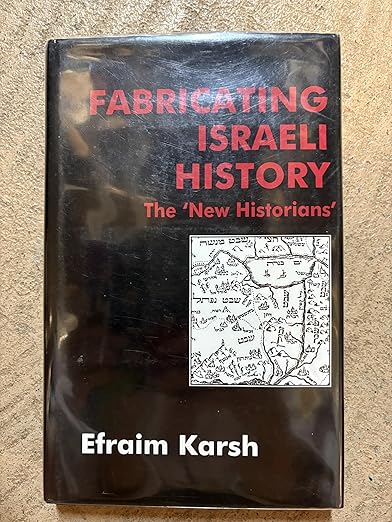
4+Fabricating Israeli History: The New Historians Hardcover – 1997
by Efraim Karsh (Author)
3.9 3.9 out of 5 stars (6)
Part of: Israeli History, Politics and Society (69 books)
===
Israeli historiography has long been subjected to a sustained assault by self-styled 'new historians', vying to expose what they claim to be the distorted 'Zionist narrative' of Israeli history and the Arab-Israeli conflict. They have cast Israel as the regional villain, bearing sole responsibility for the cycle of violence in the Middle East since 1948. For some of these writers Zionism is an archaic remnant of Western colonialism, eventually destined to wither away. For others it is an exploitative and aggressive movement which has brought about the Palestinian tragedy and has perpetuated the conflict with Israel's Arab neighbours.
Fabricating Israeli History takes issue with these 'revisionists'. Through careful examination of the documentation that they have used, as well as of sources that the author believes they have either ignored or failed to trace, this book propounds that the historical facts tell a completely different story from the one they propagate.
Efraim Karsh suggests that, for the most part, the 'new historiography' has involved foul play, arguing that it has violated every tenet of bona fide research, from reading into documents what is not there to making false descriptions of the contents of these documents. Numerous examples are studied in depth to illustrate the author's argument.
===
Contents
Maps
Introduction
1. New Bottles - Sour Wine
Old Merchandise Repackaged
Archaic Fetishism of Facts
2. 'Falsifying the Record': Benny Morris, David Ben-Gurion, and the 'Transfer' Idea
Rewriting Ben-Gurion
Fabricating Protocols
The Final Insult
3. The Collusion That Never Was Looking in the Wrong Direction
Miscomprehension of the Decision-Making Process
The Abdullah-Meir Meeting:
The Danin-Sasson Reports
The Overlooked Document: Meir's Verbal
Report
The Jewish Agency and the Partition it Never Approved
Transjordanian Annexation or an Independent Palestinian State?
Old Hat, 'Revisionisť Feathers
4. The Warning that Whitehall Never Gave
Getting the Picture Wrong
What Bevin Said and Did Not Say To Abul Huda
The Warning that Bevin Never Gave
5. Bevin and the Jews: Guardian Angel or Nemesis?
Britain's Quest for 'Smaller Israel'
Stunting the Population Growth of 'Smaller Israel'
Saving the Arabs from Themselves
Britain and the Arabs: Partners in Adversity
Britain and the Jews: 'It's Not Personal -It's Strictly Business'
Conclusions
Index
Content Overview
This book is a critique of a group of scholars known as the "New Historians," particularly focusing on their reinterpretation of the events surrounding the founding of Israel in 1948.
The chapters shown cover:
Chapter 1: New Bottles - Sour Wine:
Critiques how old materials were repackaged and challenged the "fetishism of facts" in new narratives.
Chapter 2: 'Falsifying the Record':
Benny Morris, David Ben-Gurion, and the 'Transfer' Idea: Specifically argues that historian Benny Morris misrepresented archival documents regarding David Ben-Gurion's views on the transfer of Arab populations.
Chapter 3: The Collusion That Never Was:
Examines the decision-making process of the Jewish Agency and refutes claims of collusion between Zionist leaders and King Abdullah of Transjordan.
4. The Warning that Whitehall Never Gave
Getting the Picture Wrong
What Bevin Said and Did Not Say To Abul Huda
The Warning that Bevin Never Gave
5. Bevin and the Jews: Guardian Angel or Nemesis?
Britain's Quest for 'Smaller Israel'
Stunting the Population Growth of 'Smaller Israel'
Saving the Arabs from Themselves
Britain and the Arabs: Partners in Adversity
Britain and the Jews: 'It's Not Personal -It's Strictly Business'
Conclusions
Index
===Customer reviews
3.9 out of 5 stars
Fabricating Israeli History: The New Historians
byEfraim Karsh
Christopher Wanko
5.0 out of 5 stars This is how history should be written.
Reviewed in the United States on 20 September 2004
Format: PaperbackVerified Purchase
Rely on primary sources.
Be intellectually honest.
Let evidence form the conclusions.
Any first-year history major should have that drilled into their heads. It's also a basic set of tenets for journalists, academics, and anyone else seeking truth among facts and fiction.
What I gain from Karsh's book is an objective perspective of the origin of the modern conflict in Israel. I am treated to primary sources, secondary accounts, and conclusions drawn directly from the evidence, and not wild imagination or heresay. The way it hangs together, and the way it is written, almost compels you to consider going through the bibliography to learn more. Presented in the context of an academic response to sloppy historiography, it is a scathing rebuttal that cannot be ignored.
Presented as an introduction to the conflict, it doesn't stand alone. More than basic familiarity with the facts of Israel's modern (re)birth as a nation is needed to understand a majority of the references. However, once a basic understanding is in place, this book should serve as the standard by which other accounts or works are judged.
Fred
Report
Jos� Tom�s W. Veiga
5.0 out of 5 stars Five Stars
Reviewed in the United Kingdom on 8 November 2018
Format: PaperbackVerified Purchase
EK debunks the lies and half trues of the so called "new historians". Very well argued. Convincing
Report
Kyle Stanton
1.0 out of 5 stars Intentionally disingenuous at best
Reviewed in the United States on 17 January 2015
Format: PaperbackVerified Purchase
Over the past year, I've become very interested in Israeli historiography. In perhaps a backwards way, I started by reading the works of New Historians and have more recently been reading more traditional historians (Shapira, Dinur, Teveth, and now Karsh). In the 25 some odd books I've read, I think Karsh's is the most pernicious and partisan. The aggressive language the author uses throughout the book is a huge turn off. This work is para-academic at best.
Karsh relies on the diary of Ben-Gurion, intentionally misleading the reader. Ben-Gurion was deeply concerned with his legacy and knew that his diary would form the basis of his biographies. So his diary is perhaps the most sterile and least trustworthy source to quote when discussing the idea of transfer in Zionist thought. The author also attempts to frame Israel as the liberating third world nationalist movement, while painting a picture of the British as anti-semitic overlords of the inept, irrationally hostile Arabs. The British must've gotten over their Israel hatred quickly because 8 years later, Israeli troops served as foot soldiers for the Brits and French during the Sinai campaign. For Karsh, a former researcher for the IDF, national foundational myths are perhaps a little too near and dear for him to let go of.
Karsh favors only sources from brief periods of time that support his arguments, ironically what he charges with the New Historians of. For instance, he fails to look at the longue duree of relations between the Yishuv and the Hashemites. Avi Shlaim has demonstrated that after a few decades of talks and negotiations, there was indeed an understanding between the two parties. Shlaim even removed the word "collusion" from his updated works, appropriately easing up on his earlier claims.
I'm sure that this review will be attacked by the Hasbara folks on Amazon, but this book was honestly hard for me to take seriously because of the tone employed by the author. If your mind is made up on the issue of Israel and Palestine, this book will not change your mind either way.
Report
Kenneth D. Willis
5.0 out of 5 stars Morris Gives A Lame Reply to Karsh
Reviewed in the United States on 20 January 2007
Format: PaperbackVerified Purchase
If the above excellent reviews leave you less than entirely convinced of the worthlessness of Morris' thesis [how could they?], the final cap may be the lame reply Morris gave in the Middle East Quarterly.
[...]
Morris says that Karsh's earlier [prior to the current book] work "is a mélange of distortions, half-truths, and plain lies...." Morris fails to give a single example to support his accusation, but simply says, "It does not deserve serious attention or reply."
If all Morris can muster in his defense is an ad hominem attack on Karsh, reasonable persons can safely conclude that Morris is engaging in psychological projection.
===
Profile Image for Emma.
Emma
30 reviews
Follow
April 4, 2010
looks in depth into several instances of the very creative rewriting of historical events around the formation of Israel by those who would prefer that it hadn't been.
most readable is a late chapter on the history of UK involvement. their historic ties and treaties with the governments of the Arab countries they helped create after WWI goes a long way to explaining the continued entrenched hostility towards Israel.
mid-east
2 likes
Like
Comment
Profile Image for Lucas.
Lucas
382 reviews
1 follower
Follow
January 31, 2016
Although this is by no means a complete introduction to historical research or the Israeli/Arab conflict, the author provides many useful lessons on both topics throughout the work. I find Karsh's accusations of dishonesty, lack of balance, and sheer laziness convincing in most regards. It is difficult to acknowledge error, but malfeasance can generally only be judged by others, since humans are terrible at admitting wrongdoing. I believe that many of the writers Karsh eviscerates in this volume have the intention to deceive their audience. This is an unfortunate and growing problem in academia. I worry that this will perpetuate conflict, instead of resolving it.
Like
Comment
Displaying 1 - 3 of 3 reviews
===
===
3 The Collusion that Never Was
The facts of history do not exist for any historian
till he creates them
CARL BECKER
One of the central myths propagated by the 'new historio-graphy' is that 'in 1947 an explicit agreement was reached between the Hashemites and nd the Zionists on the carving up of Palestine following the termination of the British mandate, and that this agreement laid the foundation for mutual restraint during 1948 and for continuing collaboration in the aftermath of war'. According to this myth, the alleged agree ment was reached in a secret meeting on 17 November 1947 between the Acting Head of the Jewish Agency's Political Department, Golda Meir, and King Abdullah of Transjordan, and was 'consciously and deliberately intended to frustrate the will of the international community, as expressed through the Uruted Nations General Assembly, in favour of creating an independent Arab States in part of Palestine', 'The common ground for the agreement was a mutual objection. to the creation of a Palestinian state', runs the myth. The Jewish Agency in particular abhorred such a possibility, asserting that the creation of a Palestinian state would perpetuate the ideological conflict in Palestine.
Most forcefully articulated by Avi Shlaim's Collusion Across Papp The Monthe
70 Fabricating laraeli History
the Jordan, this myth is predicated on the single episode approach, namely, the identification of an allegedly critical event which has supposedly affected the course of history in a profound way in this particular case the course of the Israeli-Palestinian conflict, if not of the Arab-Israeli conflict. While ostensibly dealing with the 30-year-long record of intermittent covert contacts between Transjordan's King Abdullah and the Zionist movement, Shlaim's book effec-tively focuses on the short period between the run-up to the 1947-49 War and its immediate aftermath. More specifically he traces the clinching of the alleged 'collusion' to the Meir-Abdullah conversation.
In an abridged paperback edition published two years later, Shlaim watered down the nature of the alleged Zionist-Hashemite understanding to 'a clear and explicit if not neces sarily binding agreement... on bypassing the Palestinians and peacefully dividing the territory of the British mandate between themselves. He also removed the pejorative 'collu-sion' from the book's title, though insisting that the alleged agreement 'did involve at least some of the elements asso-ciated with collusion'. In an article p article published in 1995, Shlaim watered down the nature of the alleged deal still further to an unwritten agreement', while praising it as 'a reasonable and realistic strategy for both sides. Yet he expressed regret for changing the title of the paperback edition. Collusion is as good a word as any to describe the traffic between the Hashemite king and the Zionist movement during the period 1921-51', he stated, "forgetting' that his thesis unequivocally traced the alleged collusion to the Abdullah-Meir meeting, and not to the intermittent Hashemite-Zionist contacts as a whole.
Needless to say, the notion of an agreement that is 'not necessarily binding constitutes a contradiction in terms
THE ABDULLAH-MEIK MEETING: THE DANIN-SASSON REPORTS
Having established these two methodological flaws in Shlaim's thesis, let the two Zionist accounts of the meeting used by Shlaim-the reports of Ezra Danin and Eliyahu Sasson-speak for themselves. First Danin's report, as narrated by Shlaim:
In the course of the ensuing conversation Abdullah invited his visitors to join him in thinking aloud: they had discussed partition in the past and he was inter-ested to know what their current thinking was 'Over the past thirty years you have grown and strengthened yourselves and your achievements are many' [he said]. 'It is impossible to ignore you, and it is a duty to compromise with you. Between the Anabs and you there is no quarrel. The quarrel is between the Arabs and the British who brought you here, and between you and the British who have not kept their promises to you. Now, I am convinced that the British are leaving, and we will be left face to face. Arry clash between us will be to our own disadvantage. In the past we talked about partition. I agree to partition that will not shame me before the Arab world when I come out to defend it. My wish is to take this opportunity to suggest to you the ider, for future thought, of an independent Hebrew Republic in part of Palestine within a Transiondan
Asked if he [Le., Abdullah) would be prepared to sign a written agreement in the event of a common denominator being identified in political, economic and defence matters he replied affirmatively and asked them [i.e., his Jewish interlocutors) to produce a draft. In bringing the meeting to an end he re iterated that concrete discussions could only take place after the UN had made its decision and that they must meet again as soon as the decision was known."
Sasson's report, as cited by Shlaim, reads as follows:
[Abdullah) will not allow his forces to collide with us nor co-operate with other forces against us. Belittled military power [of] Arab States. Believed would not dare break into Palestine. In case he will decide [to] Invade Palestine will concentrate [on] Arab areas with a view to prevent bloodshed, keep law and with a order, forestall Mufti. Prepared [to] co-operate with us [in] this matter... Believe position Mufti weakened. Not to be expected head of Arab provisional govern ment with support [of] Arab world. Abdullah ready [to] sign written agreement with us provided we agree [to] assist attach Arab part to Transjordan. Replied we prepared [to] give every assistance within. frame [of] UN Charter. Agreed meet after 25th of this month after UN decision.
Between them the two reports prove the following points
As stated by Abdullah at the outset, the conversation was
seen as a joint exercise in 'thinking aloud' about the general.
The Colhaxion that Never Was 71
which renders Shlaim's collusion thesis hollow. There cannot be half an agreement. Either there is one or there is none. The essence of an agreement, both at the personal and at the collective levels, is an understanding that binds all involved parties in one form or another and is considered by them as sach, even if the agreement has not yet received full legal formalization. Whether formal or informal, explicit or tacit, written or unwritten, an agreement is always binding in the minds of its makers; otherwise it would not have been reached in the first place.
But leaving aside this contradiction, a careful examination of the very two documents used by Shlaim to substantiate the daim of collusion'-reports by Ezra Darin and Eliyahu Sasson, two Zionist officials who attended the meeting will easily reveal that Meir's response to Abdullah's territorial ambitions was far less committal than Shlain lets us believe. Moreover Meir's own verbal al report on the conversation, which Shlaim. fails to bring in his book despite his keen awareness of its existence (he cites the part of this report which does not address the November 1947 meeting), proves beyond a shadow of doubt that Palestine was not divided on 17 November 1947
Last but not least, the Jewish Agency with which Abdullah allegedly struck the deal on the division of Palestine was totally unaware of the existence of any such deal for months after its alleged conclusion: it did not authorize Meir to divide Palestine' with the Hashemite King, and it did not approve any such action post factum. In fact, Meir's conversation with. Abdullah was never discussed by the Jewish Agency Executive, If Meir reached 'a clear and explicit if not necessarily binding agreement with King Abdullah on bypassing the Palestinians and peacefully dividing the territory of the British mandate between themselves which she did not-she also bypassed her own movement.
The Collution that Never Was 87
state that would include both buuks of the Jordan, with me at its head, and in which the economy, the army and the legislature will be joint.
Noticing the unease evoked by this suggestion, Abdullah stressed that the Hebrew Republic would not be dominated by Transjordan but would simply be part of the Transjordanian monarchy. He did not press for an answer but simply explained that in the event of such a republic being formed, his kingdom could be expanded to embrace Greater Syria and even Saudi Arabia.
Mrs. Meir drene attention to the fact that the Palestine question was under consideration at the UN and that her side was hoping for a resolution that would establish two states, one Jewish and one Aruh, and that they wished to speak to the king only about an agreement haseal on such a resolution. Abdullah said he understood and that it would be desirable to meet again immediately after the UN pronounced its decision in order to discuss how they might co-operate in the light of that decision. At this point Abdullah asked how the Jews would regard an attempt by him to capture the Arsb part of Palestine? Mrs. Meir replied that they would view such an attempt in a favourable light, especially if he did not interfere with the establishment of their state and avoided a clash betrosen his forces and theirs and, secondly, if he could declare that his sole purpose usas to maintain law and order until the UN could establish a government in that area. Now it was the king's turn to he startled and he answered sharply: But I want this area for myself, in order to annex it to my kingdom and do not want to create a new Arab Stufe which would upset my plans and enable the Arabs to ride on me. I want to ride, not to be ridden! He also brushed aside a suggestion that he might secure his objectior by means of a referendum in which his influence would be decisive
88 Fabricating Israeli History
The Collusion that Never Was 89
principles of a possible Hashemite-Jewish understanding, not as one designed to reach a concrete agreement. Hence his avoiding of pressing for an answer to his preferred option; hence his concluding remarks that no concrete issues could be discussed until after the UN General Assembly had made its decision.
In Abdullah's thinking, partition 'that will not shame me before the Arab world' meant 'an independent Hebrew Republic in part of Palestine within a Transjordan State that would include both banks of the Jordan with me at its head. This was the basis of his acquiescence in the partition plan of the Peel Commission in 1937 and the thrust of his message to his Zionist interlocutors, both before and in the wake of the Second World War. And this was no idle talk: Abdullah truly believed that an autonomous Jewish province would greatly benefit his kingdom, mainly through the influx of Jewish funds and technological know-how. As his Prime Minister, Samir al-Rifai, told Brigadier I.N. Clayton of the British Middle East Office (BMEO) in Cairo on 11 December 1947: 'the enlarged Transjordan State with the support of Jewish economy would become the most influential State in the Arab Middle East
It was only upon realizing that this solution was totally unacceptable to the Jews that Abdullah opted for the lesser choice of incorporating the Arab areas of Mandatory Palestine into his kingdom. But even then he did not view the borders set by the United Nations as final and never tired of trying to convince the Jews either to give him some of the territory awarded to them by the UN or even to forego the idea of an independent State, the last such attempt being made in his second meeting with Golda Meir on 11 May 1948, three days before the establishment
Clayton Foreign, 17 Пеской 1947, ийм РО МЕТ
90 Fabricnting Israeli History
of the State of Israel and its subsequent invasion by the Arab States.
Contrary to Shlaim's claim, Abdullah was not prepared to "commit himself in writing' to the division of Mandatory Palestine between himself and the Jews. As shown by Shlaim's own text above, Abdullah was not asked by his Jewish interlocutors to sign an agreement on the division of Palestine but rather an agreement in either of the political, economic or defence spheres in the event of a common denominator being identified in any of these matters. It would have been sheer madness, if not political suicide for Abdullah to have committed himself in writing to the division of Mandatory Palestine between himself and the Jews.
Most importantly, in no way, shape or form did Golda Meir give Abdullah a 'green light to annex the Arab part of Mandatory Palestine to his kingdom. Quite the reverse in fact. While quiescent in his possible capture but by no means annexation! of this area, 'especially if he did not interfere with the establishment of their state and avoided a clash between his forces and theirs, she made it crystal clear that a) she wished to speak only about an agreement based on the imminent UN Partition Resolution; b) the sole purpose of Transjordan's intervention in Palestine 'was to maintain law and order until the UN could establish a government in that area', namely, a short-lived law enforcement operation aimed at facilitating the establishment of a legitimate Palestinian government. There is little doubt that the Zionist movement preferred to see Abdullah at the head of this government rather than the extremist Palestinian leader, Hajj Amin al-Husseini, or the Mufti as he was com monly known; hence Meir's suggestion for a referendum
The Collusion that Never Was 91
that would establish Abdullah's supremacy in the Arab parts of Mandatory Palestine, both in the eyes of its Palesti nian population and the world at large, and would legi timize his claim to rule this area. But the distance from this
position to approval of Abdullah's annexation of this territory to his kingdom is very great indeed. In other words it was the Jewish representative at the meeting who defended Palestinian political rights, by insisting on the ephemerality of the Transjordanian seizure of the Arab parts of Mandatory Palestine as a means to faci litate the establishment of a legitimate government there; and it was the Arab leader who insisted on annexing the area to his kingdom rather than 'create a new Arab State which would upset my plans and enable the Arabs to ride on me
Hence Shlaim's conclusion that in November 1947 the Jewish Agency succeeded in reaching a clear and explicit if not necessarily binding agreement with King Abdullah on bypassing the Palestinians and peacefully dividing the territory of the British mandate between themselves is both wrong and misleading:
First, as shown by Shlaim's own account, it was Abdullah and not Meir who sought to bypass the Palestinians and seize their territory. The Jews, after all, were about to be granted their part of Mandatory Palestine by the United Nations within less than two weeks and had no need to receive this territory from a party who did not possess it in the first place. All they wanted was to avert an unnecessary war with this kry neighbour and to coexist peacefully with whoever ruled that part of Mandatory Palestine
===
92 Fabricating lenaeli History
Second, as noted above, Meir never gave her consent to the annexation of the Arab part to Transjordan but insisted on a solution concomitant with the UN Partition Resolution. In Danin's words: 'We explained that our matter was being discussed at the UN, that we hoped that it would be decided there to establish two states, one Jewish and one Arab, and that we wished to speak now about an agreement with him [ie, Abdullah! based on these resolutions. In Sasson's words: 'Replied we prepared [to] give every assistance within [the] frame [of the] UN Charter
Third, the Jewish Agency could succeed in reaching an agreement with Abdullah on the division of Palestine for the simple reason that it did not officially seek such an agreement and did n did not approve it. As noted earlier, Meir's meeting with Abdullah was never discussed by the JAE, and therefore she was not authorized to strike a concrete deal with Abdullah. She was not the Chairperson of the JAE but merely acting head of the Political Department, standing in for Moshe Sharett who was conducting the diplomatic struggle for partition at the UN's temporary headquarters in Lake Success." In this capacity she could do little more than try to convince Abdullah not to violently oppose the impending UN Partition Resolution and to acquaint him to the gist of Zionist thinking which is precisely what she did.
Finally, both Danin's and Sasson's reports state unequi vocally that no concrete decisions were reached during the meeting. In the words of Danin: 'At the end he [Abdullah reiterated that concrete matters could only be discussed
The Collusion that Never Was 93
after the UN had passed its resolution, and said that we must meet again immediately afterwards"
THE OVERLOOKED DOCUMENT MEIR'S VERBAL REPORT
But how did Meir herself interpret her understanding with Abdullah? She presented no official report on her conver sation to the JAE at the time of the event, which indicates that she deemed that it contained no concrete agreement that needed to be discussed and approved by this highest decision-making institution of the Zionist movement. It was only six months later, on 12 May 1948, in a verbal report to the Provi sional State Council on her second meeting with Abdullah. (held on the previous day) in which she she failed! failed to convince him not to join the imminent Arab attack on the Jewish State, that Meir gave her own account of the November 1947 meeting:
I do not know whether all present here are aware that several months ago, about ten days before the UN Resolution, a meeting with King Abdullah took place with the participation on our part of Sasson, Danin, and myself. The meeting was in Transjordan, though on Jewish territory, that is he came from Amman to see us. The meeting was conducted on the basis that there was an arrangement and an under standing as to what both of us wanted and that our interests did not collide.
For our part we told him then that we could not promise to help his incursion into the country [Le., Mandatory Palestine), since we would be obliged to
94 Fabricating laraeli History
observe the UN Resolution which, as we already reckoned at the time, would provide for the estab lishment of two states in Palestine. We could not therefore so we said give active support to the violation of this resolution. If he was prepared and willing to confront the world and us with a fait accompli-the tradition of friendship between us would continue and we would certainly find a common language settling those matters that were of interest to both parties.
He then promised us that his friendship towards us still existed and that there could be no confrontation. between us. He spoke on his friends and on the other [Arab] states and especially on the Mufti; he dis-missed the strength of the other neighbouring states and agreed with us that if we were attacked by Arabs it went without saying that we had to respond.
The meeting was conducted very amicably and with-out any arguments. During the conversation he said, as if by passing, two things that raised some suspicion, apprehension. But the meeting ended on the understanding that we would meet again after the UN Resolution. The two things that raised suspicion were:
a) He wanted to know what we thought about the possible inclusion of the Jewish State (the Jewish Republic' as he called it) within the Trans-jordanian Kingdom,
b) He hoped to have a partition that would not disgrace him [in front of the Arabe).
These two things raised, as already noted, our appre
The Collusion that Never Wan 95
hension, and we thought that in due course we
would discuss the matter
As is clearly evident from Meir's account, Mandatory Palestine aus not divided in November 1947. There was mutual recognition of the lack of enthusiasm on either side for military confrontation and of the existence of a certain convergence of interests. But no definitive agreement on the future of P'alestine was reached. To the contrary, as Meir saw it. Abdullah was made to understand that the decision on whether to confront the world with a fait accompli by annexing the Arab parts of Palestine to his kingdom was exclusively his, and that he could expect no Jewish support for such a move. This gist is also borne out by Sasson's and Danin's reports: 'Replied we prepared [to] give every assistance within [the] frame [of the UN Charter'; Mrs. Meir replied that they would view such an attempt in a favourable light... if he could declare that his sole purpose was to maintain law and order until the
UN could establish a government in that area.
Shlaim narrates the part of Meir's report relating to her second meeting with Abdullah, yet, significantly enough, he fails to mention its most critical point for his case, namely Meir's account of her November 1947 conversation in general, and her refusal to help a solution that was non-concomitant with the UN Resolution in particular. Is it because this would have pulled the rug from under his absurd claim that the Zionist movement was seeking to subvert the very UN Resolution which it was so assiduously trying to bring about? Shlaim's abstention from using Meir's report and his exclu sive reliance on Danin's and Sasson's accounts, though not without overlooking their most critical points, is all the mone incomprehensible in this particular case since it was Meir after all who allegedly gave Abdullah the green light to annex the
Golda 'sport at the Proof 123bay 1948
96 Fabricating Israeli History
Arab parts of Mandatory Palestine to his kingdom. Even if Shlaim deems Meir's account of her November 1947 meeting to be unreliable, his minimum obligation still is to introduce it to his readers and to explain his reasons for discounting it. But then there is no particular reason to suspect that Meir's account, given to the Yishuv's'government' in camera, is less reliable than that of her advisers. Indeed, not only does Shlaim not question the authenticity of Meir's report but he also lauds it as 'nowhere as unsympathetic and unflattering about Abdullah's behaviour as the account she later wrote in her memoirs. If Meir's account of her May 1948 meeting was so fair-minded, then surely the part relating to the November 1947 conversation is no less reliable. Danin who attended the meeting certainly believed so. Yet Shlaim preferred not to bring it in his book.
OLD HAT, REVISIONIST FEATHERS
Not surprisingly, Shlaim's distortion of Meir's reply to Abdullah has been unanimously endorsed by his fellow 'new historians'. Benny Morris, without doing any original research on the subject, warmly endorsed the thesis that the Yishuv and the Hashemites 'had conspired from 1946 to early 1948 to nip the impending UN partition resolution in the bud","
Bid., 18 December 1948, p. 885 (emphasis addesk). Ibid., 4 January 1949, p. 927.
Morra, 1948 and After, p. 10.
104 Fabricating Israeli History
totally "forgetting that until February 1947 Britain was the Mandatory Power for Palestine; that until UNSCOP's majority recommendation on partition was published on 31 August 1947, a solution in this vein was by no means a foregone conclusion; that until the General Assembly passed the Partition Reso-lution on 29 November 1947, there was no absolute certainty that UNSCOP's recommendation would be adopted by the United Nations; and that, above all, this Partition Resolution was what the Zionist movement had been consistently
fighting for
For his part, llan Pappe goes further than Shlaim in mis-representing the record. While Shlaim at least brings Danin's and Sasson's reports more or less in their entirety (though keeping away Meir's own report), Pappé makes no mention of the most significant part in Meir's reply, namely her objec tion to any agreement non-concomitant with the UN Partition Resolution, and her insistence on the ephemerality of Trans-jordan's occupation of the Arab parts in Palestine until the establishment of a legal government there. As Pappé put it:
In November 1947, King Abdullah met the head of the Political Department of the Jewish Agency, Golda Meyerson (Meir), and offered the Jews an independent Jewish republic as part of a Hashemite monarchy covering Transjordan and ex-mandatory Palestine. When this was rejected, he asked for the lewish Agency's consent to his annexing the territories allotted to the Arabs in the UN partition plan. The Jewish Agency representative gave her consent in return for the king's promise not to attack the future Jewish State."
For that purpose in November 1947 a meeting took place between Golda Meyerson (Meir), the acting
The Collusion that Nmer Was 105
head of the Political Department of the Jewish Agency, and King Abdullah. At this meeting Abdullah pre-sented a new vision of Palestine in which a Jewish republic would be integrated into a newly-formed Hashemite kingdom consisting of Transjordan and Palestine [as shown earlier, this was not a new vision' but rather Abdullah's long-standing solution to the Palestine problem-E.KJ. When, not sur prisingly, this was rejected out of hand by the other side, Abdullah asked for Jewish consent to the annexation to Transjordan of the UN-defined Arab States. To this the Jewish Agency representative did give her assent, in return for the king's promise not to attack the Jewish State in the event of a war breaking out."
That the 'new historians' have distorted Meir's reply to Abdullah is scarcely surprising; the interesting point is that 'old historians have preceded them in doing so. For example, while citing Meir's insistence on the ephemerality of the Transjordanian seizure of the Arab parts of Palestine, Aharon Klieman has been captive of the same misconception as Shlaim and Pappe. Thus, he wrote in his study of Hashemite-Zionist relations published two years before Shlaim's book, 'an authorized representative of the [Jewish] Agency and on Ben-Gurion's behalf gave a clear and rather explicit agreement to the Hashemite leader's occupation of the "Arab part of Western Palestine according to the partition principle, on condition that he would not obstruct the establishment of the Jewish State"
According to Morris, 'Shlaim's description of the Yishuv-Hashemite relations down to 1951, including the premise of tacit Israeli-Jordanian agreement during 1948' has been by
==
104 Fabricating Israeli History
totally 'forgetting' that until February 1947 Britain was the Mandatory Power for Palestine, that until UNSCOP's majority recommendation on partition was published on 31 August 1947, a solution in this vein was by no means a foregone conchesion, that until the General Assembly passed the Partition Reso lution on 29 November 1947, there was no absolute certainty that UNSCOP's recommendation would be adopted by the United Nations; and that, above all, this Partition Resolution was what the Zionist movement had been consistently fighting for
For his part, llan Pappé goes further than Shlaim in mis representing the record. While Shlaim at least brings Danin's and Sasson's reports more or less in their entirety (though keeping away Meir's own report), Pappé makes no mention of the most significant part in Meir's reply, namely her objec tion to any agreement non-concomitant with the UN Partition Resolution, and her insistence on the ephemerality of Trans-jordan's occupation of the Arab parts in Palestine until the establistunent of a legal government there. As Pappé put it:
In November 1947, King Abdullah met the head of the Political Department of the Jewish Agency, Golda Meyerson (Meir), and offered the Jews an independent Jewish republic as part of a Hashemite monarchy covering Transjordan and ex-mandatory Palestine. When this was rejected, he asked for the Jewish Agency's consent to his annexing the territories allotted to the Arabs in the UN partition plan. The Jewish Agency representative gave her consent in return for the king's promise not to attack the future Jewish State.
For that purpose in November 1947 a meeting took place between Golda Meyerson (Meir), the acting
The Collusion that Never Was 105
head of the Political Department of the Jewish Agency, and King Abdullah. At this meeting Abdullah pre-sented a new vision of Palestine in which a Jewish republic would be integrated into a newly-formed Hashemite kingdom consisting of Transjordan and Palestine [as shown earlier, this was not 'a new vision' but rather Abdullah's long-standing solution to the Palestine problem E.KJ. When, not sur prisingly, this was rejected out of hand by the other side, Abdullah asked for Jewish consent to the annexation to Transjordan of the UN-defined Arab States. To this the Jewish Agency representative did give her assent, in return for the king's promise not to attack the Jewish State in the event of a war breaking out."
That the 'new historiana' have distorted Meir's reply to Abdullah is scarcely surprising; the interesting point is that 'old historians' have preceded them in doing so. For example, while citing Meir's insistence on the ephemerality of the Transjordanian seizure of the Arab parts of Palestine, Aharon Klieman has been captive of the same misconception as Shlaim and Pappé. Thus, he wrote in his study of Hashemite-Zionist relations published two years before Shlaim's book, 'an authorized representative of the [Jewish) Agency and on Ben-Gurion's behalf gave a clear and rather explicit agreement to the Hashemite leader's occupation of the "Arab part of Western Palestine according to the partition principle, on condition that he would not obstruct the establishment of the
Jewish State According to Morris, "Shlaim's description of the Yishuv-Hashemite relations down to 1951, including the premise of tacit Israeli-Jordanian agreement during 1948' has been by
- Cond: Men
105 Fabricating Israeli History
and large accepted by 'the Israeli historiographic commu-nity. The truth of the matter, as shown by Klieman's above citation, is that it is Shlaim who has been following in the foot-steps of 'the laraeli historiographic community' rather than the other way round"
Interestingly enough, Klieman, the quintessential Zionist historian, even goes further than Shlaim in censuring the Hashemite-Jewish "connection'. While Shlaim views this connection as a 'reasonable and realistic strategy for both sides Klieman deems it politically imprudent but avoids the pious high moral ground taken by Shlaim. This provides further proof, if such were at all needed, that the difference between 'old' and 'new' historians has nothing to do with access to new facts, and not necessarily even with their interpretation: for in this case both 'old' and 'new' historians have (mis)interpreted a specific historical episode in precisely the same way.
True, there have been a handful of historians who have highlighted the restrictive nature of Meir's response to Abdullah. But even they fail to recognize that a) decisions of such magnitude cannot be made in the course of a single con versation; b) that Meir was not authorized to make a decision of this kind; c) that no agreement that bound the Zionist movement could conceivably be reached without the authori zation of the JAE-which was never given; d) that the Jewish Agency showed no awareness of the existence of any such agreement and that Zionist distrust of Abdullah remained unabated for a long time after the Meir-Abdullah meeting, and that e) the Jewish Agency remained undecided between the two options-an independent Palestinian State or Trans jordan's annexation of Western Palestine-wellafter the Meir-
For others who have edad the new stand in the af
Hashenze-Zionist relations see Chapter 14. 2123-2 (London Cargo Pand, The Strugg 14
The Collsusion that Never Was 107
Abdullah meeting, with its most influential leaders. David Ben-Gurion and Moshe Sharett, disposed to the former option Not least, even these more careful historians have overlooked Meir's own account of the meeting, focusing instead on Danir's report.
This in turn brings us back to the conclusion that on this particular historical episode both 'old' and 'new' Israeli historians have unquestioningly been recycling an old and familiar myth, whose broad contours were delineated already 30 years ago, while ignoring the only first-hand account of the person involved. Shlaim is not even 'new' in being wrong


No comments:
Post a Comment